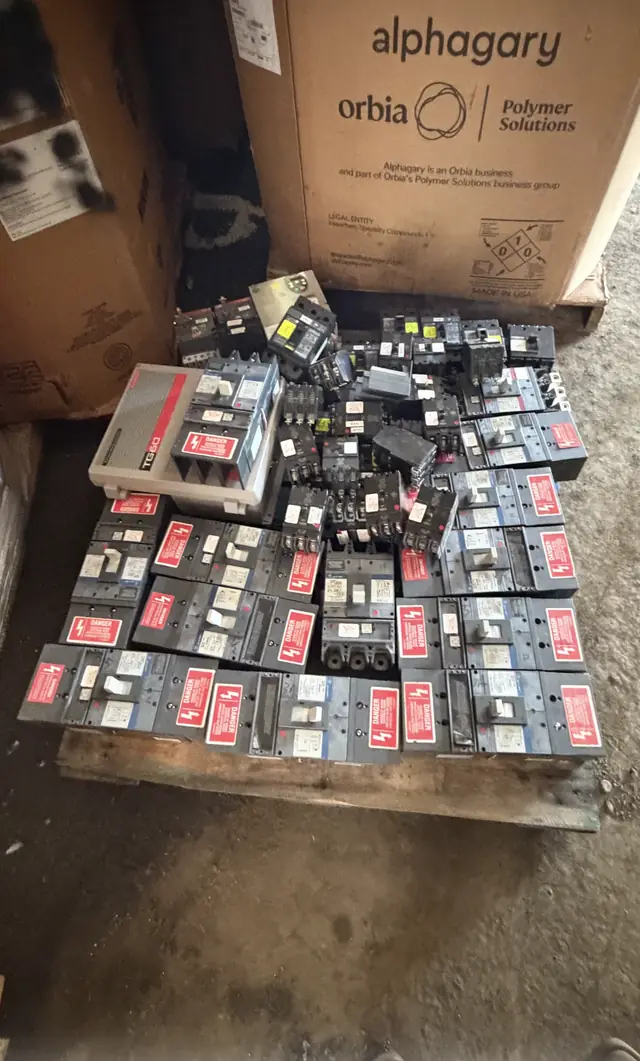
Do not perform energized testing unless you are a qualified electrical professional and permitted by the authority having jurisdiction. If you find burn marks, exposed conductors, structural cracks or loose primary contacts, stop work and consult a qualified professional before proceeding.
What we review and how to submit for consideration
We review qualifying breaker trucks, drawout cradles, cradle-mounted accessories, adapter plates and common switchgear parts for conditional purchase. Submissions that include original photo sets, readable nameplate images, and exact catalog or data-sheet references receive faster, more accurate evaluation. Providing clear identification and honest condition descriptions speeds evaluation and commercial consideration.
Submission is not a guarantee of purchase. Acceptance depends on current demand, completeness as proven by your evidence, and review by our team. Include the full photo and documentation package described below so reviewers can compare the parts to catalog evidence and make an informed conditional decision.
- Typical items we review: breaker drawout trucks, fixed or drawout cradles, roller assemblies, contact carriers, auxiliary modules, adapter kits and mounting hardware.
- Provide original (not stock) photos of the actual items you intend to sell.
- Include exact catalog pages, part number references, or manufacturer data sheets when available.
How to identify a truck, cradle or part: exact fields to capture
Collect and report every readable identification field from the item. Key identification fields are model or catalog number, part number, serial number, nameplate text, electrical ratings (ampere and voltage frame ratings), pole or pole-equivalent count, and any stamped or engraved date codes. If the truck or cradle has a separate assembly number or subcomponent markings (rollers, contact carrier, cam assembly), capture those too.
Measure and note physical dimensions and mounting details when nameplate information is missing or partial: overall length, width, depth, mounting bolt pattern and roller spacing. Exact dimensions plus catalog evidence allow reviewers to determine whether a truck and cradle represent a complete, compatible assembly or a parts candidate.
- Model/catalog number and manufacturer-marked nameplate text (photograph the nameplate close-up).
- Serial number and date codes (photograph sequentially numbered items).
- Frame/ampere rating and voltage class as shown on nameplate or catalog.
- Physical dimensions, mounting bolt pattern and roller spacing if nameplate is missing.
Describe condition clearly using honest, specific language
Use unambiguous condition terms and give specifics. Common, useful descriptors are: new-surplus, new-in-box (NIB), used-serviceable, cosmetically worn, corroded, electrically untested, mechanically incomplete, damaged, or salvaged for parts. Where an item is missing obvious subcomponents (rollers, secondary connectors, interlocks, grounding straps), list what is missing and show those areas in photos.
Avoid vague phrases like "works" without backup: if electrical testing or operational checks have been performed, describe exactly what tests were done and attach test records or videos. If no testing was performed, state that the unit is untested and that the submission is documentation-only for evaluation as a parts or rebuild candidate.
- Label items by condition category and give precise notes (for example: "used-serviceable, contact faces reconditioned; missing rear ground strap").
- If an item has burn, arc damage, or bent rails, note those explicitly and photograph them.
- Attach any functional test records or bench reports, and state whether those tests followed manufacturer procedures (do not create or imply approvals).
Original photo sets and catalog evidence we need
Provide a consistent photo set for each truck, cradle or accessory. Useful photos include full-front and full-rear views, a close-up of the nameplate and serial number, close-ups of contact faces and roller assemblies, images of interlock mechanisms, mounting points, and any damaged or modified areas. For small accessories, show scale (a ruler or tape) and bagged parts with labeled tags.
Supply exact catalog pages or data sheets that match the photographed item. We rely on side-by-side comparison of your images and the catalog evidence to verify assembly completeness and identify optional parts. When catalog evidence is unavailable, provide a copy of a related manual, an exploded parts diagram, or a factory drawing if you have it.
- Required photo set (recommended minimum): overall front, overall back, nameplate close-up, contact face close-up, roller/interlock close-up, any damage close-up, and accessory/parts shots.
- Include PDF scans or photos of the exact catalog/data-sheet pages that list the part number and show included components.
- If you claim a truck/cradle is complete per catalog, show photos that demonstrate every catalog-listed subcomponent.
Organize lots and small parts to speed evaluation and logistics
Group like items and label lots clearly. Lot by catalog number or physically compatible family rather than by vague descriptions. For mixed lots, include an inventory sheet that lists each truck or cradle with its identification fields and condition note. Bag and label small hardware—pins, rollers, interlocks, mounting bolts—and photograph the bagged contents with a corresponding lot sheet.
Provide packaging and shipping dimensions and gross weight estimates for large trucks and cradles. This helps the logistics review determine transport feasibility. Note any items that require special handling due to size, weight, or hazardous residue; however, do not attempt energized testing or removal if unsafe—stop and consult a qualified electrical professional.
- Label each lot with a unique lot number and include a one-line inventory for quick reference.
- Bag and tag all small parts and fasteners; show a photo of each bag with its corresponding lot sheet.
- Provide palletized photos and a weight/dimensions estimate for large lots.
Who may be interested and what increases market value
Breaker trucks and drawout cradles may be of interest to industrial users, rebuilders, OEMs and spare-parts specialists depending on model, condition and documented completeness. Value is typically higher when an assembly is complete, includes original nameplate-identifying evidence, and matches a commonly used frame or series. Rare configurations or uncommon frame sizes can be desirable for specialized buyers, while common frames in serviceable condition often appeal to high‑volume parts markets.
Demand and acceptance are conditional. Even items that look physically similar may not match buyers’ requirements without catalog confirmation of ratings and interlocks. We evaluate commercial fit by comparing your evidence to buyer demand and our own inventory needs; acceptance decisions are made after review and are not guaranteed by submission.
- Higher interest if the truck/cradle is complete and has readable nameplate data.
- Adapters and mounting kits that allow cross-platform use can increase appeal when documented in catalog evidence.
- Uncommon or obsolete frames may attract rebuilders and specialist buyers but require clearer documentation to establish fit.
Next steps, our completeness policy, and safety reminders
To submit, assemble a single package per lot containing: the photo set described above, a typed inventory sheet with identification fields and condition notes, scanned catalog or data-sheet references, and shipping size/weight estimates. Our review considers technical fit, commercial terms, and handling feasibility. Our completeness policy means we compare your evidence against catalog lists and photos to determine whether an item will be treated as complete, partial, or parts-only.
Safety limits and legal notes: do not perform energized testing or electrical work unless you are a qualified professional and the authority having jurisdiction allows it. If you discover signs of arcing, severe corrosion, structural damage, or other safety hazards while preparing parts, stop and consult a qualified electrical professional. A web submission is an offer for review only and does not constitute an inspection, purchase order, transport authorization or safety clearance.
- Submission checklist: identification fields, full photo set, catalog/data-sheet copies, lot inventory sheet, weight/dimensions.
- Review considerations: technical fit, commercial terms, and handling feasibility — decisions are conditional and documentation-driven.
- Our completeness policy: we determine completeness by matching your photos to catalog-listed components; documented missing parts will be priced or categorized accordingly.