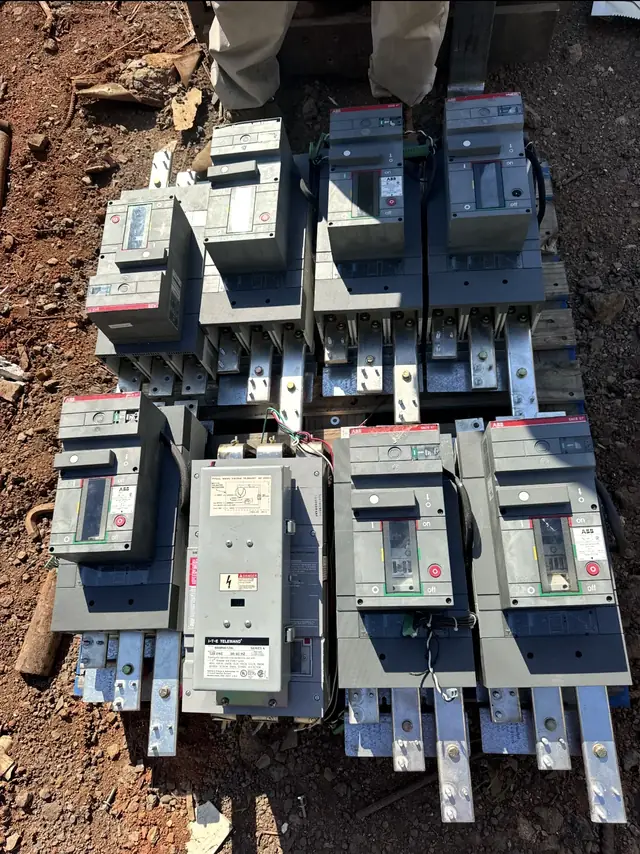
How to describe electrical switchgear
Read the maker label before grouping similar equipment. Names may include switchgear, metal-enclosed switchgear, low-voltage switchgear, medium-voltage switchgear, drawout gear, breaker lineup, power distribution gear, and switchgear section. They do not establish model, condition, or installation suitability. Send complete markings and a clear photo when unsure.
Information that helps us understand the equipment
Start with what is printed on the equipment. Do not guess a model, rating, compatibility, or condition. A complete identification set usually includes:
- manufacturer, lineup, and section nameplates
- voltage class and continuous bus rating
- short-circuit or interrupting ratings shown on labels
- breaker, cradle, relay, metering, and control identifiers
- section count, dimensions, and approximate weights
- one-line or bill-of-material records when available
- installed status and site access
Describe the lot as it actually exists
Switchgear searches often combine an assembly name with a breaker family. A useful submission separates the lineup, each section, every drawout breaker or cradle, and the controls or relays included with the project.
A clear submission helps prevent a mistaken preliminary review and saves time for both sides. Useful lot-level information includes:
- complete-lineup and loose-component counts
- missing, modified, damaged, or exposed sections
- removal and storage history
- loading, dock, forklift, crane, and rigging facts
- safe overall, nameplate, breaker, cradle, relay, and condition photos
New surplus, used, untested, incomplete, and damaged are different
Use plain, supportable condition language. Original packaging can be documented, but packaging alone does not prove an unused, authentic, complete, or operational item. Used equipment should include truthful removal and storage details. If a unit is missing hardware, modified, corroded, fire-exposed, water-exposed, fault-exposed, or otherwise questionable, say so before any shipping discussion.
Condition influences eligibility, handling, and value, but no universal price table can account for exact model demand, quantity, completeness, provenance, current stock, freight economics, and inspection results.
What a website review cannot determine
Installed, energized, arc-damaged, water-exposed, contaminated, or unknown-voltage equipment needs qualified site review before any commercial discussion.
A submission is not an offer, acceptance, authentication result, safety assessment, code determination, shipping authorization, or instruction to remove installed equipment. Any next step must be confirmed in writing.
Why exact switchgear lineup or section data prevents the wrong review
A model-family name can include multiple generations, frame sizes, ratings, mounting styles, control options, and accessories. When a seller writes only “electrical switchgear,” the reviewer cannot safely assume that visually similar units are interchangeable. Copy each label line as printed, preserve spaces and suffixes, and connect each photograph to one inventory row. If a suffix is obscured, record that uncertainty rather than substituting a nearby unit’s identifier.
For mixed lots, photograph the full group first, then create smaller model groups. Keep packaging, loose hardware, trip units, rating plugs, cradles, covers, manuals, and test documents with the matching line item. This method reduces duplicate questions and prevents a photograph of one complete unit from being mistaken for proof that every unit is complete.
What can make one lot easier to evaluate than another
A consistent lot of clearly identified electrical switchgear can be easier to review than a larger pile with mixed labels and unknown condition. Quantity, model consistency, completeness, packaging, service history, storage, current demand, documentation, location, and the work required to receive and reconcile the equipment all affect the decision. None of those factors guarantees value, but each can remove uncertainty.
Sellers should disclose deadlines and the reason the equipment is available, such as contractor overstock, a canceled project, distributor excess, facility spares, an upgrade, liquidation, or planned decommissioning. That context helps establish timing and ownership without turning an unsupported story into a condition claim.
A clean submission creates a clean written transaction record
If the switchgear lineup or section fits the current buying scope, the next communication should identify the reviewed item group and any additional information required. Written terms—not a generic web page—must address the approved quantity, price, included parts, packing, freight or pickup, receiving, inspection, discrepancies, and payment.
Keep a copy of the submitted inventory and pre-shipment photographs. Do not substitute items, add unapproved material, hide defects, or combine different conditions under one line after review. If the lot changes, update the reviewer before anything moves.
Document internal assemblies, relays, and trip components
Beyond external nameplates, many purchase reviews depend on a clear inventory of internal assemblies and protective elements. For drawout breakers and cradle systems, list the trip unit model, trip unit firmware or firmware-stickered revision if present, rating plugs or electronic setting modules, and any auxiliary switches or shunt-trip devices observed. For medium- and low-voltage sections, include relay model numbers (front-panel and chassis labels), CT and PT types and ratios as stamped, metering module identifiers, and any visible calibration or test tags. Photographs of removed covers showing relay sockets, printed circuit module labels, and breaker serial plates accelerate verification without requiring energized inspection.
When controls, control wiring harnesses, or proprietary interface modules are part of a lot, describe how those items are packaged and tagged and whether harnesses remain attached to a specific section. Note the presence or absence of manuals, configuration cards, or saved settings media—these items do not prove operability but can materially affect how a reviewer assesses the practical completeness of a lot. Keep these component-level records as discrete line items in your submission so that a single missing trip plug or relay does not obscure the status of other, clearly complete units.
- list trip unit types, rating plugs, and serials
- record relay model, chassis labeling, and test tags
- document CT/PT ratios and metering module identifiers
Photo sequencing and mapping for complex lineups
A predictable photo sequence reduces back-and-forth and speeds a reviewer’s understanding of what is actually present. Start with a wide shot of the full lineup or crated shipment to show relative arrangement, then provide medium framing of each section or chassis. For drawout breakers, include staged photos that show the cradle position (inserted, partially withdrawn, withdrawn) with an identifying tag visible in the same frame. Close-ups should capture nameplates, rating stamps, serial numbers, and any service or lab tags; use a small printed label or temporary numbered tag in-frame to connect every close-up to a specific inventory row.
Avoid single-angle, ambiguous photos that force guesswork. If units are stacked, include a side view to show stacking condition and a label view for the top and bottom unit. When a lineup includes loose small parts—rating plugs, shims, nuts and bolts, connector blocks—photograph those parts grouped with a tag that references the main line item. These mapping practices do not replace hands-on inspection, but they materially reduce uncertainty during an initial website review and help identify items that may qualify for further consideration.
- wide lineup, medium section, then close-up sequence
- use temporary number tags to link photos to inventory rows
- photograph small loose parts grouped with matching tags
Tagging, separating, and preserving mixed-condition lots
Mixed-condition lots require clear physical separation and documentation to avoid conflating complete, serviceable units with damaged or incomplete ones. Physically tag each item with a durable, readable identifier that corresponds to the submitted inventory spreadsheet and the photographs. When practical, segregate suspect or cosmetically damaged sections into a distinctly marked area and indicate whether protective covers, exposed bus ends, or missing hardware exist. This practice makes it easier to describe which specific pieces a reviewer is being asked to consider and which pieces are being disclosed as damaged, modified, or incomplete.
If preservations steps—such as applying rust inhibitor to bus stabs, placing desiccant packs in cabinets, or loosely bagging small terminal blocks—have been performed, document those actions and include before-and-after photos. Those steps can clarify handling and storage history but do not constitute a safety assessment or operational guarantee. Clear tag-to-photo linkage and a concise lot map are often the difference between a review that proceeds to written terms and one that stalls for clarification; keep those records readily accessible so any qualifying items may be evaluated without added delay.
- tag each item with a durable ID that matches the submission
- segregate and photograph damaged or incomplete pieces separately
- document non-invasive preservation steps with photos