Equipment we review
- Square D and Schneider Electric
- Eaton, Cutler-Hammer, Westinghouse, and Bryant
- Siemens, I-T-E, and Murray
- GE, ABB, SACE, and selected documented legacy brands
This index, a manufacturer lineage reference, and a reviewed-brand list help speed identification. Inclusion is informational only—submit qualifying equipment for purchase review.
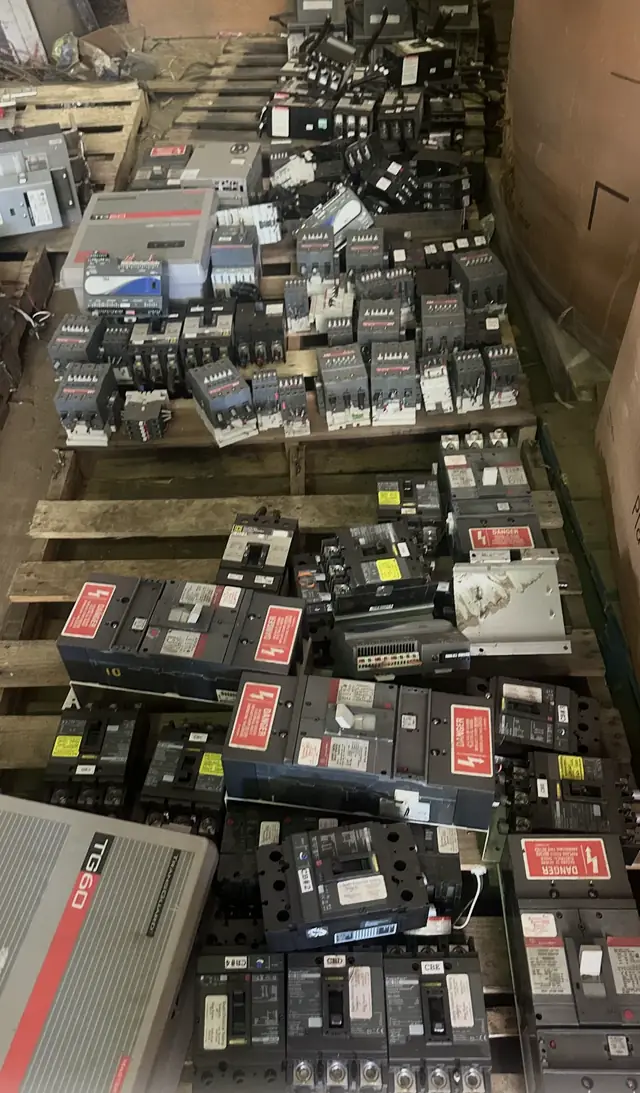
We review qualifying breakers from major current and legacy manufacturers when the original labels and complete catalog information remain readable. Brand names help route a submission, but the specific family, model, ratings, quantity, and condition determine the review.
One manufacturer name can cover many unrelated generations and breaker platforms.
Readable factory labels support identity; removed, altered, or conflicting labels require caution.
Legacy names may have later owners, but a brand relationship does not establish compatibility or affiliation.
Model consistency, quantity, condition, completeness, and current demand matter more than logo recognition alone.
We review the current and legacy brands listed here, including Square D, Eaton, Siemens, GE, and ABB families. Every decision still depends on the exact item.
No. Send the complete family, catalog number, ratings, quantity, condition, and label photos.
No affiliation is implied. Manufacturer names are used only to identify seller-owned equipment submitted for review.
Safety first: if equipment shows burning, melted components, exposed live parts, or structural damage, stop and consult an appropriately qualified electrical professional. Follow manufacturer instructions and local authorities. A website submission is not a safety inspection, approval for installation, or a purchase order.
We review qualifying circuit breakers and electrical distribution equipment for potential purchase. This page is a practical index for sellers who want to prepare items by brand and series before submitting them for purchase review. Using brand and series correctly speeds identification, but any brand listing here is informational and not a guarantee of purchase.
The index links brand names to the specific identification fields and photos that are most useful to evaluate items. We also reference a manufacturer lineage overview and a reviewed-brand list to help recognize successor companies, legacy product lines, and seller-marked equipment. Brand inclusion is not an affiliation or endorsement and does not establish compatibility or certification for installation.
To evaluate a circuit breaker, we need precise identification fields from the breaker nameplate or shipping labels. The most useful fields are manufacturer name as printed on the unit, type or series designation, catalog or model number, frame size, trip rating (amps), poles, interrupting rating (kAIC or kA), and any accessory part numbers (e.g., shunt trip, undervoltage release). Date codes, lot codes, and serial numbers are also helpful when present.
If a breaker is part of a transfer switch, motor control center, or packaged panel, describe how it is mounted and whether it is removable without altering buswork. If nameplate data is missing or unreadable, show surrounding moldings or adapter plates—these can contain casting marks or OEM labels that help trace lineage. Accurate identification reduces delays and helps us route equipment to the correct buyer pool for review.
Use clear, standardized condition language when describing breakers. Common condition terms we recognize include New Surplus, New in Box, Open Box (unused), Good Working Condition, Rebuilt/Refurbished (describe scope of work and documentation), Needs Repair, and For Parts/Salvage. Avoid vague terms like “works sometimes” without specifics—if a breaker trips during a test, describe the test and results rather than a general pass/fail.
When submitting rebuilt or repaired units, describe who performed the work and what was replaced or tested. Do not present electrical testing as a substitute for a safety inspection. We may request additional documentation, and clear condition descriptions help group equipment for inspection and potential resale or recycling pathways.
Photographs help move from inquiry to evaluation. Include a clear photo of the breaker nameplate and full-unit photos from at least three angles (front, side, and back). Close-ups of accessories, trip units, handle mechanisms, terminals, lugs, and any damage are useful. If breakers are boxed or still on pallets, include a photo of the packing label and a pallet overview with a scale object (one-foot ruler or common object) for size reference.
Organize similar items into lots by brand, series, and condition. Mixed lots are acceptable but label them precisely (for example, “10 × Eaton CL-2 250A new surplus” vs “5 × mixed 250–400A breakers, various brands, as-for-parts”). Accurate lot organization reduces inspection time and prevents avoidable rework.
We reference a manufacturer lineage overview and a reviewed-brand list to clarify corporate relationships, successor manufacturers, and discontinued brands. The lineage reference helps identify which modern or successor brand an older nameplate belongs to; the reviewed-brand list summarizes which brands and series we commonly consider for review and any notes about obsolescence or documentation.
These tools are working references and may be updated as ownership and product lines change. They exist to improve identification and reduce mislabeling. Inclusion in a reference list can help when a nameplate shows an OEM that has been acquired or rebranded, but inclusion is not a purchase commitment and does not confirm compatibility for field use.
Commercial buyers look for consistent lots, widely available accessories, and units with clear nameplates. Larger quantities of the same model and condition generally move faster through review. Value signals include new-in-box status, original packaging, high interrupting ratings, and manufacturers and series that remain in demand for industrial service or retrofit projects.
Common disqualifiers that slow or prevent purchase consideration include missing or illegible nameplates, evidence of significant heat damage or melting, missing essential accessories that are not widely available, and units permanently bonded into a custom assembly without removable mounting. Even when items appear commercially attractive, each submission remains subject to inspection and review for safety and commercial viability.
When you are ready, submit photos, identification fields, and lot counts through the submission form linked on our site. A submission begins a purchase review but is not an appraisal, offer, acceptance, or shipping authorization. After initial review we may request additional photos, documentation, or an inspection. Response times vary with volume and the complexity of the lot.
Stop and consult a qualified electrical professional if you see burned insulation, melted plastic, suspicious odors, or exposed live conductors while preparing items. Follow the current manufacturer instructions and the authority having jurisdiction for safe handling and transport. We do not provide installation, removal, energized testing, or engineering advice; all technical work should be performed by appropriately qualified personnel.
Choose the page that best matches the manufacturer, breaker family, equipment type, or question on the label.
Prepare nameplate photos, exact model and accessory details, and a clear lot count, then use our submission form to start a purchase review. Remember: submission starts a review only and is not an offer or shipping authorization.