Equipment we review
- QO and QOB branch breakers
- Homeline breakers and documented lots
- PowerPacT and MasterPact families
- I-Line and legacy Square D molded-case frames
We review qualifying Square D and Schneider Electric breakers — current review scope includes QO, Homeline, PowerPact, and MasterPact. Submit identifiable, honestly described units with clear photos and any recall documentation for conditional purchase review.
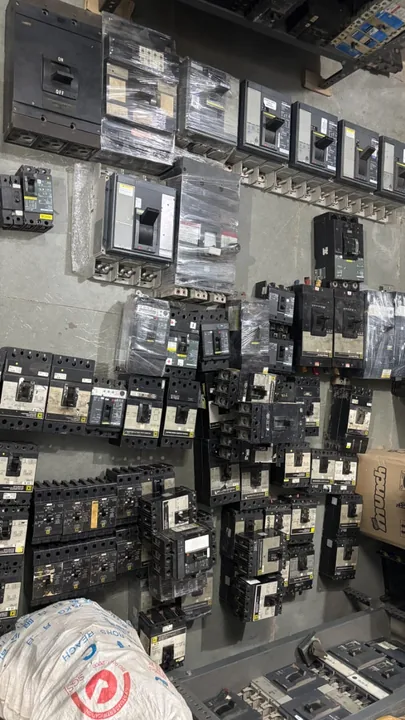
We review qualifying seller-owned Square D and Schneider Electric breakers, including documented QO, QOB, Homeline, PowerPacT, MasterPact, I-Line, and legacy molded-case families. The original label and exact series or catalog number—not the logo alone—control identification.
QO, Homeline, PowerPacT, MasterPact, and I-Line are different product groups with different evidence needs.
Suffixes, revisions, trip details, mounting, and ratings help separate similar-looking units.
Matching model groups and accurate counts are more useful than mixed logo-only pallets.
Packaging, trip units, cradles, accessories, damage, and records affect the review.
Circuit Breaker Buyer reviews qualifying Square D and Schneider Electric breakers nationwide. Send the complete model information, quantity, condition, and photos.
Qualifying lots may be reviewed. Keep the families separate and provide complete catalog numbers, counts, packaging, and condition.
No. Seller identification and purchase review do not determine listing, compatibility, authorization, or safe installation.
If you find signs of heat, arcing, or structural failure, stop handling and have the units evaluated by a qualified electrical professional. Follow current manufacturer instructions and local authority guidance.
We review qualifying Square D and Schneider Electric products for possible purchase. The current initial review scope includes QO, Homeline, PowerPact, and MasterPact series; submissions outside those families may be considered case-by-case. Submitting items begins the review process and does not mean an offer, acceptance, or that every item will be purchased.
Start by preparing clear identification and condition details for each item. Include catalog or catalog-style numbers, frame and trip information, pole count, and amperage. Provide photos and any service history or paperwork you have. The more precise and honest the information, the easier it is to evaluate whether the units qualify for conditional purchase review.
Record the visible identification fields from each breaker. Key fields include the catalog or model number stamped on the face or side, amperage rating, number of poles, frame size or series marking, trip type (thermal-magnetic, electronic trip, ground-fault/arc-fault indicators), and any date or lot codes. If a breaker has a manufacturer label or serial number, capture that as well.
If a breaker is labeled with both Square D and Schneider Electric marks, include all markings in your submission. Manufacturer names are used for identification only; a visible logo or label does not confirm suitability or compatibility for a particular installation. Precise identification reduces back-and-forth during review and can help speed a conditional decision.
Good photos answer identification questions immediately. Provide a clear, in-focus image of the breaker face showing the catalog/model number and amperage, a side image showing stickers or labels, a close-up of date/serial codes, and an overall view of the unit in relation to another object for scale. For multi-unit lots, include a photo of the entire lot and separate images of representative units.
Also attach any manuals, wiring diagrams, purchase invoices, maintenance records, or original packaging you have. If you are aware of any recall notices or service bulletins that apply to the units, include exact recall links and the affected serial or lot ranges. Supplying this material up front reduces time spent requesting basic documents during review.
Use straightforward condition categories when describing breakers. Typical descriptors that help reviewers include new-in-box (NIB), new-surplus (unused but not in original packaging), used/serviceable (showing wear but not damaged), open-trip or visibly mechanically compromised, damaged (cracked housings, missing parts), and parts-only. Avoid ambiguous phrases; be specific about observed issues such as corrosion, bent terminals, damaged mounting feet or stabs, or missing trip handles.
If you have tested units, state what tests were performed, by whom, and whether testing was destructive or non-destructive. Do not claim that testing or power cycling guarantees safety or code compliance; do not include energized testing instructions. Where units were removed from service, include the reason for removal if known (e.g., replaced for upgrade, end-of-life, failure), while acknowledging that submission is not a warranty of performance.
If you are selling multiple units, group similar breakers into lots by model, frame, and condition. Clearly label each lot with a lot number and a count, and provide a summary list of included catalog numbers and serial ranges. Consistent lotting supports faster evaluation and reduces the need for serial-by-serial inspection unless specific units are under recall review.
For logistics, show how units are packaged and secured. Provide photos of how breakers are palletized, boxed, or racked, and note any preservation measures such as desiccant packs, anti-corrosion wraps, or custom crating. For lots that must be inspected in person, be prepared to allow visual inspection while maintaining safe separation from energized equipment and using appropriately qualified supervision.
If your breakers are subject to a manufacturer or regulatory recall, include exact recall links, affected serial ranges, and any remedy documentation you possess. Do not guess at recall applicability — provide the references you have or indicate that you do not know. Supplying accurate recall information up front is important for compliance and efficient review.
Include any available purchase invoices, original manufacturer certifications, maintenance logs, or factory repair receipts. If breakers were modified or retrofitted, disclose the nature of modifications and include photos of the altered areas and any modification paperwork. Remember that submission is a review request; documentation helps establish provenance but does not itself create a purchase agreement.
After submission we evaluate identification, condition, documentation, and any recall information to determine if an item qualifies for purchase review. We may request additional photos, serial verification, or an in-person inspection for larger lots. A review response may include requests for more information, a conditional purchase interest, or a declination; it is not an immediate purchase order or payment commitment.
If we express conditional interest, we will specify which items and what further steps are necessary to progress (additional documentation, inspection, or logistics coordination). Sellers should keep items intact and stored as represented until terms are finalized. Do not consider a submission or preliminary correspondence as final acceptance, and do not ship items unless you receive explicit shipping instructions and authorization.
This page provides seller guidance for identification, documentation, and safety reminders. It outlines the information that helps evaluate items for conditional purchase review and explains how to submit materials that allow efficient verification.
Safety is paramount. If breakers show signs of heat damage, melting, severe corrosion, arcing, or contain hazardous materials, stop handling and consult an appropriately qualified electrical professional and the authority having jurisdiction. Do not attempt live testing or installation based on identification here; this page is not a substitute for manufacturer instructions, field testing by qualified persons, or a safety inspection.
Choose the page that best matches the manufacturer, breaker family, equipment type, or question on the label.
Prepare identification details, clear photos, and any recall links or paperwork, then start your submission for review. Remember: submissions are reviewed for qualification and do not guarantee a purchase.