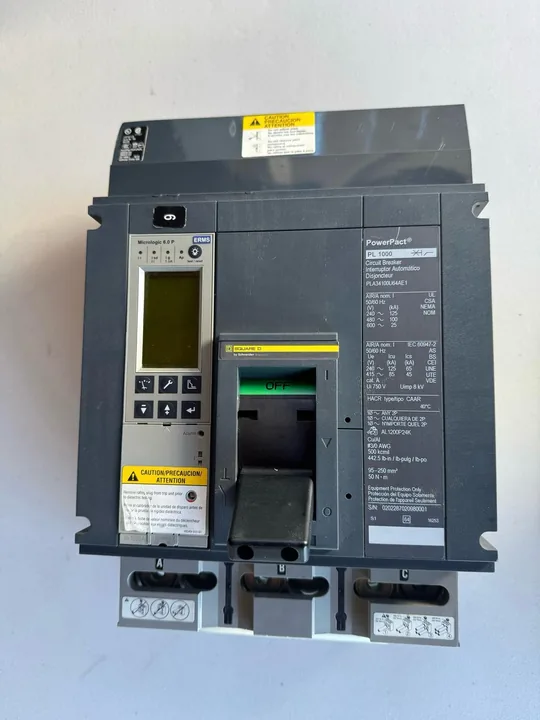
If you see burn marks, cracked housings, exposed conductors, or other evidence of damage, stop and consult manufacturer instructions and a qualified electrical professional before further handling. A submission here is not a safety inspection or approval for reuse.
How we review PowerPacT equipment
We review qualifying Square D PowerPacT circuit breakers and related assemblies for potential purchase. Submissions that include clear label fields, accurate condition descriptions, and consistent lot organization are easier to assess. A website submission is a request for review only and is not an appraisal, offer, acceptance, safety inspection, compatibility determination, purchase order, shipment authorization, or commitment of any kind.
Evaluation focuses on commercial fit: frame type, trip unit model, interrupting rating, quantity, and condition. Provide the complete set of requested photos and identification fields listed on this page so we can make an initial determination. We may request additional information after an initial review if clarification is needed.
- We review both individual breakers and larger commercial lots.
- Submit each lot as a single entry with matching identification when possible.
- Submissions without clear label photos or quantity documentation slow the review.
PowerPacT frames we commonly evaluate (B, H, J, Q, L, M, P, R)
PowerPacT breakers were manufactured in multiple frame families. In surplus and used inventories the B, H, J, Q, L, M, P, and R frames are the frame-letter groupings most often encountered. Each frame letter generally reflects a physical frame size and mounting style. When identifying a frame, note the letter usually molded into the case or printed on the main label.
Provide at least one clear photo that shows the frame letter and the primary catalog marking for each breaker. Do not assume similar-looking frames are identical—list mismatches separately. We review qualifying examples from the frames above; listing them here is illustrative and not a guarantee of purchase.
- B frame — smaller cases often used in branch and distribution positions.
- H and J frames — mid-size frames used in varied commercial applications.
- L and M frames — larger, higher-capacity molded-case assemblies.
- P, Q, and R frames — heavy-duty frames often found on feeders or mains.
Exact label fields to capture (label-field checklist)
Accurate identification is essential. Photograph the breaker label(s) so the following fields are legible: catalog number, frame letter (if present), ampere rating, number of poles, trip unit type (thermal-magnetic or electronic), trip unit model/part number, voltage rating, interrupting rating, date code or serial, accessory codes, and agency markings. Include any handwritten or stamped codes near the manufacturer label if present.
Use the concise checklist below to guide photos or transcription. If a field is missing or illegible, note that in your submission rather than guessing.
- Catalog number / model marking — primary identifier.
- Frame letter or molded-case ID — B, H, J, Q, L, M, P, R, etc.
- Ampere rating and poles (example: 3P or 2P).
- Trip unit type and model — electronic or thermal-magnetic.
- Voltage rating and interrupting rating marking.
- Date code or serial number.
- Accessory and modification codes (shunt trip, UVR, handles) if visible.
Condition descriptions and photo checklist
Use straightforward condition terms: new surplus (new-in-box), like-new, good working condition, tested functional, refurbished, cosmetic damage, mechanical faults, or unknown/as-is. If breakers were removed from service, note any visible signs of overheating, arc damage, corrosion, missing parts, or altered components. Clear, accurate descriptions reduce follow-up questions and support a faster review.
Photographs are the best way to convey condition. For each unique part or representative sample in a lot, provide high-resolution photos that show the primary label, the entire front face, the handle and trip mechanism, terminal connections, any accessory hardware, and close-ups of damage or marks. For large quantities, include a representative sample plus a wide shot of the full lot with a visible quantity label.
- Primary label (legible) — straight-on, glare-free.
- Handle and operating mechanism — show position and wear.
- Terminals — show contact areas and any corrosion.
- Close-ups of burn marks, cracks, or broken lugs.
- Wide shot of the lot with quantity tag or inventory sheet.
Organizing lots for commercial submissions
Group identical items together to accelerate review. Create lots by catalog number, frame, trip unit, and condition. Mixed lots are acceptable if the different part numbers and quantities are clearly listed in the same submission. For each lot, include a simple inventory sheet with part number, frame letter, amp rating, poles, trip type, quantity, and a reference to the associated photos.
Label each pallet, crate, or box with a lot number that matches your submission. Keep associated accessories and mounting hardware grouped with the breaker lot. If items are spread across locations, indicate where each lot is staged for potential inspection. Clear labeling reduces errors and supports efficient evaluation.
- Lot sheet: part number, frame, amp rating, poles, trip type, quantity.
- Pallet/box labels that reference the lot sheet and submission ID.
- Photograph the lot label next to a representative breaker.
What affects value and commercial fit
Several objective factors influence interest: frame type and size, interrupting rating, trip unit model, ampere rating, accessory configuration, date code and apparent age, and total quantity available. Market demand for certain trip units or frame/amp combinations can change, so clear labeling and organized lots generally help buyers evaluate more quickly.
Condition and documentation matter as well. Unused surplus with original packaging, complete labels, and matching date codes is usually simpler to assess than mixed-condition lots. If a lot includes modified units or missing components, disclose that upfront—unreported changes can materially affect evaluation.
- Higher interest drivers: rarer trip units, higher interrupting ratings, intact factory accessories.
- Quantity and uniformity typically support better commercial outcomes.
- Complete documentation (pack lists, label summaries) supports efficient evaluation.
Safety limits and legal/testing boundaries
This page does not provide electrical, installation, or energized-testing instructions. Consult manufacturer documentation, the authority having jurisdiction, and appropriately qualified electrical professionals if you encounter evidence of overheating, arc damage, exposed conductors, or other hazards. Do not perform live testing or field repairs unless you are qualified and authorized.
A submission to this site is not a safety inspection or a determination of fitness for reinstallation. If items become candidates for purchase under a separate agreement, additional documentation or testing requirements may apply at a later stage.
- Warning signs to document: heavy soot or arcing marks, cracked housings, missing trip components, burned terminals, exposed conductors.
- Avoid categorical claims like “tested and safe” unless backed by formal reports from qualified personnel.
- Submissions do not bypass local regulations or required approvals.
How to submit PowerPacT breakers for review
To begin, gather label-field photos, representative condition images, and a lot inventory sheet listing catalog numbers, frame letters, amp ratings, poles, trip type, and quantities. Upload those materials through the submission form referenced on the Sell Square D page. Submitting materials initiates a review; it is not an offer or authorization to ship.
After the initial review, there may be requests for additional photos, identification details, or documentation. If there is continued interest, follow-up communications may address inspection steps and any required records.
- Prepare: clear label photos, lot inventory, representative condition images.
- Submit: use the Sell Square D form to start the review process.
- Expect: possible follow-up for clarification—submission is for review only.