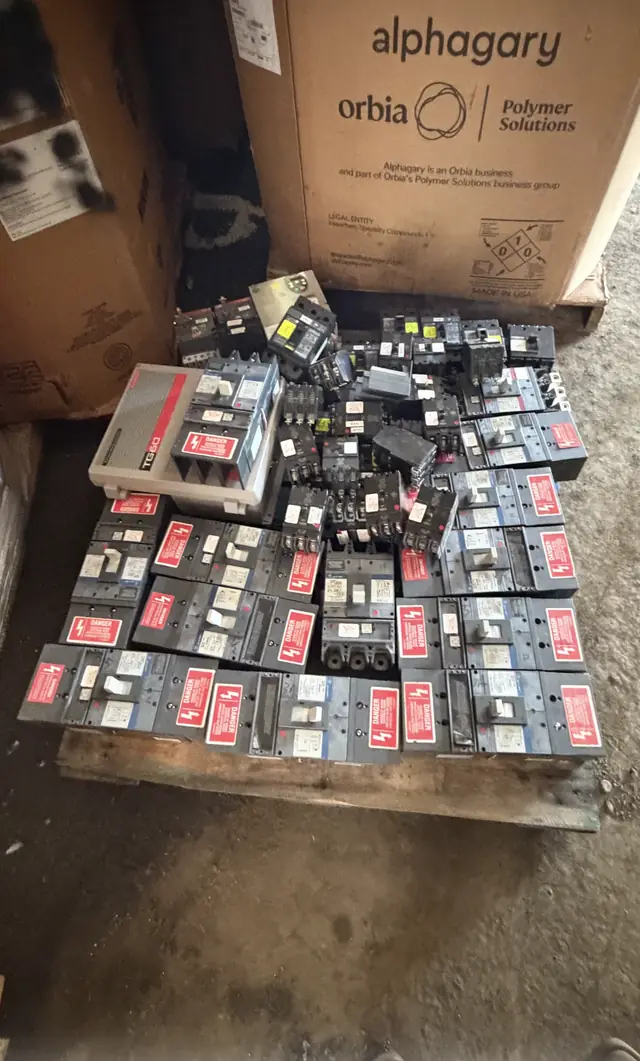
If you see signs of overheating, melting, burning, loose terminals, or missing safety covers, stop and document the condition. Follow the original manufacturer’s instructions and use appropriately qualified electrical professionals and the authority having jurisdiction for removal, testing, or disposal. This website submission is not a safety inspection or purchase commitment.
What we buy and how we review submissions
We review qualifying Square D Homeline (HOM) breakers for purchase. Submitting your HOM breakers starts a review: identification, condition, quantity, and commercial suitability are considered. Not every submission will result in a purchase; each lot is evaluated case by case against current demand and safety limits.
When you submit, include clear identification photos and accurate condition notes to support an initial determination. A careful submission speeds review and reduces follow-up. Remember: a website submission is not an appraisal, offer, acceptance, safety inspection, compatibility determination, purchase order, pickup commitment, or shipping authorization.
- We accept submissions for review — not all items will be purchased
- Provide original HOM labels and catalog numbers where present
- Note quantity, storage history, and any repairs or modifications
Exact identification: what to read on a Homeline breaker
Exact identification is the most important factor in a productive review. Look for the HOM family marking on the breaker label or molded housing; original HOM labels or clear catalog numbers are the primary evidence used. On Homeline breakers you will commonly find a catalog number, ampere rating, pole count, trip type, and manufacturing date or lot codes. Record each field exactly as stamped or printed.
Family distinctions matter because Homeline is a distinct product family. When submitting, state clearly whether the unit is labeled HOM and include the full catalog marking. Do not assume similarity to other Square D families — rely on the original marking and label details to determine whether the item belongs to the Homeline family for commercial evaluation.
- Record the full catalog/catalogue number exactly as marked
- Note amp rating, pole count, and trip type printed on the label
- Include any date, batch, or manufacturer code visible on the label
Condition language we need and honest descriptions
Use precise, honest condition descriptions. Common useful categories are new surplus (unused, still in manufacturer packaging), unused open-box (never installed but removed from packaging), and used serviceable (installed previously and visually intact). If a breaker shows any damage or evidence of malfunction — burned contacts, melted housing, broken handles, missing parts, or altered labels — disclose that explicitly.
If you are unsure whether a device is serviceable, describe what you see rather than making safety or performance claims. For example, list visible wear, handle play, corrosion, or evidence of overheating. Those observations become part of the review; physical inspection and testing by appropriately qualified personnel are separate steps and may be requested before any offer.
- New surplus: factory packaging, no installation marks (if present, show packaging)
- Used serviceable: list visible wear, installation marks, or replaced parts
- Damaged/rejected: disclose melted insulators, broken handles, or exposed conductive parts
Photos that make a submission fast to evaluate
Good photos are the single best thing you can provide. Prioritize a clear, well-lit shot of the front label showing the HOM marking and catalog number. Add a close-up of the entire breaker housing that shows the handle and any visible markings, a photo of the side or back label if present, and images of lot or packaging labels when multiple units are grouped.
If breakers were removed from panels and you can show the bus or mounting stabs without disturbing live systems, include a non-energized photo of the connection area; otherwise, do not take energized photos. Include a scale or ruler in at least one image for size reference when appropriate, and take representative photos of any damage or wear you listed in your description.
- Front label close-up with HOM marking and catalog number
- Full-face shot showing handle and overall condition
- Side/back label, date codes, and lot or box labels
- Representative damage photos and a ruler or object for scale
Group and label lots the way buyers prefer
Organize breakers by identical catalog number, ampere rating, pole count, and condition. Commercial interest often depends on how many identical items are offered together. Separate unused surplus from used serviceable units and mark boxes or pallets with a clear lot label listing the catalog number, quantity, and condition. This avoids time-consuming sorting and supports efficient evaluation.
Smaller quantities may be combined if every unit is the same catalog and condition; mixed lots should be clearly documented with counts for each SKU and condition tier. If you have serial-numbered production runs or date-code clusters, include that information to support traceability and market interest.
- Group identical catalog numbers and conditions together
- Label each box or pallet with catalog, quantity, and condition
- Provide a simple lot summary sheet with the submission
What affects commercial interest and acceptance
Commercial interest depends on quantity, condition, and current market demand. Large, consistent lots of unused or lightly used HOM breakers typically receive quicker review than small, mixed-condition collections. Age and visible storage condition also influence whether a breaker is commercially viable for resale or repurpose.
Traceability and labeling matter: lots with original HOM labels, intact catalog numbers, and minimal field modifications are easier to position in the secondary market. Qualifying equipment may be submitted for purchase review; submitting does not guarantee purchase and each lot is considered individually.
- Quantity and uniform condition increase commercial viability
- Original HOM labels and untouched housings simplify review
- Mixed or heavily modified items require more documentation
Safety limits, legal scope, and what we will not accept
Safety is the priority. Do not ship equipment suspected of internal damage, evidence of thermal failure, or units taken from energized systems without proper de-energization and documentation. If items show signs of fire damage, exposed conductive parts, or tampering with internal trip mechanisms, disclose that and expect such units to be excluded from purchase review.
Follow manufacturer removal and handling guidance and use appropriately qualified electrical professionals for any deinstallation or testing. If you see warning signs such as melted insulation or smoky odor, stop and document the condition. A photo submission is not an inspection; a site or bench inspection by qualified personnel may be requested before any final determination.
- Stop and document visible burning, melting, or charring
- Do not submit or ship energized equipment
- Use qualified personnel for removal; do not attempt risky field tests yourself