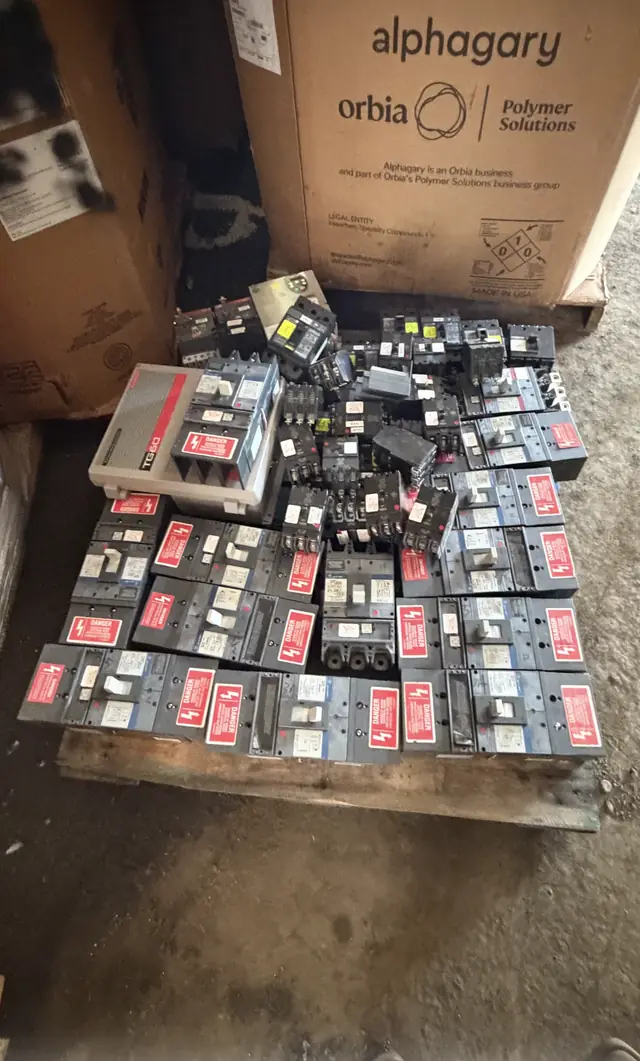
How to describe electrical switchboards
Read the maker label before grouping similar equipment. Names may include switchboard, distribution switchboard, service switchboard, switchboard section, main section, distribution section, metering section, and breaker section. They do not establish model, condition, or installation suitability. Send complete markings and a clear photo when unsure.
Information that helps us understand the equipment
Start with what is printed on the equipment. Do not guess a model, rating, compatibility, or condition. A complete identification set usually includes:
- manufacturer and assembly nameplate
- section catalog and serial identifiers
- system voltage, phase, frequency, and bus rating
- main and feeder devices
- section dimensions and approximate weight
- included meters, controls, breakers, and hardware
- lineup arrangement and one-line documentation when available
Describe the lot as it actually exists
Switchboard opportunities are evaluated as projects. The value of one section can depend on the completeness of the lineup, the breaker population, bus configuration, documentation, condition, location, and realistic freight or removal plan.
A clear submission helps prevent a mistaken preliminary review and saves time for both sides. Useful lot-level information includes:
- number of sections
- installed or safely removed status
- access, dock, liftgate, forklift, and rigging constraints
- condition and storage environment
- front, rear, nameplate, device, and lineup photographs captured safely
New surplus, used, untested, incomplete, and damaged are different
Use plain, supportable condition language. Original packaging can be documented, but packaging alone does not prove an unused, authentic, complete, or operational item. Used equipment should include truthful removal and storage details. If a unit is missing hardware, modified, corroded, fire-exposed, water-exposed, fault-exposed, or otherwise questionable, say so before any shipping discussion.
Condition influences eligibility, handling, and value, but no universal price table can account for exact model demand, quantity, completeness, provenance, current stock, freight economics, and inspection results.
What a website review cannot determine
No page can promise pickup, rigging, removal, testing, reuse, or acceptance. Those decisions require project-specific review and written terms.
A submission is not an offer, acceptance, authentication result, safety assessment, code determination, shipping authorization, or instruction to remove installed equipment. Any next step must be confirmed in writing.
Why exact switchboard data prevents the wrong review
A model-family name can include multiple generations, frame sizes, ratings, mounting styles, control options, and accessories. When a seller writes only “electrical switchboards,” the reviewer cannot safely assume that visually similar units are interchangeable. Copy each label line as printed, preserve spaces and suffixes, and connect each photograph to one inventory row. If a suffix is obscured, record that uncertainty rather than substituting a nearby unit’s identifier.
For mixed lots, photograph the full group first, then create smaller model groups. Keep packaging, loose hardware, trip units, rating plugs, cradles, covers, manuals, and test documents with the matching line item. This method reduces duplicate questions and prevents a photograph of one complete unit from being mistaken for proof that every unit is complete.
What can make one lot easier to evaluate than another
A consistent lot of clearly identified electrical switchboards can be easier to review than a larger pile with mixed labels and unknown condition. Quantity, model consistency, completeness, packaging, service history, storage, current demand, documentation, location, and the work required to receive and reconcile the equipment all affect the decision. None of those factors guarantees value, but each can remove uncertainty.
Sellers should disclose deadlines and the reason the equipment is available, such as contractor overstock, a canceled project, distributor excess, facility spares, an upgrade, liquidation, or planned decommissioning. That context helps establish timing and ownership without turning an unsupported story into a condition claim.
A clean submission creates a clean written transaction record
If the switchboard fits the current buying scope, the next communication should identify the reviewed item group and any additional information required. Written terms—not a generic web page—must address the approved quantity, price, included parts, packing, freight or pickup, receiving, inspection, discrepancies, and payment.
Keep a copy of the submitted inventory and pre-shipment photographs. Do not substitute items, add unapproved material, hide defects, or combine different conditions under one line after review. If the lot changes, update the reviewer before anything moves.
Inventory tagging and photographic linking best practices
Assign a seller-controlled inventory identifier to every discrete item and assembly before any photographs are taken. A simple alphanumeric tag applied to each section, loose door, breaker crate, and grouped spare lets reviewers match images to the submitted spreadsheet without relying on memory or ambiguous visual cues. In mixed lots, include the nameplate serial and any assembly suffix on the same inventory row, and place the physical tag adjacent to that nameplate for a clear, single-frame reference. If multiple breakers share a chassis or a sub-panel, tag each device and keep loose devices in labeled, sealed bags that reference the matching inventory line.
When preparing the photographic package, make one set of images that shows the item with its tag in a wide view, then capture a closeup of the nameplate, the lineup or breaker population, and any modification or damage areas. Add a ruler or known-size object in at least one image per item so proportions are evident. If you use sequential numbering or QR stickers, mention that system in the submitted spreadsheet and link each photo filename to its inventory ID to prevent mismatches during remote review.
- Tag each section and any loose parts with a unique inventory code
- One wide shot + nameplate closeup + damage/modification closeups
- Reference each photo filename to the inventory row
Staging, protection, and freight-readiness considerations
Evaluate the physical handling needs while the switchboard remains in place so reviewers know what a potential removal or freight operation might encounter. Record clearances (doorways, corridors, and gate widths), floor loading notes (single-point or distributed load surfaces), and the existence of fixed obstacles such as suspended ceilings or immovable ducts. Photograph lifting points, external frames, and any bolted-in-place supports without attempting removal or energized work. Use non-invasive methods to show how the assembly sits in the space and whether it is installed on a curb, pad, or raised floor system.
Protect equipment from transit damage and environmental exposure before any movement. Secure loose panels, cover exposed buswork, and consolidate small items in labeled crates or boxes; do not imply that covers or fasteners indicate the unit is complete or safe for use. If the lot will be held for a period, describe on-site storage conditions such as temperature control, humidity exposure, and whether items are indoors or under temporary shelter. For planning purposes, include any special handling constraints in the submission so potential reviewers can flag items that may require project-specific logistics or additional inspection.
- Record door and aisle clearances and any fixed obstacles
- Consolidate loose parts in labeled containers; photograph lids/covers separately
- Describe indoor/outdoor storage and environmental exposure
Documentation packet sellers can assemble to streamline review
Gather all available technical and transactional records that directly relate to the identified items. Useful materials include factory drawings, customer submittals, one-line diagrams that reference the listed sections, nameplate photographs, maintenance or service logs, inventory sheets showing original delivery and removal dates, and lists of spare breakers or replacement parts sold with the lot. If any third-party test or calibration reports exist for individual components, include those as clearly labeled attachments tied to the specific inventory item rather than a generic folder of documents.
Organizing documentation into a single, clearly indexed packet speeds remote evaluation but does not replace any subsequent on-site inspection or formal acceptance process. A well-prepared packet reduces follow-up questions and helps reviewers determine whether the items may be eligible for a current purchase review; it does not assure purchase, compatibility, or safety. Note in the submission which documents are complete, which are partial, and which items lack historical records so reviewers can prioritize what to verify if the lot proceeds to the next written steps.
- Factory drawings, one-line diagrams, and nameplate images
- Maintenance logs, removal dates, and spare parts lists
- Label attachments so each document maps to an inventory row
- State gaps in documentation clearly to avoid assumptions