Equipment we review
- Thermal-magnetic MCCBs
- Electronic-trip and adjustable-trip MCCBs
- High-interrupting-capacity frames
- Motor circuit protectors and documented accessories
Have a molded-case circuit breaker or a larger lot? Start with the exact label, condition, quantity, and location. We use those details to determine whether the equipment fits a current purchase review—not a generic promise based on one photograph.
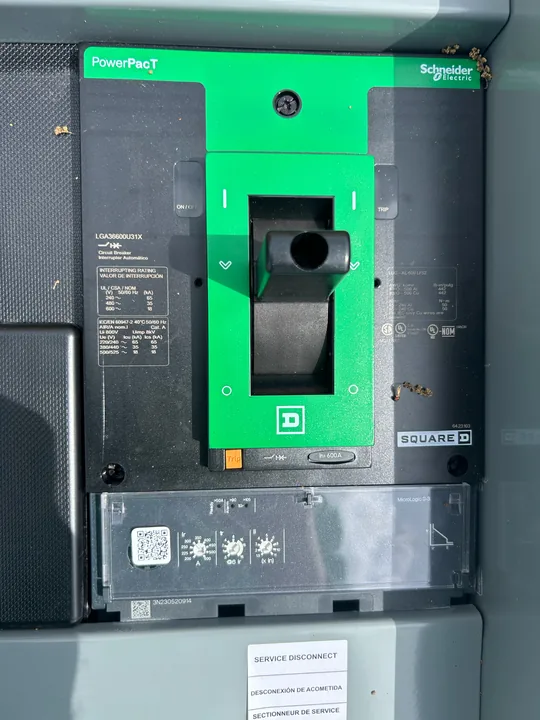
We review qualifying molded-case circuit breakers (MCCBs), including thermal-magnetic, electronic-trip, adjustable-trip, and motor-protection units. The exact frame, trip or sensor, interrupting rating, mounting, quantity, and condition are required before a purchase decision.
A frame designation and installed trip value answer different identification questions.
Ratings can vary by voltage and exact suffix; the full label matters.
Plug-in, bolt-on, drawout, terminal, lug, and accessory details affect completeness.
Packaging, visible wear, damage, records, quantity, and current model demand affect fit.
We review qualifying used and new-surplus MCCBs when the exact labels, ratings, quantity, condition, and photos are available.
No single number is enough. Capture the catalog number, frame, trip or sensor, poles, voltage, interrupting rating, suffixes, and accessories.
No. A seller review is not an installation approval, listing determination, safety inspection, or compatibility decision.
Read the maker label before grouping similar equipment. Names may include MCCB, frame breaker, thermal-magnetic breaker, electronic-trip breaker, adjustable-trip breaker, magnetic-only protector, and high-interrupting-capacity breaker. They do not establish model, condition, or installation suitability. Send complete markings and a clear photo when unsure.
Start with what is printed on the equipment. Do not guess a model, rating, compatibility, or condition. A complete identification set usually includes:
MCCBs appear across commercial and industrial distribution equipment. Similar enclosure dimensions do not establish the same frame, trip, interrupting rating, mounting method, or application. The exact label is more useful than an approximate amperage description.
A clear submission helps prevent a mistaken preliminary review and saves time for both sides. Useful lot-level information includes:
Use plain, supportable condition language. Original packaging can be documented, but packaging alone does not prove an unused, authentic, complete, or operational item. Used equipment should include truthful removal and storage details. If a unit is missing hardware, modified, corroded, fire-exposed, water-exposed, fault-exposed, or otherwise questionable, say so before any shipping discussion.
Condition influences eligibility, handling, and value, but no universal price table can account for exact model demand, quantity, completeness, provenance, current stock, freight economics, and inspection results.
A photograph or preliminary review cannot establish internal condition, safe operation, authenticity, compatibility, listing, current-limiting performance, or suitability for installation.
A submission is not an offer, acceptance, authentication result, safety assessment, code determination, shipping authorization, or instruction to remove installed equipment. Any next step must be confirmed in writing.
A model-family name can include multiple generations, frame sizes, ratings, mounting styles, control options, and accessories. When a seller writes only “molded-case circuit breakers,” the reviewer cannot safely assume that visually similar units are interchangeable. Copy each label line as printed, preserve spaces and suffixes, and connect each photograph to one inventory row. If a suffix is obscured, record that uncertainty rather than substituting a nearby unit’s identifier.
For mixed lots, photograph the full group first, then create smaller model groups. Keep packaging, loose hardware, trip units, rating plugs, cradles, covers, manuals, and test documents with the matching line item. This method reduces duplicate questions and prevents a photograph of one complete unit from being mistaken for proof that every unit is complete.
A consistent lot of clearly identified molded-case circuit breakers can be easier to review than a larger pile with mixed labels and unknown condition. Quantity, model consistency, completeness, packaging, service history, storage, current demand, documentation, location, and the work required to receive and reconcile the equipment all affect the decision. None of those factors guarantees value, but each can remove uncertainty.
Sellers should disclose deadlines and the reason the equipment is available, such as contractor overstock, a canceled project, distributor excess, facility spares, an upgrade, liquidation, or planned decommissioning. That context helps establish timing and ownership without turning an unsupported story into a condition claim.
If the molded-case circuit breaker fits the current buying scope, the next communication should identify the reviewed item group and any additional information required. Written terms—not a generic web page—must address the approved quantity, price, included parts, packing, freight or pickup, receiving, inspection, discrepancies, and payment.
Keep a copy of the submitted inventory and pre-shipment photographs. Do not substitute items, add unapproved material, hide defects, or combine different conditions under one line after review. If the lot changes, update the reviewer before anything moves.
When sellers manage dozens or hundreds of molded-case breakers, a consistent tagging and grouping method reduces confusion. Group items by the complete catalog string exactly as stamped on the unit—include hyphens, suffixes, and any trailing characters—then attach a simple tag or numbered sticker to each subgroup. Keep trip units, rating plugs, and detachable accessories physically with the subgroup they belong to; store visibly different or modified units in separate boxes. For photographic documentation, capture one wide view showing the subgroup with its tag, followed by a representative close-up of a single unit’s nameplate and terminal area so reviewers can confirm label legibility and mounting style without inferring from another unit.
For very large lots, select representative samples for more detailed imagery and notes. A practical approach is to choose a sample set distributed across the lot—beginning, middle, and end of palletized stacks or from different crates—to expose potential handling or storage variation. Alongside photos, note any serial number ranges, visible corrosion, stamped dates, or aftermarket modifications observed on the sampled units. Sellers should consider adding short handwritten notes to photo backgrounds (for example: “Box A — sample 2 of 5”) to preserve context when multiple images are reviewed later.
A clear manifest ties labels, quantities, and photos together and shortens follow‑up queries. Useful spreadsheet columns typically include: catalog/type line exactly as on the unit, frame size, trip rating or trip unit ID, pole count, listed interrupting rating (if legible), serial number or range, quantity, declared condition, storage location, and filenames for linked images. If multiple photos correspond to one row, list them in a single cell separated by a delimiter (for example: label01.jpg;terminals01.jpg). Avoid shorthand that omits suffixes or merges different catalog lines into one entry—reviewers need the same literal identifiers you see on the nameplate.
Agree on a simple file-naming convention before you shoot so images remain associated with spreadsheet rows. A compact pattern might combine catalog, subgroup tag, and image type (for example: ABB-S4A-250-Box3-label.jpg). Preserve original camera timestamps when possible and include a master manifest CSV that pairs each filename with its spreadsheet row. If you compress images for upload, keep an untouched archive copy locally so you can reproduce any requested higher-resolution detail without re-photographing the equipment.
Several recurring issues create needless delays: combining different catalog numbers under a single quantity entry, submitting photos that crop off interrupting ratings or manufacturer codes, and omitting accessory items such as handles, cradles, or rating plugs. Other frequent missteps include ambiguous condition descriptions (for example, using “fair” without describing the observed defect) and failing to separate visibly altered or reworked units from stock that appears unmodified. These problems force clarifying questions that can be avoided with a bit more upfront detail.
Corrective steps are straightforward and within the seller’s control. Before submitting, split mixed lots into distinct rows that mirror what is physically boxed or palletized, re-shoot any image where critical label lines are unreadable, and list missing parts explicitly next to the affected line item. Where a suffix or character on a nameplate is unreadable, mark that field as “suffix unreadable” rather than guessing. A short pre-submission checklist signed by the preparer—date, inventory count verified, photos attached—helps show that the provided record accurately reflects what will be available for inspection if the lot proceeds to the next stage.
Send the manufacturer, catalog number, quantity, condition, location, and clear exterior photographs. If the lot fits our current review scope, the next steps can be discussed in writing.