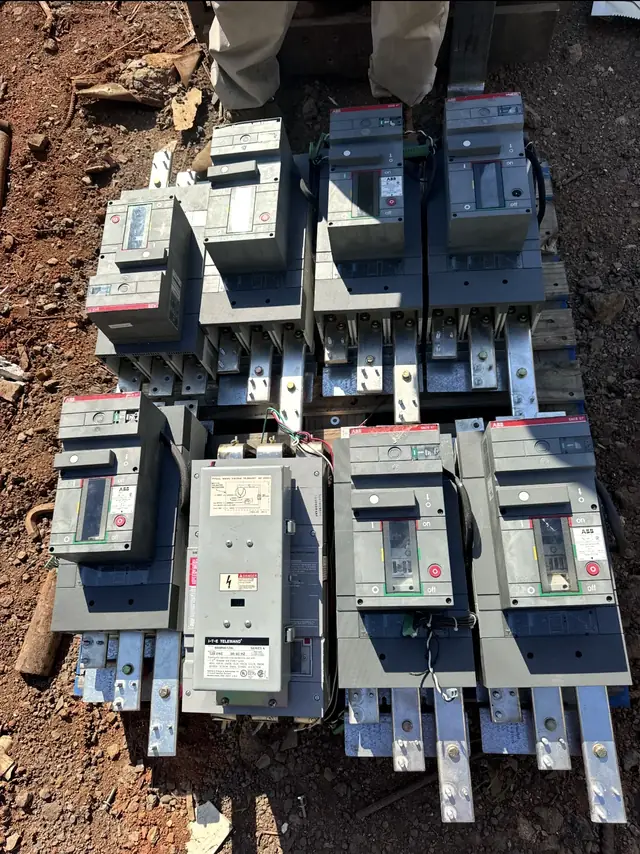
Identify the breaker category without forcing a guess
Circuit breaker is a broad commercial term. Sellers may have branch breakers, molded-case circuit breakers, insulated-case breakers, low-voltage power breakers, air circuit breakers, vacuum breakers, motor circuit protectors, electronic trip units, drawout cradles, or a mixed lot containing several families. The physical appearance alone does not establish the type.
Use the manufacturer’s full product marking and the context of the removed equipment. If the label is unclear, submit a safe photograph and mark unknown fields as unknown.
Molded-case circuit breakers and related devices
Molded-case breaker reviews commonly depend on the manufacturer, family, complete catalog number, frame, trip or sensor rating, poles, voltage, interrupting rating, mounting, terminals, accessories, and condition. Thermal-magnetic, electronic-trip, adjustable, magnetic-only, current-limiting, and other variants should not be grouped by amperage alone.
- Fixed-mount and plug-in configurations
- Thermal-magnetic and electronic trip
- Frame, sensor, rating plug, and trip distinctions
- Motor circuit protectors and breaker-adjacent devices
- New surplus, used, untested, incomplete, and damaged condition groups
Low-voltage power, air and drawout breakers
A power-breaker submission may involve the breaker, trip unit, rating plug, drawout cradle or cassette, secondary disconnects, shutters, hardware, accessories, and the switchgear section from which it came. Those pieces should be documented together and then listed separately so the reviewer understands completeness.
Obsolete does not automatically mean valuable or unusable
Older equipment can have replacement demand, but age and scarcity are not enough. Product status, exact family, date or revision, service base, safety history, recall status, available substitutes, condition, legitimacy of any testing, and current demand all matter. Never describe an old breaker as rare, certified, compatible, safe, or operational without support.
Separate commercial review from electrical safety
A seller submission does not determine whether a breaker is safe to energize, properly applied, compatible with a panel, code compliant, authentic, calibrated, or suitable for reuse. Installed and energized equipment belongs under qualified electrical work practices. Heat, smoke, odor, buzzing, shocks, arcing, water exposure, fire exposure, broken cases, or altered labels require a safety-first response.
Frame, trip, sensor and interrupting ratings answer different questions
The frame can describe a breaker platform or maximum frame capability; the installed trip, sensor, or rating plug may define a different continuous-current setting. Voltage and interrupting ratings have their own conditions. Poles, frequency, mounting, terminals, protection functions, accessories, and revision may also change the exact identity. Copying one large number from the face is not a complete identification method.
Some labels use abbreviations, multiple tables, or ratings that vary by voltage. Photograph the entire label sharply rather than transcribing only the number that appears most prominent.
Physical fit is not proof of an authorized application
A breaker that appears to fit an opening is not automatically listed, classified, compatible, safely applied, or permitted for a particular panelboard or switchgear assembly. Product labeling, manufacturer instructions, the equipment listing, interrupting ratings, system conditions, code requirements, and the authority having jurisdiction may all matter.
This website can help a seller describe what is printed on an item. It does not approve an installation or tell a consumer to replace a breaker.
Photographing equipment and site context
When sellers prepare a submission, clear photographic evidence speeds identification and reduces follow-up. Include a sharply focused image of the full nameplate or label showing manufacturer, catalog number, serial or date code, and all stamped ratings. Add at least one image of the breaker as removed — showing how it sat in the panel or cradle, adjacent components, and any panel or section tags that indicate equipment origin. If multiple pieces are submitted as a lot, provide a consolidated overview shot and individual close-ups for each serial or catalog-marked item. Photograph suspected damage, such as cracks, bent stabs, corrosion, or missing covers, from multiple angles and include a ruler or common object for scale.
Organize images with descriptive filenames and include a brief caption for each photograph when you submit: manufacturer–catalog–serial and a short note such as 'left terminal view' or 'label, front.' Preserve original file resolution and EXIF metadata when possible; reviewers rely on accurate date and time stamps and unaltered images. If a nameplate is worn, supply multiple angles and a short transcribed readout in the submission form with 'unknown' when characters are illegible. For safety and liability reasons, do not submit energized live-panel photographs or video of equipment under load; document mechanical and marking information only.
- Full nameplate front and entire label
- Installed view showing panel tag or bus section
- Close-ups of damage, terminal markings and serials
List accessories, trip assemblies and mechanical parts clearly
When a breaker or lot includes auxiliary equipment, listing those items separately helps reviewers understand completeness and potential reuse pathways. Note trip unit model and serial, rating plugs or keying devices, auxiliary contact blocks, shunt trips, undervoltage releases, racking mechanisms, drawout cradles or cassettes, and any original mounting hardware. For power breakers, document secondary disconnect assemblies, interlocks, shutter plates, and control wiring bundles that were removed with the unit. If components were removed prior to submission, mark them as 'removed' and explain whether they were transferred with the breaker or retained, without asserting that items have been functionally tested.
Describe the condition of each accessory using consistent terms — for example, 'new-surplus,' 'used untested,' 'incomplete,' 'mechanically damaged,' or 'cosmetically worn' — and add photos that match those descriptions. Whenever available, list manufacturer accessory part numbers, date codes, and revision letters because those identifiers often determine replacement options and cross-reference accuracy. If an accessory appears to be an aftermarket retrofit or non-original replacement, state that observation rather than claiming compatibility. Remember that qualifying items may be reviewed based on the documented accessory set and condition, but a submission alone does not certify functionality, safety, or field-fit.
- Trip units and rating plugs
- Auxiliary contacts and shunt trips
- Drawout cradles, racking kits and shutters
- Mounting hardware and control wiring bundles
Naming conventions, numbers and how to report uncertainty
Catalog numbers and naming conventions differ by region and maker; an exact transcription prevents misclassification. North American-style listings commonly reference frame size and catalog code, while IEC-designated equipment may emphasize rated breaking capacity and pole configuration in a different format. Copy the complete catalog or type number verbatim, including dashes, suffixes, and revision letters, and photograph any multi-line tables that tie a given code to voltage, frequency, or accessory options. If both ANSI/UL and IEC markings exist on the same item, capture both panels and note which marking appears primary.
When label text is degraded or confusing, transcribe everything you can see and mark uncertain characters as 'illegible' or 'unknown.' Include the visible standard markings, but do not assert certification or performance beyond what is printed; standards labels assist reviewers in cross-referencing but are not a warranty. Helpful fields to call out in the submission form include manufacturer name, complete type/catalog number, frame designation, installed trip or sensor rating, interrupting rating at the specified voltage, pole count, terminal style, visible serial or date codes, and any revision suffixes. Qualifying items may be reviewed using these cross-reference details, but a submission does not replace factory documentation or an authorized approval.
- Manufacturer and complete catalog/type
- Frame size and installed trip rating
- Interrupting rating with specified voltage
- Pole count and terminal style
- Visible serial, date code and revisions