Equipment we review
- Molded-case and insulated-case breakers
- Air and low-voltage power breakers
- Branch, miniature, and specialty breakers
- Obsolete families, trip units, cradles, and accessories
Submit qualifying breakers for review using the manufacturer, series, catalog number, ratings, condition, quantity, location, and clear photographs.
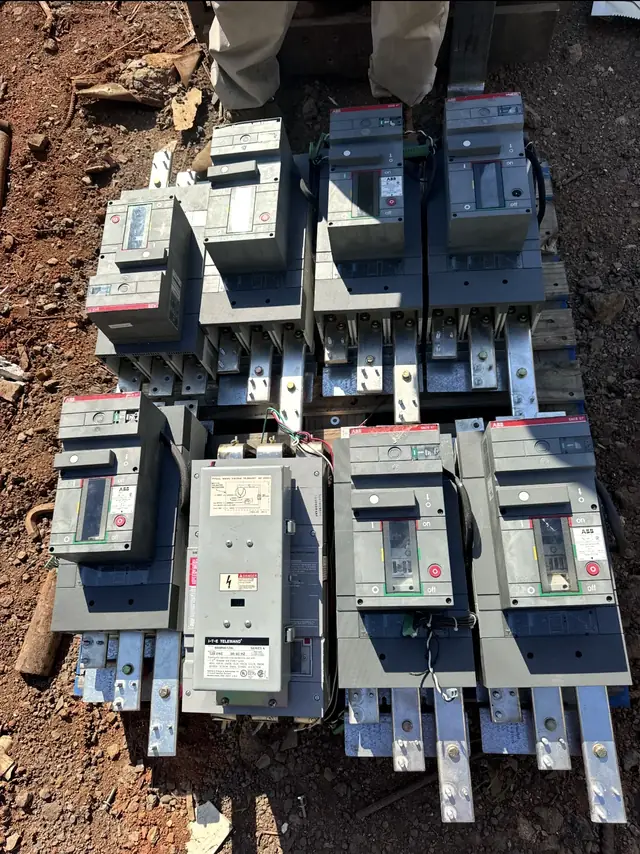
Circuit Breaker Buyer reviews qualifying used, new-surplus, obsolete, molded-case, air, drawout, branch, and power circuit breakers from individual sellers, contractors, distributors, facilities, and liquidation projects nationwide. A submission starts the review; acceptance and price depend on the exact equipment and written transaction terms.
Complete catalog numbers and readable labels remove the largest source of uncertainty.
Matching, countable groups are easier to review than mixed unidentified material.
Packaging, trip units, cradles, accessories, damage, storage, and testing records can change the review.
Model demand, location, packing, freight, and receiving work affect commercial fit.
Circuit Breaker Buyer reviews qualifying used and surplus breakers nationwide. Send the exact label, quantity, condition, location, and photos for a purchase decision.
You can submit one breaker, but commercial fit depends on its exact model, condition, completeness, demand, and shipping practicality.
No. Product and brand pages explain what may be reviewed; only a written response to the actual submission can confirm scope or an offer.
Circuit Breaker Buyer is a direct buyer that reviews qualifying used, new-surplus, obsolete, and surplus circuit breakers from contractors, distributors, facilities, liquidators, and individual owners. Whether an item fits a purchase review depends on its exact identity, quantity, condition, completeness, ownership, location, logistics, safety history, and the company’s current buying scope.
Start with the name printed on each breaker, its complete catalog number and the number of matching units. Keep branch breakers, molded-case breakers, trip units, and drawout power breakers in separate groups; identify any cradles or accessories that belong with them. We can then review the actual lot rather than guess from a broad description.
Potential review categories include molded-case circuit breakers, low-voltage power and air circuit breakers, drawout breakers and cradles, insulated-case breakers, branch or miniature breakers in appropriate quantities, electronic trip units, motor circuit protectors, and selected obsolete or medium-voltage equipment when the operational and logistics requirements can be met.
Photograph only safely accessible, uninstalled equipment or exterior labels that do not require opening energized gear. Include the manufacturer, catalog or type number, frame, trip or sensor rating, poles, voltage, interrupting rating, trip unit, mounting, included lugs or accessories, quantity, location, condition, storage history, and ownership authority.
If a number is unreadable or unknown, mark it unknown. A truthful blank is more useful than an incorrect guess.
There is no honest universal price-per-breaker table. Current demand for the exact family, the quantity available, completeness, condition, provenance, packaging, replacement-market activity, testing documentation when legitimate, and the cost of moving the lot can all affect a review.
A preliminary response based on photos remains subject to written terms and any receiving, count, identity, condition, authenticity, recall, and reconciliation requirements stated for the transaction.
Do not remove covers, touch interior parts, test energized equipment, or remove installed breakers to create a sales submission. Heat, odor, buzzing, smoke, visible scorching, shocks, water exposure, arc damage, contamination, an unresolved recall match, altered labels, or counterfeit concerns should be handled through qualified safety and compliance channels before commerce.
Look for a manufacturer such as Square D, Eaton, Siemens, GE, or ABB on the original unit label. Legacy names may also appear. A maker's name helps organize a submission but does not establish a specific model, authorized affiliation, compatibility, or condition.
A brand can span many breaker families and generations. Provide the complete family and catalog markings rather than assuming every item carrying one logo belongs in the same group.
For one loose breaker, a complete label and honest condition description may be enough to begin. For matching cartons, show the product labels and a count that distinguishes sealed, opened, damaged, and missing units. For a mixed pallet, create groups before asking for one lot-level answer. For a project removal, document the lineup context, installed status, qualified removal responsibility, section access, dates, and logistics.
Photograph a full view of each group and one legible label for each exact model. Give the quantity and condition separately for each group, and disclose missing trip units, cradles, covers, or other parts rather than mixing complete and incomplete equipment under one count.
When sellers can provide original procurement paperwork, maintenance entries, factory or third-party test certificates, or installation checklists, those records make remote identification and valuation materially easier. Useful items include purchase invoices that match catalog markings, date-stamped calibration or maintenance logs that show trip settings and adjustments, and serial-number rollups for drawout frames and cradles. For breakers with electronic trip units, configuration exports, event-history snapshots, and firmware or configuration change records help clarify whether the protection scheme aligns with prevailing aftermarket interest. Shipping manifests and lot-level packing lists that correspond to photographed counts are likewise helpful when lots are destined for another facility or cross-border movement.
Submit documents as legible PDFs or high-resolution images attached to the online form or provided via a secure file link. If records contain proprietary or sensitive business data, indicate redactions and provide a contact who can confirm provenance without exposing unrelated commercial information. A contemporaneous decommission note signed by an authorized site representative can substitute for missing paperwork in many cases, but documentation is used only to inform a preliminary review and does not by itself constitute acceptance or purchase.
Equipment that has received field modifications, retrofits, or aftermarket components needs clear, honest descriptions so a remote reviewer can assess likely interest. Examples include replaced handles, reworked lug assemblies, swapped trip relays, or added auxiliary modules; identify what was changed, who performed the work, and whether the original components were retained. If the work was performed by a manufacturer's authorized service provider or a recognized electrical contractor, include that paperwork and a point of contact for verification. Independent shop repairs or salvaged-component installations are common but should be accompanied by invoices and a description of parts' origin.
When submitting modified units, attach photos that focus on the affected areas, any serial-number continuity across original and replacement parts, and labels or work-order references that document the change. Do not remove safety covers to show internal changes; photograph accessible external evidence and supply service records instead. Label modified units clearly in any inventory and, when lots include both unmodified and modified breakers, separate them before submission. Visible modifications do not automatically preclude a review, but they often require additional validation and may change which buyers will consider a lot.
Accurate handling and size data help determine whether a lot is practical to move and store. Include unit weight approximations, frame or cradle footprint dimensions, pallet counts, and whether items are banded, crated, or free-standing. Note any protruding hardware, missing feet, or bolted bases that affect lift points and stacking height. If equipment remains installed, describe whether it is in a panel row, on a substation structure, or otherwise obstructed by adjacent systems, and indicate any site constraints such as locked yards, restricted hours, or required escorts that could affect access.
When photos show the site context, include a wider-angle shot for access routes and close-ups for labeling and corner damage. A simple floorplan sketch indicating pallet locations, dock orientation, nearest staging area, and truck approach reduces follow-up questions during preliminary review. Share any typical time windows when a site contact can meet a logistics coordinator and note if forklifts, cranes, or specialized rigging would be required for safe handling—provided purely for planning. Supplying logistics detail helps prioritize which lots are workable, but it is not an authorization to collect, ship, or sell equipment.
Use the form for one breaker, a pallet, or a larger project lot. Submission does not guarantee an offer or authorize shipment.