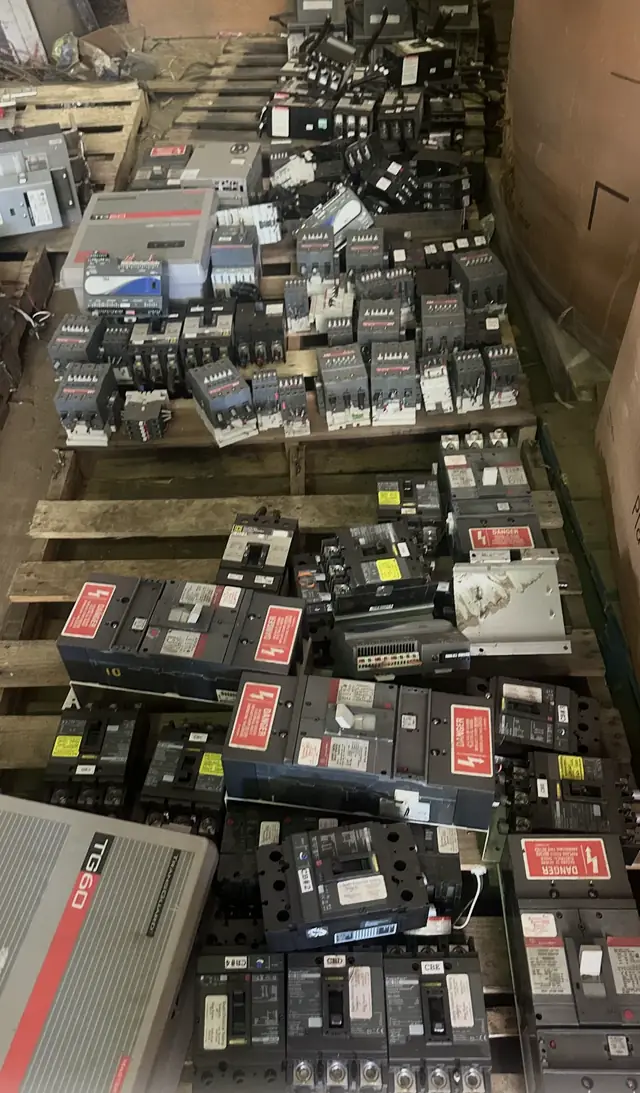
Identify the equipment
Provide the manufacturer, exact catalog or type number, electrical ratings visible on the label, quantity, declared condition, location, and safe photographs. For larger assemblies, include nameplates, section counts, major devices, dimensions, estimated weight, installed status, and access facts.
Clarify the lot
We may ask for additional angles, packaging information, serial or date codes, trip-unit details, accessory lists, provenance, storage history, recall information, or an itemized inventory. Do not open equipment, remove safety covers, or enter energized gear to answer a question.
Review the current fit
A preliminary review considers whether the item fits the current purchasing scope, can be identified responsibly, appears eligible for resale or another approved channel, and has practical transaction economics. Not every old, large, rare, or working-looking breaker has a market.
Receive transaction-specific written terms
If the lot fits, written terms can address price, quantity, item identity, included components, offer validity, packing, freight or pickup, insurance, title and risk, receiving, inspection, discrepancies, returns or other disposition, and payment. Website language never overrides the accepted transaction documents.
Pack or stage only after approval
Follow only the packing, labeling, carrier, pickup, or site instructions issued for the transaction. Protect terminals, handles, trip units, labels, and loose accessories. Photograph the lot and package before closing it when requested. Do not ship unapproved equipment.
Receiving, reconciliation and payment
The receiving process may verify count, catalog identity, included parts, visible condition, packaging damage, and other agreed review points. Any discrepancy and payment timing must follow the transaction-specific written terms, not a generic promise.
Keep the inventory, photos and written terms connected
Assigning an item number to each model group creates a simple evidence chain from the seller’s list to the photographs, preliminary review, written terms, packing list, shipment, receiving count, and final reconciliation. That chain matters when a pallet contains similar-looking products or when accessories are packed separately.
Record changes instead of silently replacing items. If quantities, condition, location, included parts, or timing change after review, the buyer needs the revised facts before arranging the next step.
Know who controls safety, packing, freight and inspection
The seller remains responsible for truthful information, ownership authority, site safety, and any obligations assigned in writing. Qualified electrical personnel control de-energization and removal. The packing party controls the approved packing work. The carrier controls transportation under its rules. The receiving process controls the agreed identity, count, and visible-condition checks.
Writing those roles down prevents a website phrase such as nationwide buyer from being misunderstood as an automatic rigging, removal, freight, insurance, or payment commitment.
Photographing and labeling lots for efficient review
High-quality visual records reduce back-and-forth and help reviewers verify which component is which without repeated site visits. Favor clear, evenly lit images that show mounting faces, terminal areas, nameplate regions, and any wear or damage. Capture several distances: full-assembly shots to show context, mid-range images to reveal accessory placement, and tight close-ups of text, stamps, or unique marks. When a piece is grouped with similar items, include at least one shot that shows the entire group and one image that isolates the individual item with a visible identifier to avoid confusion during inspection reconciliation.
Image metadata and filenames are practical tools that keep photos usable during review. Embed or retain timestamps and, when available, GPS tags; export or save files with a short item code and date in the filename so reviewers can link images to the inventory quickly. If items are tagged on site, place the tag so it is legible in the photo without obscuring critical markings. Store images in a consistent folder structure and, when sharing, provide a brief index that maps each file name to the inventory line so reviewers spend less time hunting for corroborating views.
- Use neutral, non-reflective backgrounds for small parts
- Include a simple scale reference in at least one close-up
- Capture both sides of modular trip units and accessory plates
Assembling a documentation bundle that speeds preliminary evaluation
A concise, searchable packet of documents helps reviewers determine whether a lot warrants deeper consideration. Useful items include spec sheets or OEM literature that correspond to the photographed models, an itemized inventory with any available serial or batch ranges, and a concise condition note for each line item that clarifies visible defects versus unknowns. When multiple similar models exist, a single spreadsheet that cross-references item codes to photos, quantities, and short remarks reduces ambiguity. Organizing electronic files by item code and keeping each file under a predictable name or PDF bookmark saves review time.
Mindful redaction and concise provenance statements are practical for lots that contain commercially sensitive information. Remove unrelated billing or contact data from documents before sharing, and consider including a one‑page cover summary that highlights key facts such as approximate pallet counts, approximate gross weight ranges, and any known exclusions (for example, missing accessories). Providing an honest outline of what is unknown — such as last operational date when not documented — can be as helpful as listing known attributes because it focuses follow-up questions on what matters.
- Provide a CSV or spreadsheet linking item codes to photo files
- Include OEM part references or published datasheets when possible
- Add a short cover summary to highlight known unknowns
Inspection flags that commonly trigger follow-up
Certain observable conditions tend to require additional documentation or an in-person assessment before a lot can be advanced. Examples include evidence of field modification (solder, non-factory fasteners, cut or re-drilled panels), inconsistent or missing nameplate information across otherwise identical units, visible thermal distress at contacts or buswork, and accessories or fasteners packed separately from the main device. Packaging damage that exposes terminals or nameplates also prompts further questions. When any of these flags are present, reviewers typically request deeper photographic coverage, an itemized explanation, or provenance that explains the anomaly.
You can streamline the response process by preemptively disclosing known anomalies and providing targeted support materials. A short note that identifies modifications, matches spare accessory part numbers to photographed items, or explains why serial sequences skip numbers will often reduce clarification rounds. Supplying replacement or repair documentation that already exists — without implying that the lot is certified or safe for reuse — helps reviewers understand whether additional verification is needed. Clear disclosure does not guarantee a transaction but helps the review progress more predictably.
- Flag and explain any non-factory alterations
- Photograph and list separate accessory kits with their item codes
- Note any visible nameplate damage or missing markings