Equipment we review
- Fixed and drawout low-voltage power breakers
- Air circuit breakers and withdrawable assemblies
- Cradles, cassettes, trucks, and secondary disconnect parts
- Electronic trip units, rating plugs, and documented accessories
Have a low-voltage power or air circuit breaker or a larger lot? Start with the exact label, condition, quantity, and location. We use those details to determine whether the equipment fits a current purchase review—not a generic promise based on one photograph.
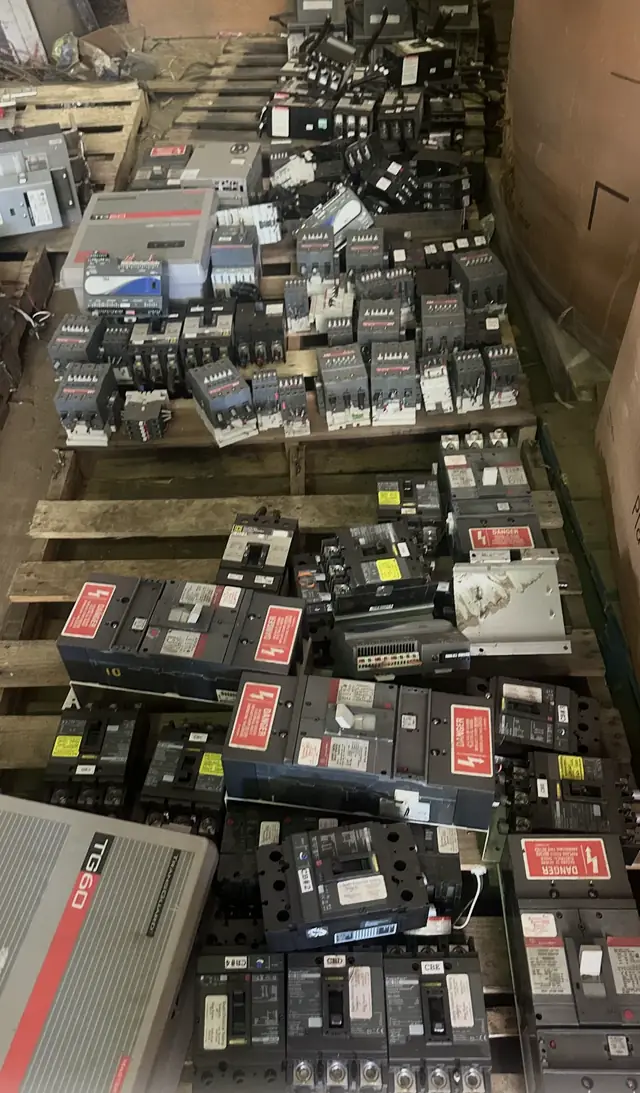
We review qualifying low-voltage power and air circuit breakers, including fixed and drawout units, cradles, cassettes, trip units, rating plugs, and related switchgear components. Complete breaker-and-cradle identification is especially important for these systems.
A correctly documented breaker, cradle, trip unit, and accessory set is easier to review than loose unidentified parts.
Missing secondary disconnects, shutters, interlocks, hardware, or trip components can change fit.
Removal history, records, storage conditions, corrosion, contamination, and visible wear matter.
Weight, dimensions, packing, loading, location, and approved transport affect feasibility.
We review qualifying fixed and drawout air or low-voltage power breakers nationwide when the breaker, cradle, trip unit, condition, and logistics are documented.
Yes, if available. Photograph and identify it separately, along with secondary disconnects, shutters, interlocks, and included hardware.
Do not operate or remove installed equipment for a sales photo. Qualified personnel and site energy-control procedures come first.
Read the maker label before grouping similar equipment. Names may include LVPCB, air circuit breaker, ACB, drawout breaker, fixed breaker, withdrawable breaker, power breaker, cradle, cassette, and electronic trip unit. They do not establish model, condition, or installation suitability. Send complete markings and a clear photo when unsure.
Start with what is printed on the equipment. Do not guess a model, rating, compatibility, or condition. A complete identification set usually includes:
Power breakers often arrive as systems rather than isolated pieces. A breaker, its drawout cradle, trip unit, rating plug, and related switchgear context may all affect whether a lot can be identified and evaluated efficiently.
A clear submission helps prevent a mistaken preliminary review and saves time for both sides. Useful lot-level information includes:
Use plain, supportable condition language. Original packaging can be documented, but packaging alone does not prove an unused, authentic, complete, or operational item. Used equipment should include truthful removal and storage details. If a unit is missing hardware, modified, corroded, fire-exposed, water-exposed, fault-exposed, or otherwise questionable, say so before any shipping discussion.
Condition influences eligibility, handling, and value, but no universal price table can account for exact model demand, quantity, completeness, provenance, current stock, freight economics, and inspection results.
Do not rack, open, energize, test, or remove installed equipment for a sales photograph. Qualified personnel and site energy-control procedures must come first.
A submission is not an offer, acceptance, authentication result, safety assessment, code determination, shipping authorization, or instruction to remove installed equipment. Any next step must be confirmed in writing.
A model-family name can include multiple generations, frame sizes, ratings, mounting styles, control options, and accessories. When a seller writes only “low-voltage power and air circuit breakers,” the reviewer cannot safely assume that visually similar units are interchangeable. Copy each label line as printed, preserve spaces and suffixes, and connect each photograph to one inventory row. If a suffix is obscured, record that uncertainty rather than substituting a nearby unit’s identifier.
For mixed lots, photograph the full group first, then create smaller model groups. Keep packaging, loose hardware, trip units, rating plugs, cradles, covers, manuals, and test documents with the matching line item. This method reduces duplicate questions and prevents a photograph of one complete unit from being mistaken for proof that every unit is complete.
A consistent lot of clearly identified low-voltage power and air circuit breakers can be easier to review than a larger pile with mixed labels and unknown condition. Quantity, model consistency, completeness, packaging, service history, storage, current demand, documentation, location, and the work required to receive and reconcile the equipment all affect the decision. None of those factors guarantees value, but each can remove uncertainty.
Sellers should disclose deadlines and the reason the equipment is available, such as contractor overstock, a canceled project, distributor excess, facility spares, an upgrade, liquidation, or planned decommissioning. That context helps establish timing and ownership without turning an unsupported story into a condition claim.
If the low-voltage power or air circuit breaker fits the current buying scope, the next communication should identify the reviewed item group and any additional information required. Written terms—not a generic web page—must address the approved quantity, price, included parts, packing, freight or pickup, receiving, inspection, discrepancies, and payment.
Keep a copy of the submitted inventory and pre-shipment photographs. Do not substitute items, add unapproved material, hide defects, or combine different conditions under one line after review. If the lot changes, update the reviewer before anything moves.
When submitting images, prioritize technical detail over single illustrative shots. Useful photographs show the breaker faceplate, the full nameplate or label in readable resolution, the cradle or cassette mounting features, and the trip-unit or rating-plug cavity. Include a clear view of the drawout handle or fixed-mount flange, the bus-stab area or connection points, and any serial or date codes. Lighting should eliminate glare that obscures stamped or printed characters; if a manufacturer label sits deep in a recess, provide a close-up taken perpendicular to the surface so characters remain legible. Do not rely on a distant warehouse photo as the only proof of identity.
Link each set of images to a single line item in your inventory list so a reviewer can match photos to quantities and reported completeness. If a breaker has removable accessories—handles, shunts, auxiliary contacts, shutters, or rating plugs—photograph each accessory separately beside a labeled note or inventory tag. When items are packaged, open one representative package on camera (if safe and allowed) to show internal packing and included parts; this prevents misinterpretation when many packages look identical. Qualifying items may be reviewed only after images and identifiers meet the reviewer’s clarity standards.
Mixed lots slow technical reviews unless components are segregated and documented. Create physical groups by model family, frame, or completion state (complete drawout sets, incomplete units, cradles only, trip units only). Use temporary tags or numbered labels on each group and record those numbers in your inventory spreadsheet. Small parts such as screws, springs, carriage pins, and rating plugs are best placed in labeled clear bags attached to the matching breaker or cradle; list bag contents precisely rather than describing them generically. If items were removed from switchgear, note the original section identifier or rack position to aid provenance checks without suggesting compatibility.
In your electronic submission include a short reconciliation column: photographed (Y/N), bagged small parts (Y/N), and any missing or visibly altered items. If a lot contains a mix of field-modified units, units with aftermarket accessories, or legacy parts, call out those exceptions in the inventory row rather than combining them under one line. This level of separation helps the reviewer determine which groups fit a current review scope and which will likely require further inspection.
Nameplate strings and catalog numbers often include brief suffixes or letter groups that indicate trip architecture, sensor type, auxiliary options, or revision level. Common examples seen on low-voltage power and air breakers include short designators for electronic versus thermal-magnetic trips, current-transformer polarity or burden notes, and cradle-fit variants. Those suffixes can change the expected accessory set; for example, two breakers with the same base family number may differ in the presence or absence of a particular auxiliary contact or rating plug type. When you transcribe identifiers, keep suffixes and hyphens exactly as printed and flag any characters you cannot read rather than guessing their meaning.
Because the same manufacturer may reuse family names across different eras, include any nearby stamping, date code, or serial prefix in your submission. If there are separate markings on the trip unit, the frame, and the cradle, record each line separately and indicate their physical relationship (for example: trip unit serial A installed in breaker frame X, mounted on cradle Y). These transcription details improve the accuracy of a remote review and reduce follow-up inquiries; qualifying items may then be prioritized for further evaluation if they match the current buying scope.
Send the manufacturer, catalog number, quantity, condition, location, and clear exterior photographs. If the lot fits our current review scope, the next steps can be discussed in writing.