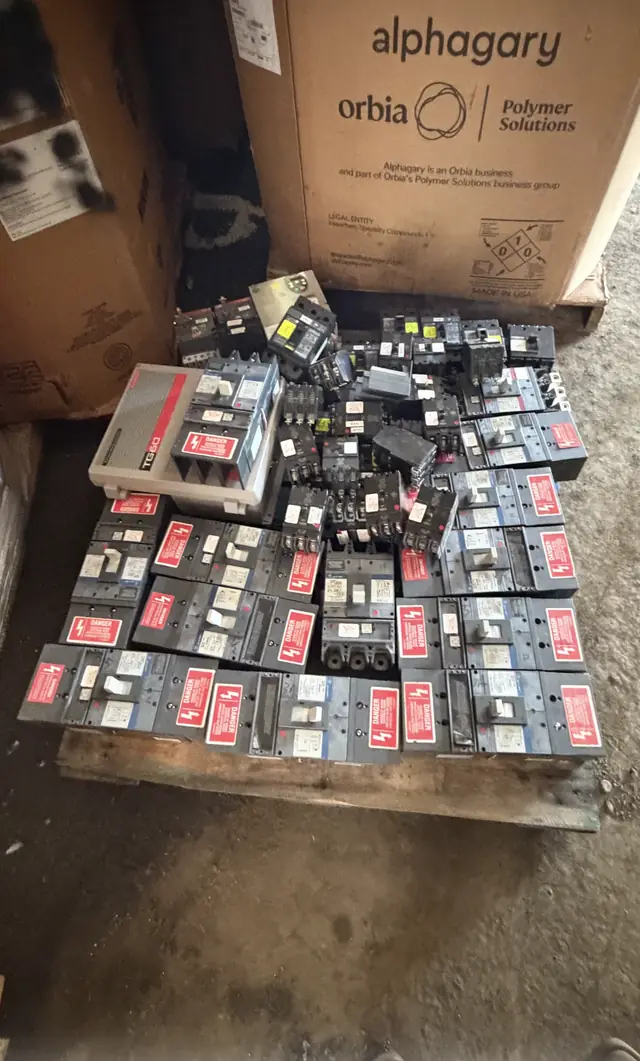
Stop if a photograph would require opening, touching, testing, moving, or approaching energized or damaged equipment.
Photograph uninstalled equipment or safely visible exterior labels
Do not remove a deadfront, enclosure cover, barrier, terminal shield, or arc-resistant panel to obtain a photograph. Do not reach into energized equipment, defeat an interlock, rack a breaker, disconnect a conductor, or perform a test for a sales submission. If the needed label is not safely visible, ask qualified personnel whether it can be documented during an approved de-energized work process.
Capture the lot before the close-up
Begin with an overall photograph showing the quantity and arrangement. Add one front view of the breaker, one clear label or nameplate view, one side or rear view when the equipment is already safely removed, and views of trip units, terminals, cradles, hardware, packaging, and visible damage when relevant.
Use light, focus and scale without hiding the label
Clean only with a safe dry method appropriate to removed equipment. Use indirect light to avoid glare, hold the camera parallel to the label, tap to focus, fill the frame, and take a second angle. Do not cover catalog numbers with fingers or place private paperwork in the background.
Show the uncomfortable details
Include corrosion, broken handles, chipped cases, missing terminals, cut wires, bent stabs, damaged packaging, heat marks, water staining, modifications, missing trip units, and incomplete cradles. Hiding a visible defect delays the review and creates receiving problems.
What a photo cannot prove
A photograph cannot prove authenticity, internal condition, safe operation, calibration, testing, compatibility, listing, recall clearance, code compliance, or value. It is an identification and visible-condition aid only.
Use the same order for every item group
A repeatable sequence makes a large lot easier to review: item-number card, overall group, breaker front, full label, secondary label, side or rear only when safely accessible, included trip unit or cradle, packaging, and each visible defect. Keep the item-number card next to the equipment without covering markings.
For matching units, photograph representative items and any unit whose condition differs. Do not use one clean example to conceal damage in the rest of the group.
Preserve context and avoid misleading edits
Cropping can remove phone-screen controls, empty borders, or irrelevant surroundings, but it should not remove damaged areas, identity markings, or context needed to understand the equipment. Avoid filters that change colors or hide corrosion. Keep original files when possible and send readable versions through the private form.
If a label contains another party’s personal or confidential information, ask how to redact that information without removing equipment identity or condition evidence.
Recognize manufacturer layouts and critical markings
Different manufacturers place key identification data in different places. For example, one maker may put catalog and frame numbers on the front face while another places ratings on a rear nameplate; some labels include both human-readable text and machine-readable barcodes or QR codes. When photographing, aim to capture the entire face of any multi-part label and any adjacent stamped or molded markings (date codes, lot stamps, revision letters). If a barcode or QR code is present, take a clear, parallel close-up so the pattern can be read; if a code is obscured by grime, note that honestly rather than guessing characters from a partial view.
Partial or ambiguous markings slow a review. If a serial number or date code is only partially legible, include a contextual image that shows the label’s placement on the part as well as a close-up crop that maximizes legibility without obscuring surrounding text. Photograph both sides of detachable nameplates or covers when safely accessible; some manufacturers use supplemental plates or stickers that carry the definitive catalog sequence or UL file number. Remember that a clear image of a marking helps a reviewer narrow possibilities, but visual evidence alone does not establish provenance, functionality, or compliance; qualifying items may be reviewed for purchase consideration.
- Capture entire label area plus adjacent molded or stamped marks
- Photograph barcodes/QR codes parallel and unobstructed
- Include context shot showing where the plate is mounted
Document trip units, releases, and included mounting hardware
Accessories change the use and value of a circuit breaker and are frequently separate serial-numbered components. Photograph any fitted trip unit, shunt trip, undervoltage release, electronic trip module, or auxiliary contact assembly from multiple angles so the module markings and any connector interfaces are visible. If a breaker is offered with racking handles, draw-out cradles, or extensions, show how those parts attach and any fasteners or adapters included. For modular trip units, a close-up of the connector face and the module part number can be decisive when a reviewer assesses whether an accessory belongs to the breaker being documented.
Document the mechanical condition of attachments as well as presence or absence. Capture mounting hardware, terminal bolts, straps, and any custom brackets or machine modifications alongside the breaker so their fit and condition are evident in relation to the unit. Photograph spare parts or packaging that accompany the breaker, and note when an item is offered without originally paired accessories. Photographs and descriptive notes should make clear what is present, but they do not prove functional compatibility or electrical safety; qualifying breakers and accessories may be reviewed further if the visuals indicate a potential match.
- Show trip modules and connector faces from two angles
- Photograph handle/racking hardware and how it attaches
- Include any spare fasteners, labels, or accessory packaging
Name, group, and describe images to speed the review
Organize files so each photo can be associated with a single catalog number or lot line. Use concise filenames that pair an item number or lot code with a short descriptor (for example: Lot123_BreakerFront.jpg, Lot123_Nameplate_Close.jpg). When you submit multiple items, include a manifest in the upload notes that lists quantity, observed markings, and which filenames correspond to each photographed unit. If units are inventoried on a pallet, add an overall shot clearly showing the pallet ID or item-number card so reviewers can match close-ups to the correct pile without guessing.
Supply a short submission note that flags anything unusual or partial: unreadable characters, sticker overlays, mismatched accessories, or painted-over areas. Indicate whether photographs show installed items, removed items, or items on a shelf, and whether additional documentation (manufacturer spec sheets, purchase records) is available on request. Upload commonly accepted formats (JPEG/PNG) at sufficient resolution to read fine text but avoid unnecessary compression. Uploading images and notes is a request for visual review only and does not create a purchase, inspection, approval, or shipping instruction; qualifying items may be reviewed for possible purchase consideration.
- Use filenames that include lot or item IDs
- Provide a manifest linking images to item lines
- Note unreadable markings and the photographed condition