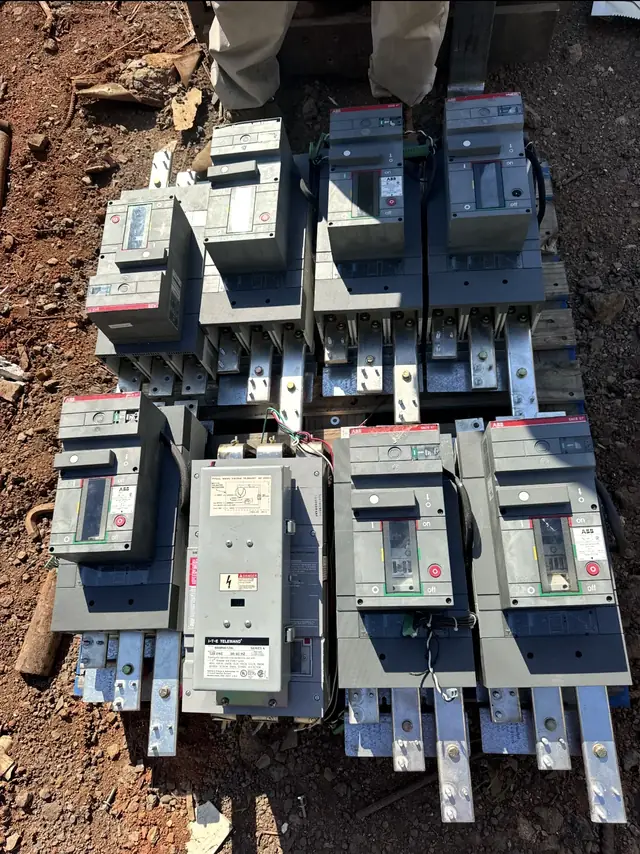
Confirm the equipment can be documented safely
The ordinary seller path is for uninstalled equipment or labels visible without entering energized gear. Qualified personnel and site procedures must control de-energization, lockout/tagout, verification, disconnection, removal, and any access behind covers.
Write down the exact label fields
Capture the manufacturer, product family, complete catalog or type number, poles, voltage, trip or ampere rating, frame, interrupting rating, trip unit, mounting, date or lot code, and included accessories. Do not infer a missing field from another unit.
Separate new surplus, used, untested, incomplete and damaged
Use one condition description consistently. Note packaging, removal history, storage, rust, moisture, heat or arc evidence, cut conductors, missing lugs, broken handles, altered labels, open cases, and missing trip or cradle components.
Count by exact item group
A buyer needs to know whether there is one breaker, twenty matching units, an assorted pallet, or a complete project. Use a spreadsheet for larger lots and connect each photo set to the corresponding line.
Send the facts and wait for the written next step
Include contact details, city and state, ownership authority, time constraints, safe removal status, and logistics facts. Do not ship, palletize, dismantle, or schedule pickup until the lot is reviewed and the applicable terms are accepted.
Confirm ownership, authority and any site restrictions
The person submitting the lot should know who owns it, whether another party has approval rights, whether a landlord or customer controls removal, and whether liens, project closeout terms, evidence holds, environmental rules, or internal asset procedures apply. Facility and contractor inventory may require purchase, removal, or decommissioning records.
Do not submit another person’s inventory as your own or promise a removal date you do not control.
Keep the equipment stable while the facts are reviewed
Avoid mixing the reviewed lot with new arrivals, removing trip units or accessories, swapping cartons, cleaning away labels, testing equipment without an agreed qualified process, or moving the lot to a different site without notice. These changes can make the original photographs and count unreliable.
If the equipment must move for safety or operational reasons, document the change and tell the reviewer. Safety and site operations always come before preserving a sales arrangement.
Build a self-contained inventory package for quick review
A focused reviewer package ties each photographed unit to a single spreadsheet line so questions can be answered without site follow-up. Prepare a simple CSV or XLSX that lists a unique line number for every item group, the manufacturer, full catalog/type number, poles, amp and interrupting ratings where visible, frame or chassis size, trip unit type (if present), serial or lot numbers, condition code, and the exact storage location on site. Next to each line include the file names of the image set that correspond to that row — for example 12-Front.jpg, 12-Label.jpg, 12-Closeup.jpg — so an individual’s pictures are inseparable from the entry they document.
Include any available supporting files with the package: purchase invoices, asset tags, maintenance or removal notes, manufacturer subassembly sheets, or original shipping cartons’ markings. If an item has multiple accessories (handles, shunt trips, CT assemblies, racks), list those in a dedicated column and attach an accessory photo group. Remember that uploading a complete package initiates a review inquiry only; a submission is informational and does not represent acceptance, inspection, or a commitment to purchase or collect.
- File naming example: Lot-Line_PhotoType.jpg (e.g., 3-07_Label.jpg)
- Preferred image detail: label closeups, full-unit front, mounting interface
- Spreadsheet columns to include: line#, qty, MFG, catalog/type, serial, condition, photos
Item-level details reviewers look for by breaker family
Reviewers separate units by family because some attributes are decisive for valuation or further inquiry. For molded-case breakers note whether the trip element is thermal-magnetic or electronic and whether the unit appears to be a drawout or fixed-mount design. For power-frame or low-voltage power breakers, reviewers look for frame size markings, accessory mounts, and whether the unit is a bolted or racked type; for medium-voltage or vacuum interrupter breakers, photos of the insulator stack, actuator, and interrupter enclosure gaiting are useful. Clearly state the trip unit model when it is visible and photograph the label area at high resolution so ratings and manufacture codes are legible.
Accessories and subcomponents often affect review outcomes. Capture racking rails, arc chutes, auxiliary contact blocks, handle assemblies, shunt-trip modules, undervoltage releases, CTs or sensor packs, and any factory-installed UPC or serial decals. If an item is missing a known accessory, document that loss and where the accessory was last seen. Do not assume that a component’s presence proves compatibility or authenticity; reviewers will treat reported assemblies as descriptive facts to be verified if the item progresses beyond the initial review stage.
- Accessory photos: one image of assembly installed, one of detached part with label
- Common family shorthand: MCCB (molded-case), LVB/PF (low-voltage power/frame), VAC (vacuum)
- Use condition codes consistently (e.g., NEW-SURPLUS, USED-TESTED, UNTESTED, INCOMPLETE)
Common causes of review delays and how to prevent them
Many review hold-ups occur because critical label photos are unreadable, images are not matched to line items, or lots mix different conditions without clear segregation. Before submitting, walk the lot with a phone or camera and capture a representative overview image of each pallet or rack location, then take label closeups for every unique catalog or serial combination. If units have been separated by condition, photograph the separation boundary (for example the pallet tag or marked shelf) so the reviewer can tell which images belong to which condition bucket. Good lighting and at least one ruler or familiar object in closeups helps confirm scale for non-standard breakers.
Clear, early communication about site constraints and access speeds the process. Provide a best contact and preferred hours to reach someone on site, list any safety or entry requirements a reviewer should know about, and note whether units are reachable only with a forklift, catwalk access, or ladder. Do not schedule removal, shipment, or on-site inspections until a written process and terms are agreed. Submissions are informational; they do not represent an inspection, acceptance, or authorization to perform removal or transport activities.
- Pre-check: confirm label legibility from 12–18 inches before photographing
- Tie images to spreadsheet rows before uploading
- Note storage environment (indoor dry, covered outdoor, unprotected pallet)