Equipment we review
- Switchgear and switchboard sections
- Panelboards, interiors, mains, branch devices, and covers
- Dry-type and other reviewable transformers
- Transfer switches, busway, controls, drives, and project surplus
From breaker pallets to switchgear projects, clear identification and logistics information turns mixed electrical surplus into a reviewable opportunity.
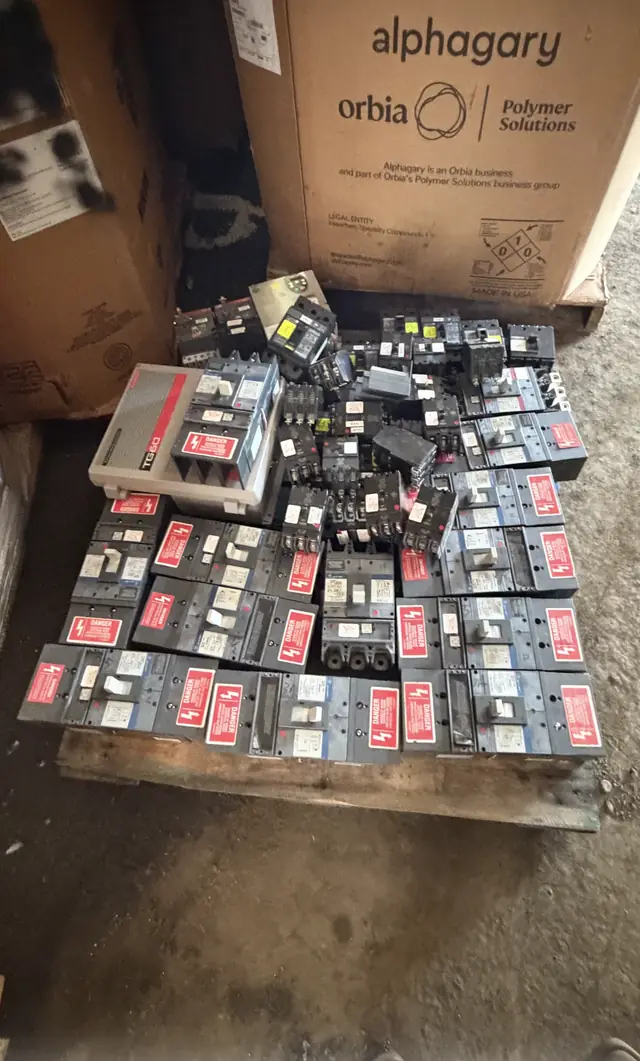
Circuit Breaker Buyer reviews qualifying surplus distribution and control equipment, including switchgear, switchboards, panelboards, transformers, breakers, transfer switches, busway, motor controls, and related components. Large equipment requires an inventory and logistics facts before a commercial decision.
Sections, devices, covers, hardware, documentation, and accessories affect whether a project is usable.
Storage, exposure, damage, alteration, missing parts, and legitimate records change the review.
Access, loading, dock, liftgate, forklift, crane, rigging, and schedule facts can determine feasibility.
Configuration, age, ratings, included devices, and current demand influence commercial interest.
Circuit Breaker Buyer reviews qualifying surplus distribution and control equipment nationwide when the equipment and logistics can be documented safely.
No removal is promised by the website. Installed equipment requires qualified electrical planning and project-specific written responsibility.
List each section or model group, ratings, installed devices, condition, dimensions, weight, location, access, and matching photographs.
Electrical surplus can include panelboards, load centers, switchboards, switchgear, transformers, motor control equipment, busway, bus plugs, safety switches, transfer switches, starters, contactors, drives, fuses, trip units, and related components. A category appearing on this website is not a promise that every model or condition will be accepted.
A spreadsheet is usually more helpful than a gallery of unlabeled photos. Group identical items only when the manufacturer, catalog number, revision, condition, included components, and location match. Include quantities, ratings, package status, dimensions and weights for larger equipment, and notes about missing or altered parts.
Photographs should support the inventory list. They should not replace catalog numbers, condition disclosures, or safe access rules.
For switchboards, switchgear, transformers, motor control centers, and complete lineups, state whether the equipment is energized, installed, disconnected, removed, indoors, outdoors, at dock level, or in a restricted-access area. Describe forklifts, cranes, loading docks, liftgates, stairs, door openings, security requirements, and site rules only when known.
No removal or pickup claim is made until qualified personnel, scope, insurance, responsibilities, schedule, and written transaction terms are established.
A buyer review is not a universal disposal service. Recalled products, suspected counterfeits, unknown liquids, leaking transformers, batteries, contaminated equipment, fire or flood damage, and items without clear ownership may require separate compliance, environmental, or safety handling.
Disclose those facts at the beginning. Do not package or ship regulated or hazardous materials based on generic website instructions.
A folder containing fifty unlabeled images asks a reviewer to reconstruct the lot. A better package uses one row per exact model and condition group, a unique item number, a matching photo filename, and assembly-level notes. Large gear should include section numbers, devices, ratings, dimensions, weights, installed status, and site constraints. Loose components should be separated from the host assembly when their identity and condition differ.
If records such as bills of material, one-lines, test reports, removal photographs, or purchase documents legitimately exist, identify them accurately. Do not alter dates, crop out unfavorable information, or describe undocumented work as certified testing.
Some equipment may fit resale review, some may be useful only for approved parts, and some may require recycling, hazardous-material handling, manufacturer recall remedies, evidence preservation, or another lawful disposition. We do not treat all electrical material as interchangeable scrap or inventory.
List suspected recalls, missing identification, fire or water damage, leaking fluids, or unknown ownership separately at the start. Such material may require a qualified safety, manufacturer, or environmental review before any buyer discussion or movement.
Clear, unambiguous identification is the single most useful item a reviewer can receive. High-resolution images of nameplates and serial-labels allow verification of manufacturer part numbers, frame sizes, interrupting ratings, basic insulation levels, and date codes without assumption. Where trip units, relays, or firmware-controlled devices are present, visible revision stickers or printed module labels often contain the version or calibration information reviewers use to separate likely reuse candidates from units better suited for parts. When a component’s identification has been altered, obscured, or removed, note that condition explicitly rather than leaving the reviewer to infer it from unrelated photos.
Supplement photographic evidence with any available documentary traces that match the labels — original purchase invoices, shipping manifests, manufacturer packing lists, or commissioning records. If a device includes a field-applied tag (for example, a service sticker, calibration tag, or repair label), include a photo of that tag and a short caption describing its provenance and date. Missing or inconsistent nameplate information is a common reason an item requires extra scrutiny; documenting what is known and what is unknown speeds a preliminary review and clarifies which qualification paths remain possible for a given lot.
Packaging state and shipment particulars materially influence how reviewers approach a submission. Indicate whether items are still in original crates, shrink-wrapped on pallets, loose in bulk bins, or assembled in sections. Provide crate or pallet dimensions and gross weights when known, and note any special packing features such as internal bracing, original manufacturer crates, or custom skids. Photographs showing all sides of crated or palletized units (including bottom corners where marking and skid conditions appear) reduce uncertainty in a logistics assessment and help establish whether an item is most likely to move as a parcel, LTL, or project freight candidate.
Report any observable indicators that could affect handling decisions without asserting removal or transport capability. Examples include whether covers, terminal shields, or control enclosures are present and intact, whether nameplates on external panels are legible, and whether there is visible external corrosion, denting, or missing fasteners. If hazardous-material labeling, oil-filled transformer tags, or sealed battery enclosures are present, mention them as an attribute for review rather than an instruction for handling. Clear shipping and packing descriptions allow a faster, more accurate review of potential routes and constraints for a qualifying lot.
A concise service history and configuration snapshot often changes how surplus units are categorized. Records that show last-known use, firmware or relay versions, recorded fault events, and parts replacements help reviewers decide whether an item should be considered for reuse, overhaul, or parts recovery. Where protective relays, intelligent trip devices, or programmable controllers are included, a list of firmware or setting versions and whether original configuration backups exist is particularly informative. Note that providing these records does not guarantee acceptance; it simply gives the reviewer a clearer factual basis for a conditional evaluation.
When available, attach or reference maintenance logs, functional-test entries, calibration certificates, and any spare-component lists that accompanied the host equipment at decommissioning. A modest accessories package — spare breakers, auxiliary contact blocks, control transformers, or matched fuses — should be listed and photographed separately from the main units. These supporting documents and spare inventories can shift a reviewer’s assessment from ‘parts candidate’ to ‘potentially reusable unit’ for qualifying equipment, but will be considered only as part of the overall submission package.
Choose the page that best matches the manufacturer, breaker family, equipment type, or question on the label.
Tell us what the equipment is, how much you have, its condition, where it is, and whether it has already been safely removed.