Equipment we review
- GE THQL/Q-Line and related documented branch families
- GE Spectra, Power Break, WavePro, EntelliGuard, and AKR equipment
- ABB Tmax and FORMULA molded-case breakers
- ABB Emax air breakers, cradles, trip units, and accessories
We review qualifying GE- and ABB-marked breakers for potential acquisition. Common examples include original THQL, Tmax, Emax, and Power Break models. Submissions are reviewed case-by-case and are not automatic purchases.
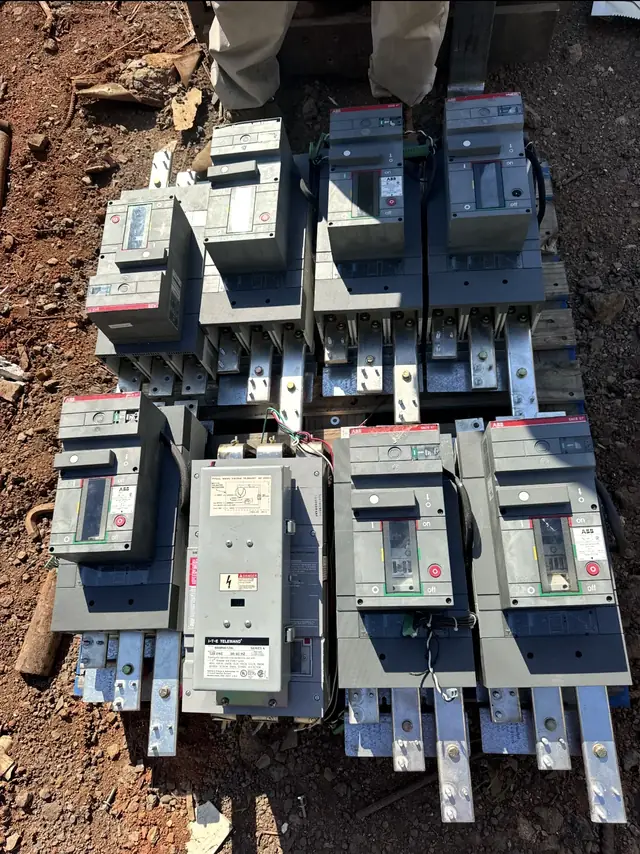
We review qualifying GE- and ABB-marked circuit breakers, including documented Q-Line or THQL branch families, Spectra and Power Break equipment, EntelliGuard and AKR power breakers, and ABB Tmax, FORMULA, and Emax families. The original manufacturer, series, ratings, and accessories must be documented separately.
GE and ABB markings may reflect different product generations; document what the item actually shows.
THQL, Spectra, Power Break, AKR, Tmax, and Emax require different fields and components.
Power and air breaker reviews may depend on the cradle, trip unit, rating plug, and accessories.
Identity, quantity, packaging, records, visible condition, logistics, and current demand affect fit.
Circuit Breaker Buyer reviews qualifying GE and ABB breaker families nationwide. Send the complete labels, ratings, quantity, condition, and photos for review.
Qualifying units may be reviewed. Include breaker and cradle identifiers, trip-unit and rating-plug details, accessories, completeness, and logistics.
No such conclusion should be drawn from this seller page. Compatibility and authorized application require current equipment-specific documentation and qualified review.
Stop and seek a qualified electrical professional if you find charred insulation, burn odors, exposed conductors, or other warning signs. Follow manufacturer instructions and the authority having jurisdiction for removal and transport. A website submission is not a safety inspection or purchase commitment.
We review qualifying GE and ABB circuit breakers and related switchgear components for possible acquisition. This page explains what we commonly look for, how to identify items, and how to prepare a clear submission. Submissions are evaluated case-by-case and may result in a purchase if the items meet our evaluation criteria and are confirmed through review.
This is not a list of items we automatically buy. Common examples we consider—original THQL, Tmax, Emax, and Power Break models—often align with our initial review, but a model name alone does not guarantee purchase. Sending details starts a review; a submission is not a purchase order, agreement, or authorization.
To avoid ambiguity we list common examples within the scope of what we routinely consider. These examples are original, seller-marked devices such as THQL miniature breakers, ABB Tmax frames and associated modules, ABB Emax low-voltage power circuit breakers, and Power Break units where the model plate is present. Mentioning these lines helps sellers identify familiar labels that often satisfy our initial screening for review.
Do not assume all items from these lines are accepted: units must match identification fields, be free of irreparable damage, and align with the condition and documentation guidelines on this page. We also consider related accessories and factory-marked replacement parts when they are clearly identified and documented by the seller. Submissions are accepted for review only; any purchase is conditional on verification.
Clear identification is the single most helpful thing you can provide. For every breaker include the maker-marking (as shown on the case), the full model or catalog number, the ampere rating, frame size, interrupting rating (kAIC if visible), and any trip unit or electronic module model numbers. If a serial number, date code, or factory label is present, photograph and list it. For multi-part assemblies, identify both the frame and any installed trip device so the relationship is clear.
If you cannot locate certain markings, describe what is legible and where it appears (for example, left side of frame or underside of handle). Use plain, specific descriptions rather than broad brand claims. Accurate identification reduces follow-up questions and speeds review. We consider seller-marked equipment only, and no compatibility or manufacturer authorization is inferred from photos or descriptions.
Describe condition honestly using straightforward categories: new surplus (uninstalled, unopened), new surplus (carton missing), used-good (functioned, normal wear), used-poor (visible damage but possibly recoverable components), and scrap (no usable parts). Note corrosion, melted insulation, broken handles, missing nameplates, bent mounting ears, or signs of modification. Items listed as modified, reworked, or with missing components should be disclosed upfront to avoid delays.
We do not perform on-site safety inspections or energized testing as part of a submission review. Do not submit items that show obvious internal arcing damage, extensive rust-through, or missing critical structural parts. Stating visible defects and including close-up photos helps determine whether an item should proceed to further verification.
Good photos reduce back-and-forth. For each unit include a clear photo of the product label, a front view showing the handle and frame, a side view showing mounting features, and close-ups of any damage or trip unit modules. If you have boxes or original accessories, photograph those labels. For lots, include an overall pallet shot, then a set of representative unit photos and detail shots of any outliers so that variations are visible.
Organize lots with simple numbering and a matching spreadsheet or CSV for quick cross-reference. For example, label items 1–25 and provide a line for each with model, ampere rating, serial number (if present), condition, and photo filenames or links. Well-organized lots shorten review time and make it easier to evaluate whether an acquisition makes commercial sense.
Our decisions consider condition, demand in secondary markets, parts recoverability, and lot size. Small lots of mixed models often require additional review; large, uniform lots are typically easier to evaluate. We also assess whether accessories and trip modules are present and correctly matched to frames. This commercial-fit review supports a conditional purchase determination.
Any purchase determination is conditional. After an initial review, we may request additional information or verification. A formal purchase is only made after terms are explicitly agreed. Submitting equipment starts the process but does not guarantee a purchase or authorize shipping.
To submit, prepare clear photos and a numbered inventory list as described above and upload them through our submission form or attach them to an inquiry. Include any available paperwork such as invoices, packing slips, or factory documentation that confirms model numbers. Provide contact details and location so we can ask targeted follow-ups if needed. Expect questions focused on missing or unclear identification and condition details.
If we determine items appear to fit the criteria described, we will request any additional verification steps. Any acquisition will be documented in a written agreement before any transfer of ownership. If you notice charred insulation, unusual odors, loose or exposed conductors, or other warning signs while handling equipment, stop and consult a qualified electrical professional. Follow current manufacturer instructions and local authority requirements for removal and transport.
Gather clear photos, a numbered inventory list, and any documentation. Use our submission form to start a purchase review. Submitting is a request for evaluation only; acquisitions are conditional.