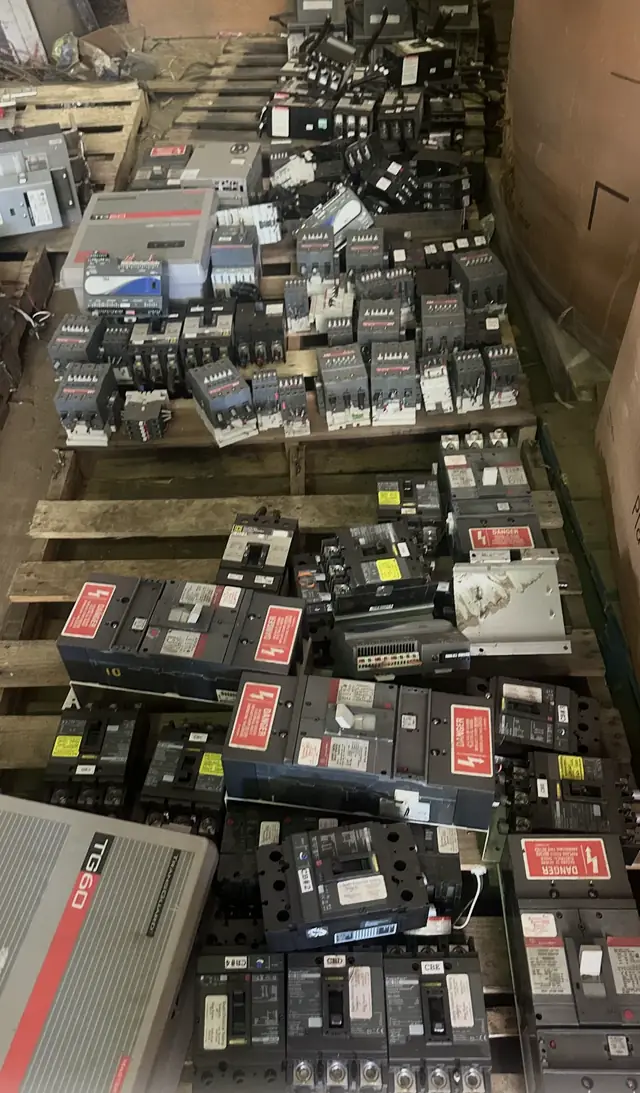
Stop and consult an appropriately qualified electrical professional if equipment shows burn damage, corrosion, missing insulation, or suspect modifications. Follow the current manufacturer instructions and the authority having jurisdiction. This submission process is not a safety inspection, installation advice, or authorization to energize equipment.
How we review qualifying I-Line breakers and panelboard parts
We review qualifying Square D I‑Line circuit breakers and I‑Line panelboard parts for potential purchase. You may submit items that you believe match I‑Line series characteristics and that fall within our current review scope; every submission is evaluated and may or may not be accepted. This page explains the identification details, photographic evidence, and organization steps that help accelerate a purchase review.
This site is not affiliated with the original manufacturer and does not imply manufacturer authorization. Submitting equipment is a request for purchase review only; it is not a binding offer, acceptance, or safety inspection. Square D and Schneider Electric names are used strictly for identification of compatible series and labeling conventions.
- We review qualifying items for purchase — not every submission will be purchased.
- Original I-Line breaker and panel labels are required for identification.
- Provide honest condition notes and clear photos to avoid delays.
Exact identification fields to copy from labels
Legible original labels are the single most important item for quick review. When you prepare a submission, copy the nameplate and breaker label text exactly as it appears. Key fields include catalog number, frame size, ampere rating, interrupting rating (kA) where shown, trip type (thermal‑magnetic or electronic), trip unit model if listed, series or type code, date or manufacturing code, and any UL/CSA file references printed on the device or panel nameplate. If multiple labels exist, capture each one in full.
For panelboard parts, include the panelboard model number, bus rating, main‑lug or main‑breaker notation, enclosure type, and any stamped catalog pages or factory part numbers. If a breaker or accessory has a stamped or aftermarket tag, include that wording as well. If any label text is missing or partially legible, note which characters are unreadable and provide close‑up photos from multiple angles and lighting to document the area.
- Breaker catalog number and amp rating
- Frame size and interrupting rating (kA) if present
- Trip unit model or type code and date/manufacturing code
- Panelboard model, bus rating, and enclosure markings
Describe condition honestly — use clear condition language
Use straightforward condition descriptions. We rely on the seller’s condition language and photos to determine whether an item fits our review scope. Helpful descriptors include unused in original packaging, new‑old‑stock (NOS), lightly used with normal wear, serviceable with repairs, parts‑only, and damaged. Avoid vague terms such as like‑new without supporting photos; pair your description with images that confirm the claim and show edges, terminals, lugs, and any wear points.
If a breaker was removed from service, indicate whether it was de‑energized during removal and whether any maintenance or testing occurred afterward, if known. Do not provide energized testing instructions or offer installation advice. If the item is missing components such as handle ties, cover segments, mounting hardware, or terminal screws, list those parts explicitly in your condition note so we can understand what is included.
- New in original packaging
- New-old-stock (NOS)
- Lightly used — cosmetic wear only
- Serviceable — may need testing or calibration
- Parts-only or damaged — specify defects
Photos and documentation that speed evaluation
Clear photos that show label detail, serial or barcode information, and mounting features significantly speed our review. Provide a well‑lit close‑up of the manufacturer label for every distinct part number, a full‑face photo of the breaker or part, and an image showing mounting tabs or bus stabs. For panelboard parts, include the enclosure front, interior bus area, and nameplate. Multiple angles and a ruler or common object for scale are helpful when size or spacing is not obvious.
If you have original packing slips, manufacturer cut sheets, or factory labels from a panelboard subassembly, attach them. Do not send physical documentation until requested; upload digital files in the submission form. Avoid editing, retouching, or obscuring label text in photos — unaltered images are necessary to confirm identification and build an accurate line item list.
- Close-up of original manufacturer label
- Full assembly face and mounting features
- Interior bus area and panel nameplate for panel parts
- Multiple angles and scale reference
- Supporting factory documents or packing slips (digital)
How to organize lots and package submissions
Group items by exact catalog number and amp/frame size to create clear lots. Mixed lots slow the review; if you have many similar breakers, make separate lots for each catalog number and provide a count for each lot. When parts are too small to submit individually, place identical items in marked bags or bins and label each container with part number and quantity. Clearly mark lots that are missing accessories or that contain non‑functional units so expectations are accurate.
When describing large inventories, include representative photos for each lot and an itemized list showing counts and label text. If breakers were reclaimed from a panel, note whether they were removed in a single batch or over time and whether any breakers were modified. Proper lot organization supports a more efficient evaluation and reduces follow‑up questions during the review.
- Create one lot per catalog number and frame/amp rating
- Label bags or bins with part number and count
- Provide representative photos and an itemized list
- Flag mixed or missing-component lots clearly
What falls inside our review scope and commercial limits
Our review scope focuses on items commonly associated with I‑Line panelboard systems. Typical submissions include I‑Line plug‑on molded‑case breakers, mechanical accessories made for I‑Line panels, I‑Line panelboard sections and interiors, bus assemblies, and related mounting or enclosure hardware that retains original labeling. We may also review breakers removed from service if the original labels and condition permit clear identification. This list is not exhaustive, and items outside this focus may be declined.
Items lacking original labels, showing extensive undocumented modification, or subject to active safety or regulatory concerns may be excluded from consideration. Inclusion in our review process does not indicate endorsement, compatibility, or installation suitability. Each item is evaluated for identification clarity, condition, and commercial fit. Final outcomes depend on the materials provided and the results of the review.
- Commonly reviewed: I-Line plug-on breakers, panelboard parts, and labeled subassemblies
- We require original labels for positive identification
- Modifications and missing labels may disqualify an item
- All items undergo condition and market-fit evaluation
How to submit and what to expect from our engagement process
Begin by completing the submission form on our site with the exact label text, condition description, lot organization details, and photos. Submitting items is a request for purchase review; after we receive your materials we generally confirm receipt and may request additional photos or documentation to complete identification. Our response may invite next steps, request a closer look at specific items, or decline, and is not a purchase order until formalized in writing.
When you submit, include contact details and your location for logistical planning; do not assume pickup or shipping will be arranged. Keep original labels intact and preserve items in the state described. If more information is needed, we will ask for it; otherwise, expect a concise reply indicating the outcome of the review and any further actions if appropriate.
- Complete the online submission with exact label text and photos
- Attach representative lot photos and an itemized list
- Receipt is typically confirmed; more details may be requested
- A purchase is not final until a written agreement is issued