Stop and seek help when you see signs of overheating, smoke damage, exposed conductors, or damaged insulation. Follow current manufacturer removal and handling instructions and use appropriately qualified electrical professionals and the authority having jurisdiction for any energized work or removal. A web submission is not a safety inspection or approval.
What we mean by generator circuit breakers and why the distinction matters
When we say generator circuit breakers we are describing a breaker intended, rated, or labeled for generator-duty applications — not one single proprietary technology. Generator-duty can appear across molded-case, low-voltage power breakers, and generator switchgear breakers. The review considers qualifying items that show clear generator-duty markings, documented voltage/frequency ratings, and intact original nameplates.
This distinction matters because generator-duty is an application classification: it indicates a breaker was designed for or configured to handle generator-related electrical conditions. For a purchase review, the emphasis is on explicit evidence on the unit (nameplate text, G-rating or equivalent notation, manufacturer generator-duty option codes, and nameplate-listed voltage/frequency ranges) rather than assuming generator suitability from appearance alone.
- Generator-duty may be marked as G, G-Frame, Gen, or with model option codes — check the nameplate.
- Common form factors include molded-case, draw-out power breakers, and switchgear-mounted generator breakers.
- Items showing nameplate-listed voltage ranges commonly used with generators are more likely to be considered.
Exact identification fields to include with a submission
To start a purchase review, provide the exact fields that appear on the manufacturer nameplate or label. Nameplate data is primary evidence for technology and voltage ratings: manufacturer, full model or catalog number, serial number, frame size, interrupting rating (kAIC), rated voltage, rated frequency, number of poles, and any generator or G-duty option codes.
If a nameplate or label is missing or illegible, the unit’s commercial interest drops because rated performance or original configuration cannot be confirmed. Include date codes, revision codes, and any factory option tags visible on the breaker or its carriage. These fields are used to match acceptable voltage/technology combinations before any physical inspection is considered.
- Manufacturer and full catalog/model number (exact characters).
- Serial number and date code (visible on nameplate).
- Rated voltage and frequency, interrupting rating (kAIC), and rated continuous current (A).
- Generator-duty marking or option code (G, Gen, G-Frame, or builder option).
- Number of poles and frame size designation.
Honest condition language and what we accept or flag
Use clear, non-euphemistic condition terms: new-old-stock, unused surplus, lightly used, repaired, mechanically incomplete, or visibly damaged. For example, describe whether the breaker has been removed from service, whether it operated as part of a generator set, and whether it has been tested or reconditioned by a recognized shop. These descriptions, combined with photos and documentation, help determine whether to request further details or proceed to an on-site evaluation.
Certain visible defects usually disqualify a unit from positive review or lower its commercial likelihood. These include severe heat or arc discoloration on the nameplate or contact areas, missing or altered nameplates, melted or cracked insulators, or evidence of modification to trip assemblies. Items described as functional but lacking nameplate evidence will be considered conditionally until physical inspection verifies ratings.
- Preferred: original nameplate intact, minimal surface wear, intact handles and trip assemblies.
- Condition flags: missing/altered nameplate, heat/arc discoloration, cracked insulation, broken carriage.
- Describe any recent maintenance, factory rebuilds, or shop test reports and include supporting documentation.
Photos that speed a technical review
High-resolution photos are among the fastest ways to get a preliminary determination. Take steady, well-lit images of the nameplate close-up, the full front of the breaker, the handle/operating mechanism, and any factory option plates. If the breaker is draw-out, show the carriage and connector interface; if it is part of a transfer assembly, show adjacent hardware that indicates rated configuration.
Photos should be annotated with the breaker’s catalog/model number and serial to avoid mismatches during lot handling. Do not send photos of energized equipment. Where internal components are exposed because the unit is open for maintenance, include an interior photo that shows contact surfaces and trip assemblies; that internal imagery helps reviewers assess visible wear without requesting an immediate site inspection.
- Nameplate close-up (legible, at least one clear photo).
- Full-unit front and side views showing physical condition and mounting style.
- Handle/operating mechanism close-up and a photo of any accessory or trip units.
- Carriage/draw-out interface if applicable and interior contact/trip photos when accessible.
How to organize lots and label inventory
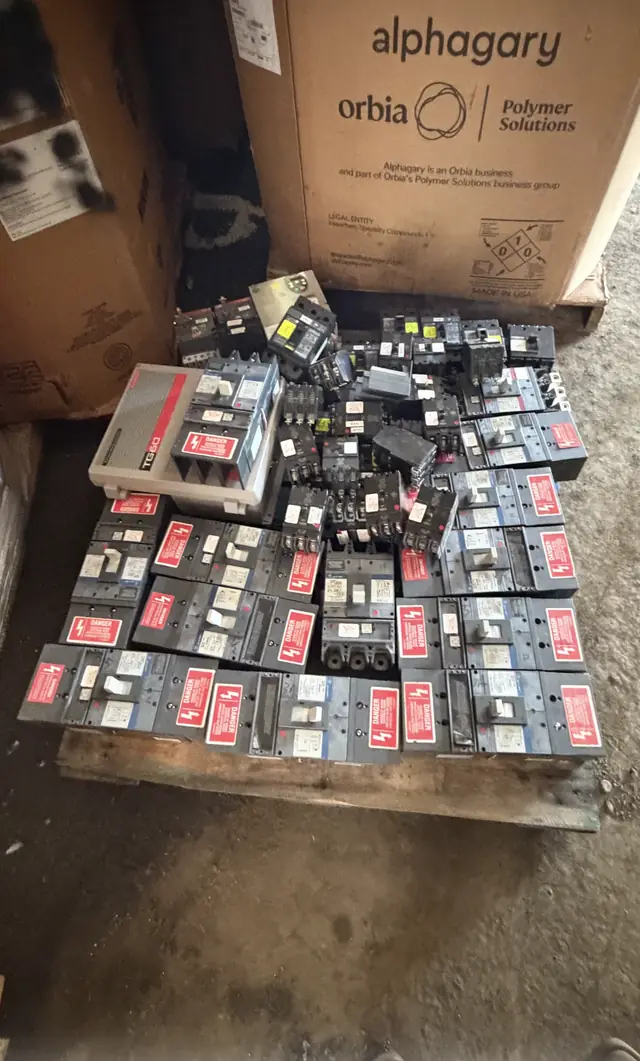
Group breakers by manufacturer, frame size, and rated voltage. Mixing unmatched frame sizes or voltages in a single lot slows review and can reduce potential value. Keep units with identical part numbers and condition notes together and create a simple manifest that lists each serial number and nameplate rating. A clear manifest speeds verification and reduces follow-up questions during review.
For large quantities, palletize same-type units and attach a manifest visible in the lot photos. Use basic separation for different rated voltages (e.g., 120/240V, 480V, 600V) and for units explicitly marked for generator-duty versus those without such markings. Include one representative nameplate photo per unit on the manifest to document identity during remote review.
- Make lots homogeneous by manufacturer, frame size, and rated voltage.
- Create a manifest with serials, model numbers, and condition notes for each unit.
- Palletize same-type units and include representative nameplate photos.
Commercial fit: documented voltages, technologies, and valuation signals
Purchase reviews focus on units that show documented voltages and recognizable generator-duty designations. Examples of common voltage ranges that attract review include popular generator voltages such as 120/240 V single- and three-phase, 277/480 V three-phase, and 600 V classes when supported by nameplate evidence. Presence of a generator-duty designation or factory generator option code typically increases technical interest because it signals intended application.
Valuation is driven by traceable nameplate data, available test reports, manufacturer rebuild history, and the commercial demand for that specific breaker model. Breakers with original factory test reports, documented maintenance records, or recent shop calibrations may be reviewed more quickly. A submission initiates a purchase review; it is not a purchase agreement or payment authorization.
- Commonly reviewed voltage examples: 120/240 V, 277/480 V, and 600 V where nameplates support those ratings.
- Generator option codes and original factory test reports increase appeal for review.
- Documentation such as maintenance logs and factory rebuild records helps valuation.
Next step: how to submit a breaker for purchase review
To begin the purchase review, send the manifest, clear photos, and nameplate fields through the submission form or contact channel. Include the breaker’s condition description and any supporting documentation such as factory test reports or maintenance records. Submitting these items starts a technical review and may prompt a request for additional detail or a site inspection.
A web submission is not an appraisal, offer, acceptance, inspection, or a pickup or shipping authorization. After review, you may be asked to provide physical inspection access, functional testing by a qualified shop, or further photos before any commercial terms are discussed. Qualifying items are reviewed for potential purchase; not every submission results in an offer.
- Include a manifest with serials, model/cat numbers, and condition notes.
- Attach high-resolution nameplate photos and representative unit images.
- List any available test reports, maintenance records, or factory rebuild receipts.