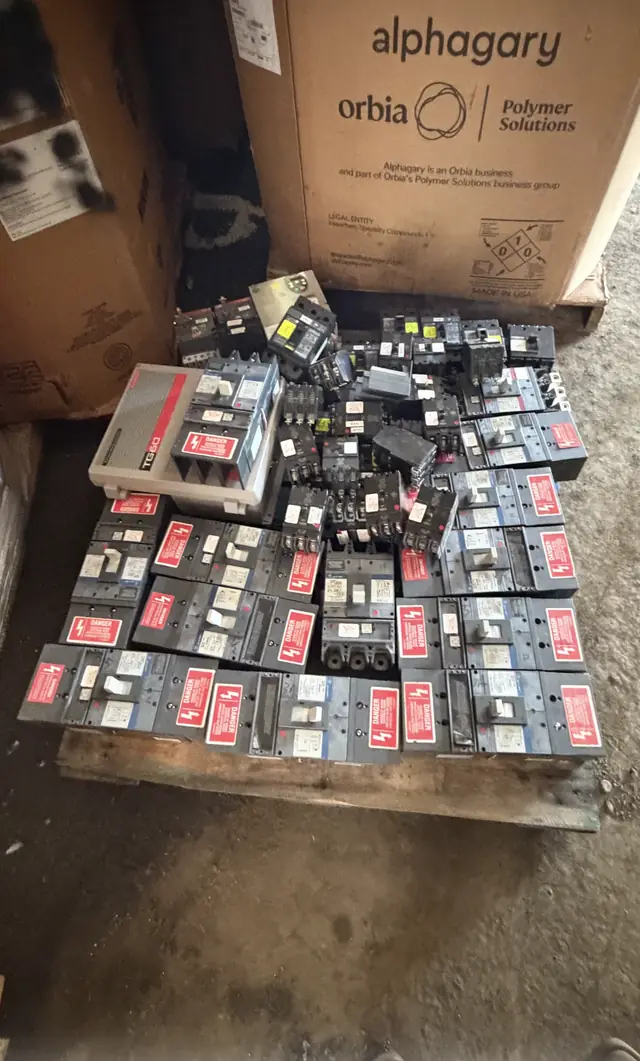
Stop and seek a qualified electrical professional if you find burn marks, melted parts, exposed conductors, or other signs of electrical damage. Do not perform energized testing unless you are appropriately trained. Follow the manufacturer’s current instructions and the authority having jurisdiction for safe removal and handling.
What we review and the review process
We review qualifying miniature and branch circuit breakers, including residential single-pole MCBs and multi-pole branch breakers, for purchase consideration. Submissions that include clear identification, accurate condition notes, and useful photos are evaluated for potential purchase. A submission is not an appraisal, offer, acceptance, safety inspection, compatibility determination, purchase order, pickup commitment, or shipping authorization.
During initial intake we look for complete identification, consistent lot organization, and obvious physical condition. If a submission appears to meet current review thresholds and documentation standards, we may request clarifying information. Because acceptance is conditional, provide as much accurate detail as possible to support a timely evaluation.
- We accept used, surplus, and obsolete MCBs for review — not every item will be purchased.
- Submissions are reviewed for identification and condition before any transaction decision.
- Providing complete documentation can shorten review time.
Exact identification fields to include
Successful submissions include the breaker’s maker marking (if present on the part), the full catalog or model number as shown on the breaker, ampere rating, trip curve or type (for example thermal-magnetic vs electronic), pole count (single-pole, double-pole, 3-pole), voltage rating, and any date or lot codes molded or stamped into the case. For bolt-on or plug-on styles, show the tab or base area where part numbers and mounting style are printed. If a separate trip unit or handle mechanism has a serial or model number, document that too.
Document AFCI/GFCI/dual-function and tandem information as separate fields (see next section). If breakers have OEM or installer-added markings, note them but prioritize original factory markings. Include the exact wording you see instead of paraphrasing; when numbers are faint, provide close-up photos at multiple angles.
- Required ID fields: catalog/model number, amp rating, trip type, pole count, voltage rating, mounting style (plug-on or bolt-on), date/lot code.
- Note any additional trip unit or accessory model numbers attached to the breaker.
- Record any non-factory markings and whether the original factory label is intact.
AFCI, GFCI, dual-function, and tandem units — how to document them
Mark AFCI, GFCI, and dual-function breakers clearly in your submission. These units have different functions and are often tracked separately. In your descriptions include whether the unit is marked AFCI, GFCI, or both (dual-function), and photograph the area where that function is indicated. Do not perform energized testing; instead report any known test history and whether the breaker has a manual test button.
Tandem (or “skinny”) breakers occupy a single slot but provide two separate circuits — treat them as a distinct family. For tandems, indicate which slots or handle ties are present, whether the breaker is labeled for use as a legal replacement in certain positions, and provide clear photos showing both pole faces and the mounting foot. Photograph the mounting features and contact areas clearly without connecting to any panel or bus.
- Label AFCI/GFCI/dual-function explicitly and include photos of test-button and marking locations.
- For tandem breakers, show front and underside to document contacts and part numbering for each sub-pole.
- Do not imply compatibility with any specific panel in your submission.
Honest condition language and safety limits
Use straightforward condition terms: New (unused, factory-sealed), New surplus (unused but removed from original packaging), Like-new (minimal wear), Used serviceable (shows wear but no obvious damage), Damaged (cracked housing, missing parts, visible corrosion), and Salvage (missing essential components or visibly unsafe). Describe whether mechanical parts move freely, whether the handle and trip mechanism appear intact, and whether the original factory label remains legible.
Safety-first: stop and seek professional help if you see burn marks, melted insulation, pitting on contact faces, or a breaker with a previously melted trip or repair. No installation or energized-testing guidance is provided here. Follow the current manufacturer instructions and the authority having jurisdiction for safe removal and handling.
- Preferred condition for fast review: intact factory label, no visible thermal damage, functional handle movement.
- Clearly mark units that are used in hazardous environments or that show signs of overheating.
- If available, include any factory test records but do not submit them as proof of safety or compatibility.
Family distinctions and commercial fit
Different breaker families are evaluated on distinct commercial criteria. Thermal-magnetic residential branch breakers, electronic trip commercial breakers, bolt-on industrial branch breakers, and tandem/skinny families each attract different demand. When you list a lot, identify the family grouping clearly and provide counts by family. Grouping by catalog/model number and trip type improves the speed and accuracy of evaluation.
Commercial fit depends on uniformity and quantity. Mixed lots are harder to evaluate quickly. If you have common residential single-pole breakers in large quantities, present them as uniform lots. Specialty or obsolete families typically qualify with smaller minimums but need clearer identification and condition notes. These distinctions help determine whether a submission should progress to the next stage of review.
- Group and count by family: thermal-magnetic, electronic trip, tandem, bolt-on, plug-on.
- Uniform lots (same model, same condition) receive faster consideration than mixed lots.
- Specialty families may be reviewed on smaller minimums but require complete ID and clearer photos.
Photos, lot organization, and packaging
Good photos speed review. Provide clear, well-lit images of front, side, and underside (or mounting face) for each model type. Include close-ups of the catalog/model number, amp rating, trip label, date codes, and any test buttons or accessory modules. For tandems and dual functions, photograph labels for both sub-poles. Avoid reflections and blurring; if a label is faint, take multiple shots at different angles.
Organize lots logically: group identical breakers together, label each group with a short inventory sheet (model, ampere, pole count, quantity, condition), and include an overall wide shot showing how groups are staged. If possible, pack separately by family and tape a printed inventory sheet to each box. Do not ship items until any follow-up acceptance and shipping instructions are confirmed.
- Photos to include: full face, label close-up, underside/mounting face, handle position, and any damage.
- Provide an inventory sheet showing family, model, pole count, amp rating, and unit count for each lot.
- Staging photos that show lot organization and labeling reduce back-and-forth questions.
How to submit and what happens next
Submit qualifying equipment with the identification fields, photos, and lot inventory described above. Because submissions vary, typical example minimums are shown as guidance: small specialty families may be reviewed at 1–3 units, while common residential single-pole MCBs usually require 10 or more units for quick consideration. These are examples, not guarantees; final thresholds depend on family, condition, and demand. A submission initiates evaluation — not a purchase agreement.
After submission, the documentation is reviewed and additional photos or lot separation may be requested. If further information is needed, we will ask — do not ship items until instructed. Remember: a submission is not an appraisal, offer, acceptance, safety inspection, compatibility determination, purchase order, pickup commitment, or shipping authorization.
- Include full ID, clear photos, and a lot inventory with your submission.
- Expect a follow-up request for clarification rather than an immediate purchase decision.
- Do not ship equipment until you receive explicit shipping instructions following acceptance.