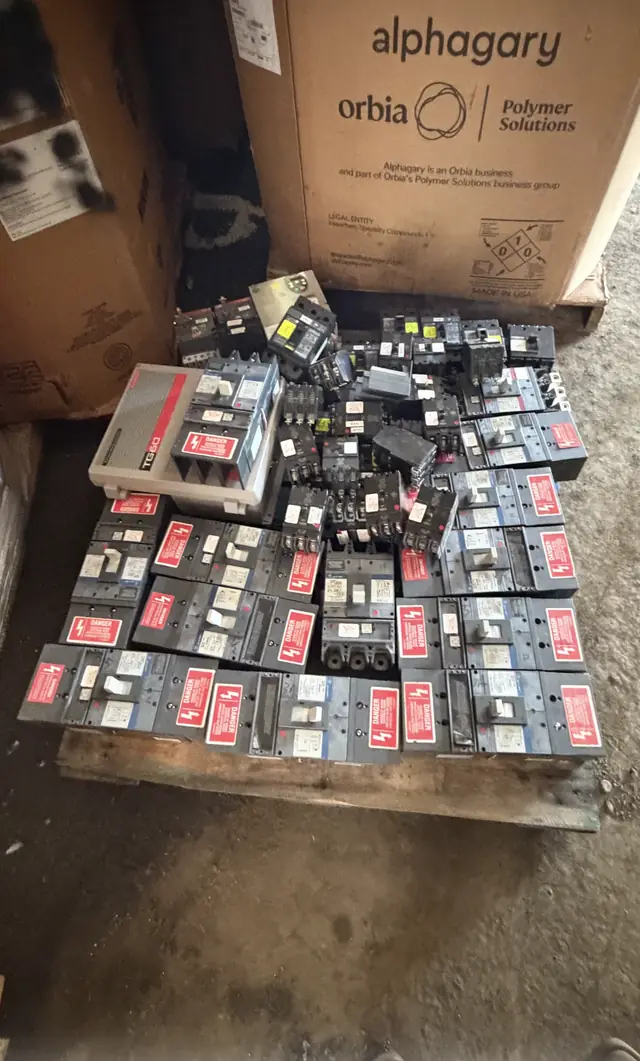
Stop handling breakers that show overheating, melted insulation, exposed live parts, or impact damage. Follow current manufacturer instructions and use appropriately qualified electrical professionals and your authority having jurisdiction for removal, testing, and installation decisions.
Who we review and why this matters
We review qualifying legacy Westinghouse and Bryant circuit breakers for purchase consideration. These models are part of Eaton’s historical product lineage but not every legacy breaker is eligible. Our interest focuses on identifiable breakers with original markings, clear condition, and the documentation that supports safe reuse or resale in commercial markets.
If you searched to sell Westinghouse breakers, find Bryant breaker buyers, or move obsolete Eaton lineage breakers, start by assembling clear evidence. The combination of original labels, exact Eaton replacement records, and accurate condition descriptions materially affects whether an item is commercially reviewable. Submissions that lack identifying information or show irreparable damage are less likely to be accepted for purchase review.
- We review, not automatically accept, legacy Westinghouse and Bryant breakers
- Original labels and Eaton replacement records are high-value evidence
- We cannot determine installation suitability — that requires a qualified professional
Exact identification fields we need
Precise identification starts with original nameplates and label data. For each breaker, capture the manufacturer marking (Westinghouse or Bryant), catalog or model number, frame size, trip unit type (thermal-magnetic, electronic, etc.), ampere rating, interrupting (AIC) rating, and date or lot codes if present. Serial numbers and factory build codes help us verify lineage and assess market demand.
Where available, include Eaton replacement records or cross-reference documents showing Eaton’s lineup equivalences. Exact Eaton replacement records are especially useful for breakers that were rebranded or carried forward under Eaton portfolios. While replacement records do not imply a manufacturer endorsement by us, they improve our ability to evaluate commercial fit for obsolete Eaton-lineage breakers.
- Nameplate/catalog number — required where available
- Frame size and trip unit details — critical for matching
- Amp rating and interrupting capacity (AIC) — necessary for valuation
- Serial/build codes and manufacturing date stamps — help establish age
- Eaton replacement/cross-reference records — strongly preferred
Honest, useful condition language
Describe condition using specific, objective terms. Useful condition categories include New Old Stock (NOS) in original packaging, unused surplus with installation marks, used but serviceable, serviceable after maintenance, and damaged or scrap. Avoid vague adjectives — state what is worn, corroded, altered, or missing: for example, ‘trip handle intact, paint blistering on enclosure, pitted terminal lugs.’
We may review items in all of the above categories, but condition affects our interest and price. Breakers with missing nameplates, altered trip units, evidence of overheating, impact damage, or exposed internal parts are often excluded from purchase review. Be clear about any known history such as being removed after a fault, stored in a damp environment, or previously retrofitted with non-original parts.
- Use precise phrases: New Old Stock, unused surplus, used-serviceable, service-needed, damaged/scrap
- Note any signs of overheating, corrosion, impact, or missing parts
- Disclose previous repairs, modifications, or non-original components
Photos and documentation that speed review
Photographs are the primary evidence we use to triage submissions. For each breaker include clear, well-lit photos of the nameplate, the front and rear of the breaker, trip unit close-up, terminal connections, and any damage. A scale reference such as a ruler or a small card helps confirm size and terminal spacing. For multi-breaker lots, provide representative photos plus one image showing the whole lot.
Documentation matters as much as images. Attach any Eaton replacement or cross-reference records, original manufacturer datasheets, purchase invoices, and removal reports if available. Original labels and exact Eaton replacement records allow faster, more accurate matching to current market demand and reduce follow-up questions during review.
- Nameplate close-up (clearly legible) — top priority
- Front, rear, and terminal-area photos
- Photo of trip unit and handle mechanism
- Lot overview and individual item images for multi-item submissions
- Attach any Eaton replacement or manufacturer datasheets
How to organize and list lots for commercial review
Group breakers into logical lots to reduce handling time: same model/catalog number, identical amp ratings, and matching condition. For multi-unit lots include a count, a short inventory (catalog numbers and serial ranges), and a representative photo. Clearly label each crate or pallet and provide a packing list so reviewers understand quantity, condition mix, and any missing components.
Smaller sellers benefit from simple spreadsheets listing item ID, catalog number, frame and trip data, condition category, and photo filenames. For larger decommissioning projects, separate functional units from scrap and mark units needing trip-unit refurbishment. Organized lots allow faster commercial assessment and can reveal which subsets of your material are most likely to be reviewed for purchase.
- Sort by model/catalog number, rating, and condition
- Provide a count and short inventory for each lot
- Label crates/pallets and attach a packing list
- Mark items requiring refurbishment or missing original labels
How valuation and commercial interest are determined
Commercial interest is driven by demand, rarity, and verifiable identification. Breakers that match common historic Eaton cross-references, have intact nameplates, or appear in Eaton replacement records are typically easier to place. Specialty trip units, higher interrupting ratings, and models out of modern production can attract stronger interest if condition and documentation support safe reuse.
We evaluate each submission case-by-case. Factors we consider include market demand for that model, completeness of identification data, overall condition, quantity available, and accompanying documentation such as Eaton replacement records. Quantity can improve commercial viability — single units may be reviewed but larger, well-documented lots are often of greater interest to buyers and collectors of obsolete Eaton-lineage breakers.
- Demand and rarity influence interest more than simple age
- Intact nameplates and Eaton replacement records raise review priority
- Larger, uniform lots typically attract more commercial attention
- Condition and documentation together determine final terms
Safety limits and how to submit for review
Do not attempt energized testing, installation, or field repairs for the purpose of sale. If any breaker shows burn marks, melted insulation, open contacts, or missing safety barriers, stop handling it and document its condition with photos. Always follow manufacturer instructions and consult an appropriately qualified electrical professional and the authority having jurisdiction for any removal, testing, or reuse decisions. We do not provide installation, safety inspections, or engineering determinations.
To submit, prepare your photos, documentation, and a short lot inventory and use the submission form on the parent page. A clear submission speeds review but is not a purchase order or acceptance. We will review qualifying equipment and follow up with questions or a conditional interest statement; any actual purchase requires separate confirmation. Keep originals of all documentation and label shipped items consistently with the submitted inventory.
- Stop and document any unit with signs of thermal damage or exposed conductive parts
- Do not perform energized testing for sale purposes — use qualified professionals
- Submission is a review; it is not an offer, inspection, or purchase authorization
- Include original labels and any Eaton replacement records to speed review