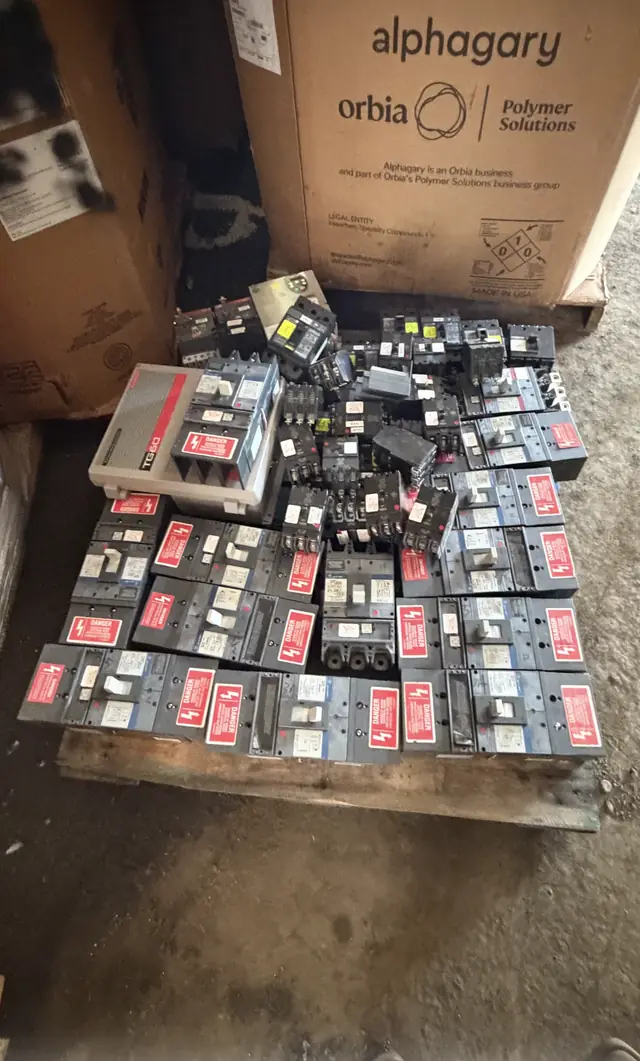
Stop and secure items that show severe corrosion, burning, missing labels, mechanical damage, or evidence of overheating. Follow the manufacturer’s current instructions and use appropriately qualified electrical professionals for removal, testing, or installation. A website submission is not an inspection, offer, or safety clearance.
We review legacy Square D FA/KA/LA/MA/NA/PA breakers for purchase review
CircuitBreakerBuyer.com reviews qualifying legacy Square D circuit breakers and frames—specifically items marked as FA, KA, LA, MA, NA and PA family breakers—for potential purchase. Submitting your equipment begins a review process; not every submission results in an offer. To accelerate evaluation, include original legacy labels on the units and any documentation you have that ties the units to legacy product literature or documented obsolescence references.
We identify equipment by the maker’s legacy markings and by the information you provide. Use the exact text and numbers from the breaker nameplate, label, or casting rather than approximations. References to Schneider obsolescence bulletins, legacy catalogs, or the accepted-family matrix you compile for your shipment can materially speed a decision because they establish the model family and documented obsolescence status. This page explains what to gather, how to describe condition, how to organize lots, and what we typically ask for during review.
- We review qualifying items for purchase review; submission is not an offer or acceptance.
- Original legacy labels and obsolescence references are especially helpful.
- Accepted families commonly reviewed include FA, KA, LA, MA, NA and PA.
Exactly how to identify a legacy Square D breaker
Accurate identification is the most important part of a submission. Record the entire label text, not just the ampere or frame size. Important fields include catalog or model numbers, frame designation (FA/KA/LA/MA/NA/PA), interrupting rating (kA), trip style (thermal-magnetic, electronic), ampere rating, serial or date codes, and any factory modification or accessory part numbers visible on the label or nearby stamping.
If a breaker has multiple labels or a stamped casting, photograph and transcribe each one. When a label is faded or partially missing, note that condition explicitly and supply any supporting paperwork you have—original purchase invoices, maintenance tags, or legacy catalogs. Where available, include references to Schneider obsolescence notices or legacy documentation that identify the family line; those references are treated as submission evidence rather than proof of universal compatibility or authorization.
- Catalog/model number and frame family (e.g., FA, KA, LA, MA, NA, PA)
- Ampere rating and trip type
- Interrupting rating (kAIC), voltage rating, and date/serial codes
- Accessory part numbers, lug sizes, and factory modifications
- Exact text from all labels and castings; photographs of each label
Describe condition honestly and consistently
Use clear, objective condition language. We commonly assess condition along lines such as new surplus (unused in original packaging), good serviceable used, cosmetically worn but functional, and damaged or missing critical components. Be specific about what is present: handles, auxiliary switches, trip units, bus connectors, and factory nameplates. Avoid ambiguous phrases—quantified descriptions and photos reduce back-and-forth and speed review.
If units were bench-tested or replaced as part of a retrofit, state that plainly and include non-proprietary test results or service records if available. Do not perform energized testing in the field to obtain a picture; follow safe removal procedures and engage qualified electrical professionals. Remember, submission of condition information and photos starts a purchase review; it does not constitute an inspection or acceptance of safety or functionality by CircuitBreakerBuyer.com.
- New surplus / unused in original packaging
- Good working order / serviceable used
- Cosmetic wear but intact labels and terminals
- Missing parts, damaged mechanisms, or compromised labels
Photos and documentation that speed review
Provide clear, well-lit photos that show the label in high resolution, the entire breaker from multiple angles, terminal and interrupting faces, and any accessories. Close-up images of serial numbers, date codes, and factory labels are often decisive. A single photo that crops or blurs the label can add days to the review while we request clarification; multiple sharp images prevent that delay.
Beyond photos, supply whatever paperwork you have that supports the family identification or obsolescence claim: original manuals, packing lists, maintenance logs, or manufacturer legacy catalogs. If you reference Schneider obsolescence sources, attach or point to the specific document or bulletin you have on hand. Those documents are treated as supporting evidence for purchase review and do not create any endorsement or warranty by CircuitBreakerBuyer.com.
- High-resolution close-up of the nameplate/label
- Full-unit views from front, side and rear
- Terminals, lug area and bus connection photos
- Photos of accessories, trip units and handle assemblies
- Attach any legacy catalogs, manuals, purchase invoices or obsolescence bulletins
How to organize and stage lots for commercial review
Group breakers into lots by family and model when possible. A lot that contains only one family and consistent condition will be reviewed faster than a mixed-lot pallet with multiple frames and unknown conditions. For each lot, provide a simple inventory sheet listing model numbers, quantity, serial/date codes and a short condition note. If you have multiple identical units, state the total and supply representative photos rather than separate photos of every single breaker unless condition varies.
Label lots physically and electronically so photos and documents match the inventory sheet. If shipping is later considered, separate fragile or incomplete items from full assemblies to avoid damage. We do not prescreen for shipping or pickup at initial review, but clear lot organization reduces inspection time and clarifies what is being offered for review.
- Group by family and model (FA, KA, LA, MA, NA, PA)
- Provide an inventory sheet: model, qty, serial/date codes, condition
- Photograph a representative unit for uniform lots and call out exceptions
- Keep incomplete or damaged units separate and clearly marked
What influences our review and potential interest
Several objective factors shape review outcomes: clear identification, presence of original legacy labels, documented obsolescence status, quantity available, and condition. Units from families commonly sought for repairs or legacy maintenance tend to move faster in the secondary market, but any submission is judged case-by-case. The presence of Schneider obsolescence references or legacy catalog pages that confirm the model family can be a helpful part of your submission evidence.
Rarity and the availability of replacements or compatible parts also affect valuation. Large, well-documented lots with consistent condition and complete labels generally receive faster consideration. Remember that our review is an evaluation process; receiving an invitation to provide additional information is normal and does not imply a purchase commitment.
- Clear original nameplates and legacy labels
- Documentation showing obsolescence or family identification
- Quantity and consistency of units in a lot
- Condition, accessories and presence of original packaging
How to submit and what to expect next
To start a purchase review, gather the photographs, inventory sheet, transcribed label fields, and any obsolescence references you can find. Submit these materials through our sell form or by the method indicated on the parent sell page. After submission we may request additional photos, clarification on condition, or supplementary documentation; submissions that include original legacy labels and Schneider obsolescence references are generally processed sooner.
Understand important limits: a website submission initiates a review and is not an appraisal, offer, acceptance, safety inspection, compatibility determination, or shipping authorization. We may make a conditional offer, decline, or request more information. Do not remove equipment from service or perform hazardous testing to prepare photos; if equipment is energized or in service, engage appropriately qualified electrical professionals before attempting removal or further examination.
- Prepare photos, inventory sheet and label transcriptions before submission
- Attach or cite any Schneider obsolescence documents if available
- Submit via the sell form on the parent page to begin review
- Expect a request for clarification rather than an immediate purchase order