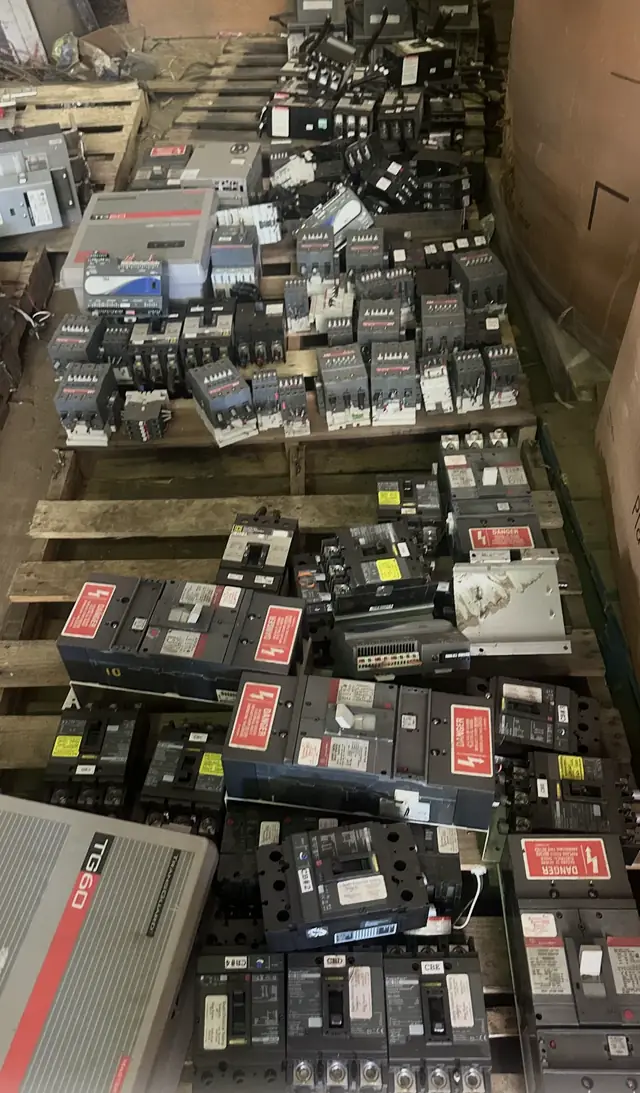
Stop and seek help if you encounter damaged enclosures, exposed live terminals, leaking components, scorch marks, or unknown residues. Follow current manufacturer instructions and have work performed only by appropriately qualified electrical professionals and the authority having jurisdiction.
What we review and how to submit
We review qualifying industrial controls and automation components for purchase consideration. Typical category examples include programmable logic controllers (PLCs), human‑machine interfaces (HMIs), variable frequency drives (VFDs), servo and stepper drives, remote I/O modules, industrial PCs, and specialty motion or safety controllers. Listing a device here does not imply we accept every make or model; each item is assessed on identification, condition, and suitability for resale or reuse.
To start a submission, provide clear identifying information and photographs described below. A website submission begins a purchase review only — it is not an appraisal, offer, acceptance, safety inspection, compatibility determination, purchase order, pickup authorization, or shipping instruction. Providing accurate asset data speeds technical review and helps protect sensitive system information.
- Submit items only if you have authority to sell them and can remove any proprietary program code or credentials before sharing photos.
- Include quantity for each identical item and whether items are sold singly or as lots.
- Expect review by our team; items containing configuration data may receive an added privacy/security check.
Exact identification fields we need
Accurate identification minimizes follow-up and misclassification. For each unit include: manufacturer-marked model/part number, serial number, firmware or software version if visible, date code or manufacture date, and any legacy or OEM re‑labeling. Photograph data plates and any labels on the enclosure to capture these details clearly.
If an item has removable modules or expansion cards, list part numbers and serials for each module. If a device has been modified, describe the modification clearly and photograph the area showing the change. Absence of identifying labels or damaged label plates should be noted; unidentifiable items require more time and may not progress to an offer.
- Model/part number (from data plate or sticker)
- Serial number and date code
- Firmware / software version (if visible)
- Photos of data plate and front face; do not open enclosures unless power is removed and a qualified person performs the work
Honest condition descriptions and useful photos
Describe condition using plain terms: new surplus (unused), open-box, tested-good (describe test type), cosmetically worn, missing accessories, or power/failure signs. When an item has been bench-tested, state the scope and describe test outputs without implying a formal safety inspection. If an item previously failed, list observed symptoms and any diagnostic error codes visible on displays.
Photographs are the most important single item in a submission. Include a clear photo of the front and rear connections, the data plate, any tool-switched DIP settings, and any physical damage. For modules, include a photo of the PCB edge connectors. Avoid sharing screenshots or photos that include program code, network addresses, or passwords; redact or crop such details before upload.
- Front, rear, and data plate photos for each unit
- Close-up of serial/part stickers and any damage
- Photos of connector pins and module edges
- If tested, a short description of test steps (e.g., powered briefly, booted to OS) — do not provide live configuration or program files
How to organize lots and an example mixed lot
Group identical or clearly compatible items into lots. A well-organized lot reduces inspection time and increases chances of a smooth review. Use one submission per lot and include a count, the common model/firmware details, and whether units are sold together or individually. Label each box or pallet with a lot number that matches your submission photos and listing.
Original mixed-lot example (anonymized): a single lot contained ten PLC CPU modules (same part number, five with visible date codes 2018–2019), twenty remote I/O modules of two different part numbers (10 of each), and three HMIs of the same model but two with cosmetic bezel damage. The submission included individual photos for one of each module type, data-plate shots for CPUs, and a manifest listing serials and locations on pallets. This example illustrates clear labeling and consistent documentation; it does not imply acceptance.
- Lot count and part breakdown (e.g., 10 x CPU-A, 20 x I/O-B)
- Photograph one representative unit per variant plus one full-pallet photo
- Match physical lot labels to your submission manifest
Category guide and evaluation hints
We use a category guide during review to set common expectations for condition and documentation. Categories commonly reviewed include: control CPUs, power/drive modules, I/O modules, HMIs and operator terminals, motion controllers and servo drives, and industrial PCs. For each category, acceptable submissions typically include clear identification, intact data plates, and a reasonable proportion of functional units or verifiable test data.
The guide is a reference, not a blanket guarantee. Common positive indicators include labeled parts with readable serials, consistent firmware or date ranges, and intact mechanical interfaces. Common rejection indicators include missing, illegible, or suspect serials; units with non‑diagnosed intermittent faults; or devices that show obvious water corrosion or burnt components. Each item is subject to individual technical and commercial evaluation.
- Control CPUs: prefer readable data plates and firmware info
- Drives: check for shaft/encoder damage, burned smells, or oil ingress
- HMIs/IPCs: note any touchscreen failures and whether storage media is present
Asset-data handling, privacy and security steps
Submissions often include serial numbers and device labels that can be linked to production systems. We recommend removing or redacting any operational program files, passwords, encryption keys, or network addressing information before sharing images. When configuration screenshots are necessary for clarity, redact identifiable program blocks and addresses. The review process may include a privacy or security review to flag potential exposure, and we aim to avoid retaining or sharing sensitive operational content.
Asset data provided with a submission is handled under a structured review to assess technical suitability, commercial fit, and data exposure risk. This approach limits unnecessary handling of sensitive program content. If additional information is needed, requests focus on clarification and documentation rather than assumptions about operational compatibility.
- Remove or redact program files, network addresses, and passwords before submitting photos
- If media (SD card, HDD) is included, list its presence and whether it contains configuration files
- Follow-up questions may focus on clarification; do not grant live system access as part of a submission
What happens after you submit and the next step
After you submit lot details and photos, your submission enters a conditional review. That review assesses identification completeness, visible condition, potential safety flags, and privacy exposure. Some submissions proceed to a commercial review for a non-binding indication; others require clarification or additional photos. Submitting thorough data up front reduces delays.
Remember, a submission or indication is not a binding offer or pickup authorization. If commercial interest is identified, you may receive follow-up outlining what is needed for further evaluation. Do not remove embedded program code from devices if an agreement or specific instructions ask you to preserve it for transfer under secure conditions.
- Provide complete manifests and matching lot photos to accelerate review
- You may receive follow‑up questions focused on technical details, commercial terms, or data sensitivity
- A purchase review may still conclude without an offer if items do not meet commercial criteria