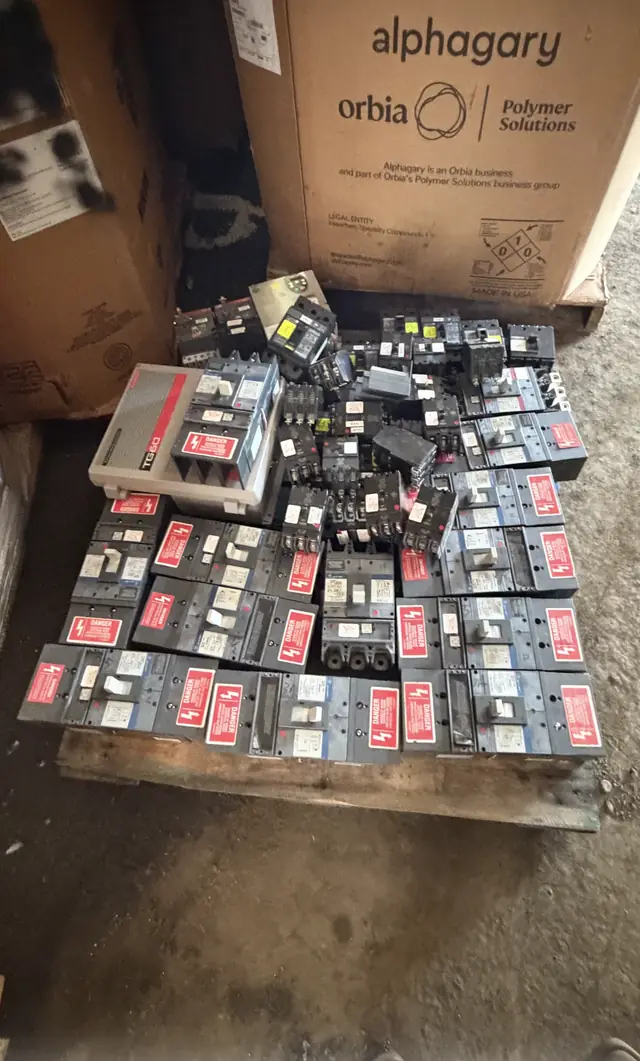
If you find cracked insulation, arc damage, unknown residues, or exposed live parts, stop work immediately and consult a qualified electrical professional. Follow current manufacturer instructions and the authority having jurisdiction for removal and handling. Submitting equipment for review is not a safety certification, a purchase order, or a shipping authorization.
How we handle Current (Federal Pacific) medium‑voltage equipment
We review qualifying Current (Federal Pacific) medium‑voltage equipment for purchase consideration. Submitting items does not create an appraisal, purchase order, acceptance, or authorization for shipment; it initiates a review process that may include technical and legal checks. Provide clear identification and owner documentation so reviewers can evaluate commercial fit and safety risk.
All submissions that claim Current or Federal Pacific origin should include original MV nameplates, Current‑company documentation, and an owner‑approved scope of assets available for sale. Items lacking original labels or owner approval will be harder to verify and may not advance past preliminary review. Qualifying submissions may be examined by technical and legal/product‑safety reviewers as applicable.
- Submission = review request, not a purchase or pickup promise
- Original MV nameplates and Current documentation speed verification
- Technical and legal reviews may be applied to qualifying items
Exact identification fields we need
Identification hinges on readable nameplate and label data. Useful fields include model or type code, catalog number, serial number, manufacturing date or date code, rated voltage or kV class, continuous ampere rating, interrupting or short‑circuit rating, and any internal part numbers visible on components. If a breaker has additional factory or retrofit tags, include those too.
Do not assume cosmetic markings or paint alone are sufficient. Original MV nameplates and any Current‑company paperwork are the strongest evidence. If a unit was reconditioned, include documentation that clearly shows the change, the party that performed work, and the date. Lack of consistent identification fields will require more time for verification and may limit review outcomes.
- Nameplate fields: model/type, serial, kV class, amp and interrupting ratings
- Photograph any factory tags, stamped dates, and internal component markings
- Include paperwork that references the same serial/model numbers
Honest condition categories and what to report
Use unambiguous condition language: new‑surplus (uninstalled), new‑old‑stock (NOS), removed‑serviceable, removed‑untested, or damaged/for‑parts. For removed equipment, describe why it was removed (upgrade, failure, decommission) and whether it was in live service immediately before removal. Include any available service logs or maintenance records that support your description.
Report visible defects and telltale signs that affect safety or re‑use potential: corrosion or pitting on contact areas, insulation discoloration, evidence of overheating or arcing, missing antifriction parts, degraded gaskets, or mechanical damage to operating linkages. Do not attempt energized testing yourself; instead list any manufacturer or third‑party tests previously performed and supply supporting reports.
- State the condition category clearly (e.g., removed‑serviceable)
- Explain removal reason and last service status when known
- List visible damage and attach close‑up photos or test reports
Photos that speed verification
Good photos shorten review time. Include clear, well‑lit close‑ups of the original nameplate(s), connection points, terminal blocks, contact surfaces, and any internal components that are visible without destructive disassembly. Provide wider shots that show the complete assembly and how accessories or mounting frames are attached. Use a neutral background and avoid reflections that obscure text.
Add a scale reference in at least one image (ruler, tape measure) and capture any serial numbers from multiple angles if they are partially obscured. For large assemblies, include photos showing nameplate plus an image of the unit installed in context so reviewers can assess mounting and accessory interfaces. Poor or missing photos commonly delay or halt review.
- Close‑up of original MV nameplate and all factory tags
- Full assembly views (front, rear, sides) and installation context
- Close shots of terminals, contacts, and any damage with a scale
Documentation and owner‑approved scope to include
Required unique evidence includes Current‑company documentation and original MV labels. Provide any available manuals, original factory test certificates, factory wiring diagrams, and nameplate scans. If there are external test reports (third‑party dielectric, timing, or capacity tests), include them and make sure serial and model numbers match the unit you submit.
Owner‑approved scope is essential. Upload documents that show the owner’s authorization to sell the listed items — for example, a signed asset disposition list, surplus authorization, or bill of sale drafts. Where applicable, identify any limitations on transfer, such as lease or consignment terms. Submissions that lack owner approval or clear chain‑of‑custody documentation cannot complete the legal review stage.
- Factory manuals, wiring diagrams, and factory test certificates
- Third‑party test reports and maintenance logs that reference serial numbers
- Owner authorization or signed scope showing assets available for sale
Organize quantities and lot presentation for commercial fit
Group similar units by model, condition, and accessory set into lots. Separate new‑surplus items from removed units and keep retrofit or modified items in distinct lots with clear modification notes. Buyers evaluating medium‑voltage gear often need consistent batches — a single mismatched unit is harder to market than a small uniform lot.
Be explicit about quantities, spare parts, and partial assemblies. If you have spares such as replacement contact sets, insulating sleeves, or operating mechanisms, list them and state which primary units they match. If items are staged for inspection, describe staging location and accessibility; do not include pickup or shipping commitments in your submission.
- Make lots by model, condition, and accessory compatibility
- List quantities, spares, and partial assemblies clearly
- Note staging location and inspection accessibility (no pickup promises)
Safety limits, warnings, and review scope
Stop work and seek a qualified electrical professional if you observe exposed conductors, brittle insulating components, evidence of arc damage, or unknown internal contamination. Do not perform energized tests or on‑unit repairs yourself; follow current manufacturer instructions and engage appropriately qualified personnel as defined by your authority having jurisdiction.
Our submission process is not a safety inspection or certification. Any purchase review may include technical checks and may involve legal, trademark, or product‑safety review depending on the item. Even after a favorable review, buyers typically perform their own acceptance testing and safety verification before reuse or installation.
- Stop and consult a qualified electrical professional when you see arc damage, exposed live parts, or severe insulation degradation
- Do not energize or test unknown units yourself; follow manufacturer guidance
- Submission is not a safety certification or approval for reuse
How to submit and what happens next
When you’re ready, submit a single package that includes high‑resolution photos, a completed identification checklist, condition notes, and owner‑approved scope documents. Provide contact information for the asset owner and any additional party who can confirm chain of custody. Use clear filenames that reference serial or model numbers so reviewers can match photos to paperwork.
If a submission meets verification expectations, it may be reviewed by technical and legal/product‑safety reviewers as applicable. That review determines whether an item advances in our process; it does not guarantee a purchase. If the submission lacks sufficient identification or documentation, reviewers may request clarification or additional materials before proceeding.
- Upload photos, nameplate scans, manuals, and owner authorization in one submission
- Use filenames tied to serial/model numbers and include a concise item list
- Review may include technical and legal/product‑safety checks; submission ≠ purchase