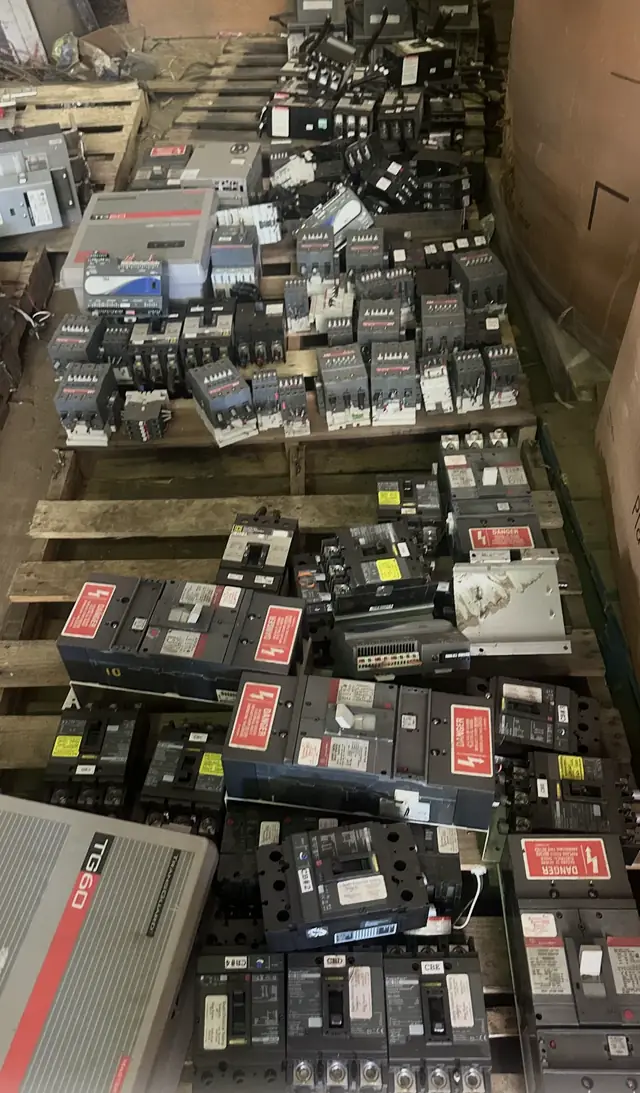
If you observe burn marks, melted insulation, exposed conductors, or other signs of hazard, stop and consult a qualified electrical professional and the authority having jurisdiction. Follow all manufacturer instructions and do not perform energized testing unless you are trained and authorized.
How we review qualifying Crouse-Hinds items
CircuitBreakerBuyer reviews qualifying Crouse-Hinds-branded circuit breakers and related electrical equipment for possible purchase. We do not accept every submission; qualifying items may be submitted for purchase review to determine commercial fit, condition, and market demand.
This page explains the identification fields, evidence and photos that speed evaluation, how to organize lots, and the commercial factors buyers look for. Preparing clear documentation and original labels markedly improves the speed and clarity of our purchase review.
- We review submissions but do not guarantee purchase.
- Include original labels and factory nameplate photos whenever possible.
- Supply any current-brand cross-reference materials you have (for example, Eaton technical sheets or part cross-references).
Exact identification fields to collect
Accurate model and nameplate data are essential. Key fields buyers use to identify Crouse-Hinds equipment include the catalog or model number, frame designation, trip unit or trip setting (electronic or thermal-magnetic), ampere rating, interrupting rating (AIC/KAIC), voltage class, and any serial or lot numbers stamped on the unit.
Original labels and legible nameplates are especially important. If a breaker has been relabeled, removed, or altered, note that clearly and include photos showing the area where the label was attached and any stamped chassis markings that remain visible.
- Catalog/model number and any suffixes (e.g., -L, -F, trip code).
- Frame size and amp rating (e.g., 250A, 600A).
- Interrupting rating (kAIC) and voltage (e.g., 480V).
- Trip unit type (electronic adjustable, fixed thermal-magnetic, molded case, etc.).
- Visible serial numbers, date codes, or lot codes.
- Original Crouse-Hinds nameplate or sticker photos.
Describe condition honestly and consistently
Use consistent, straightforward condition descriptors. Common useful categories are: new-unissued (factory packaging intact), new-surplus (unused but removed from original packaging), used-working (installed and actively used), used-nonworking (known fault or unknown condition), and for parts, serviceable or for repair. Avoid vague claims; describe observed defects and whether tripping mechanisms operate freely when moved manually.
When listing damage, be specific about corrosion, physical distortion, missing handles, accessories, or modification to trip units. If units were bench-tested or exercised by an appropriately qualified electrical professional, indicate who performed the work and what tests were run, but do not present submissions as safety inspections or code approvals.
- New-unissued, new-surplus, used-working, used-nonworking — pick one and explain.
- Note visible corrosion, pitting, or contamination and its location.
- Report missing handle ties, auxiliary contacts, shunt trips, or mounting parts.
- If devices were stored, state storage conditions (indoor, dry, racked, palletized).
Photos and documentation that speed review
High-quality photos replace many back-and-forth questions. Provide clear, in-focus photos of the nameplate, full unit from two angles, accessory modules (auxiliary contacts, shunt trips), mounting hardware, and close-ups of any damage. Include a ruler or object for scale if size is not obvious from the image.
Include any manufacturer documentation you have, such as original Crouse-Hinds datasheets, installation instructions, or current-brand cross-reference documentation (for example, Eaton technical bulletins or cross-reference tables). These references help buyers determine parts interchangeability and market acceptance without implying manufacturer endorsement.
- Close-up of original nameplate and serial/date code.
- Full-unit photos from front and rear showing terminals.
- Accessory modules and control connections photographed separately.
- Photos of internal trip mechanisms only if safely de-energized and removed by qualified personnel.
- Attach PDFs of datasheets, catalog pages, and any Eaton or current-brand cross-reference documents you have.
How to organize lots and present quantities
Group items by identical model, frame size, and condition to create coherent lots. Buyers evaluate lots more quickly when all units share the same identifying model number, amperage, and interrupting rating, and when their stated condition is consistent. Avoid mixing both new-unissued and used-working units in the same lot unless you clearly separate them in the listing.
Provide exact quantities, unit weights if relevant, and how items are packaged for pickup or shipping. If you have a serial-numbered inventory, include a spreadsheet with serial numbers and condition notes; this reduces uncertainty around per-unit variability and can speed a purchase decision.
- Create lots by identical model number, amp rating, and condition.
- List exact unit count and how many of each condition category exist.
- Indicate palletized, boxed, or loose packing and approximate pallet dimensions.
- Include a serial-numbered inventory spreadsheet when possible.
Market demand signals and acceptance evidence
Buyers look for evidence that Crouse-Hinds equipment is in demand and can be resold or reconditioned. Useful acceptance evidence includes comparable parts in active secondary markets, current-brand cross-reference documents (for example, Eaton cross-reference sheets), and any recent purchase or maintenance records showing interchangeability. Providing this evidence does not imply manufacturer endorsement but helps buyers assess commercial viability.
Other demand signals are quantity, condition consistency, and availability of accessory parts (handles, auxiliary contacts, shunt trips). Presenting original nameplates and up-to-date cross-reference materials typically increases buyer confidence and can improve offer clarity during review.
- Provide any cross-reference documentation that links Crouse-Hinds part numbers to current-brand equivalents.
- List recent repair or maintenance records if available (date and nature of work).
- Show accessory and mounting parts availability to increase lot value.
- Demonstrate consistent condition across multiples to reduce per-unit risk.
Safety limits, legal notes, and next steps
Stop and do not attempt energized testing or removal if you see damaged insulation, burn marks, severe corrosion, or other obvious safety hazards. Follow the original manufacturer instructions and engage appropriately qualified electrical professionals and the authority having jurisdiction for any removal, testing, or installation work. This page does not provide electrical, installation, or safety instructions.
A website submission is not an appraisal, offer, acceptance, safety inspection, compatibility determination, purchase order, pickup commitment, or shipping authorization. To start a review, prepare the checklist below and submit via our online form. Qualifying items may be submitted for purchase review; any purchase decision is subject to final inspection and commercial terms.
- Do not perform energized work; use qualified electrical professionals for removal and testing.
- Prepare original-nameplate photos, a model/serial spreadsheet, and condition descriptions before submitting.
- A submission starts review only — it is not a purchase agreement or safety clearance.
- Include any Eaton or current-brand reference docs you have to aid evaluation.