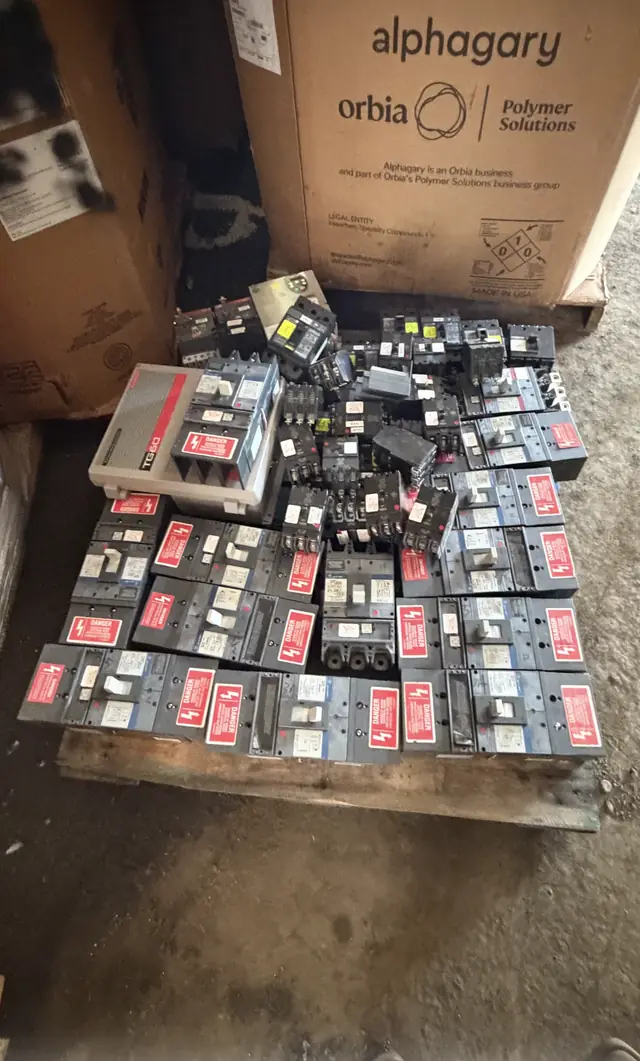
Stop work and consult current manufacturer instructions if you find visible overheating, missing safety labels, or structural damage. Do not perform energized testing or installation without appropriately qualified electrical professionals and the authority having jurisdiction. Submitting inventory for review is not a safety inspection or approval for reuse.
What we review for purchase
We review qualifying Thomas & Betts branded circuit breakers and related electrical equipment for purchase. Qualifying items may be submitted for purchase review; submission does not equal an offer, acceptance, or safety inspection. We look for clearly identified parts, complete accessory sets, and documentation that supports traceability and provenance.
Typical categories we consider include molded-case circuit breakers, bolt-on breakers, replacement trip units, panelboards, busway components, and accessories such as handles, auxiliary contacts, and mounting hardware. We do not imply universal acceptance of every item—each submission is evaluated on identification, condition, demand, and any available lineage documentation.
- Molded-case breakers (T&B catalog numbers and labels preferred)
- Panelboards, distribution blocks, and bus accessories
- Replacement trip units and mechanical parts
- Accessory parts: shunt trips, handle kits, auxiliary contacts
How to identify Thomas & Betts equipment
Exact identification fields speed review and improve the odds a part is a fit. The most important items are the original manufacturer label, full catalog or part number, serial number or lot code, date code, and any stamped or molded identifiers on housings. If a breaker has an internal trip assembly with markings, include photos of that marking too.
We also note ABB-lineage sources when they appear in documentation or markings. Some Thomas & Betts parts later enter secondary distributions that reference ABB or other legacy inventories; providing any packaging, original paperwork, or vendor-coded labels that tie a part to those sources helps reviewers understand provenance and potential demand. Listing exact catalog numbers and any cross-reference tags reduces back-and-forth and can lead to a more efficient review.
- Original label or nameplate visible and legible
- Full catalog/part number and serial or lot code
- Date codes, revision stamps, and internal trip markings
- Packaging labels, original paperwork, or vendor receipts
Use honest condition language and expect limits
Use clear, standardized condition descriptions so reviewers can set realistic expectations. Common, useful condition categories are: New in Box (NIB), New Surplus (uninstalled, possibly bulk-packaged), Used Good (installed previously, clean, operative appearance), Rebuilt/Refurbished (noted with testing/refurb details), Parts Only, and Unknown/As-Is. Avoid subjective adjectives without supporting photos or test records.
There are practical safety and market limits to what can be accepted: breakers with missing safety labels, damaged bus or terminal connections, evidence of overheating, or unverified internal modifications usually reduce commercial value or eliminate eligibility. Reviewers may request clarifying information when necessary, and original labels and test records—when available—help validate condition statements.
- New in Box (NIB): unopened with original labels
- Used Good: cosmetic wear but intact labels and terminals
- Rebuilt/Refurbished: provide service records or test tags
- Parts Only / As-Is: disclose missing components or damage
Photos that make a submission successful
High-quality photos replace many questions. For each unique part number, include close-ups of the full manufacturer label, a clear photo of the entire unit from at least two angles, images of terminal connections and trip assemblies, and any accessory items. If items are in boxes, include photos of the packaging label. When multiple units are present, include a shot that shows the entire lot to indicate quantity and uniformity.
Good photos should be well-lit, in-focus, and show legible text on labels. If a part has internal markings (trip units, trip cards, or internal modules), photograph those markings without attempting disassembly beyond what is safe and permitted. File formats such as JPEG or PNG and filenames that match the part number or lot reference are helpful for efficient processing.
- Label close-up showing catalog number and serial/lot code
- Full-unit images from multiple angles
- Terminal and trip-unit close-ups
- Packaging and accessory photos, plus overall lot shot
How to organize lots and documentation
Organize like-for-like items into single lots whenever possible. Reviewers evaluate commercial fit by model, quantity, and condition; a lot of ten identical breakers in the same condition is easier to assess than a mixed lot of similar-looking parts. For mixed lots, list each catalog number and quantity clearly and indicate which units are in which condition category.
Include any test reports, recent maintenance tags, or purchase receipts with each lot submission. If you have serial-number lists, packing manifests, or original purchase orders that reference the catalog numbers, include them. These documents help validate provenance, particularly when ABB-lineage information or cross-reference data is present.
- Group identical part numbers and conditions into single lots
- Provide quantity counts and serial-number lists when available
- Attach any test tags, service records, or original receipts
- Label boxes and pallets to match the submitted lot reference
What increases demand and acceptance chances
Demand is driven by clear identification, genuine original labels, completeness, and condition. Items that retain original Thomas & Betts nameplates and intact part numbers typically attract more interest. Evidence that ties a part to ABB-lineage sources or legacy OEM channels can also raise interest because it helps potential end users find compatible cross-references.
Other factors that influence acceptance include quantity (supply lots are more likely to be considered), availability of replacement trip units or accessories, and whether a model is known to be obsolete or in active aftermarket demand. Each submission is evaluated against current market demand and available evidence; providing strong documentation and photos is the most reliable way to demonstrate commercial fit.
- Original T&B labels and intact part numbers
- Documentation that supports ABB-lineage or cross-references
- Complete accessory sets and replacement modules
- Higher quantities and consistent condition per lot
Next step: submit for purchase review
To start, prepare an inventory summary that lists each catalog number, quantity, condition, and any serial numbers or date codes. Attach clear photos and any relevant paperwork. Submitting this information opens a purchase review; it is not a purchase order, shipping authorization, or safety inspection. If additional information is requested, responding promptly can help move a review to completion.
This page provides general submission guidance only and is independent of Thomas & Betts or ABB. Use current manufacturer documentation for identification. Submitting inventory for review is not an appraisal, certification, or authorization for use.
- Prepare a lot-level inventory with catalog numbers and quantities
- Attach clear photos for each unique part number
- Include any service tags, purchase receipts, or ABB-lineage notes
- Submit the package to begin purchase review — submission is not a sale