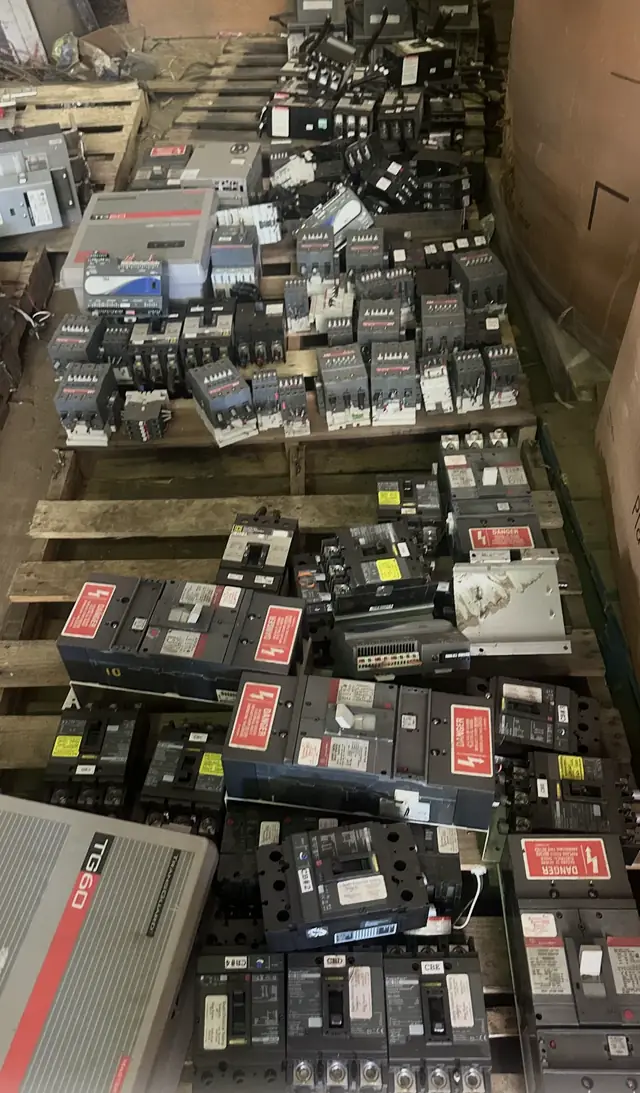
If you see signs of damage, corrosion, burning, missing covers, or unknown modifications, stop and consult the breaker’s manufacturer documentation and a qualified electrical professional. Do not attempt live testing or field modifications yourself; follow the authority having jurisdiction and use appropriately qualified personnel.
How we review qualifying items for purchase
We review qualifying circuit breakers and electrical equipment that sellers submit for purchase consideration. To speed evaluation we need clear, specific identification fields from the breaker nameplate and supporting photos; the sections below show the exact fields that matter and how to present them for a prompt review.
A website submission is not an appraisal, offer, acceptance, purchase order, pickup commitment, or shipping authorization. Submitting accurate labels and photos helps us determine commercial interest and next steps; final purchase decisions follow our inspection and standard commercial review.
- We require readable nameplate fields for initial review
- Submit multiple photos showing model and catalog labels
- Condition, lot size, and commercial fit influence interest
Ampere rating, poles, and voltage — what to read on the label
The ampere rating on a breaker nameplate is the nominal continuous rating listed as 'A', 'Amps', or a number such as 100 or 200. That number is one of the first things we look for because it defines the breaker’s intended current handling range. On many labels it appears near or with the frame designation; if you report the amp rating, include any suffixes or adjustable trip ranges shown on the same plate.
Poles and voltage information are commonly printed near the amp rating and indicate how many circuits the device protects and the intended system voltage. Poles are listed as 1P, 2P, 3P, or 4P or as 'poles: 3', while voltage may appear as '480Y/277 V', '600 V', or simply '240 V'. Capture the full line exactly as it appears — differences in notation matter for resale and commercial fit.
- Report the full amp number and any adjustable range (e.g., 100 A adj. 80–125 A)
- Note poles exactly as printed (1P, 3P, 4P, etc.)
- Record the voltage line exactly (including wye/delta notation if present)
Frame size and model numbers — decoding the manufacturer line
Frame size is a manufacturer-defined designation that groups breakers with common mounting and bus dimensions. It typically appears near the manufacturer logo or model series and may be a short code (for example, 'F-Frame' or '800 F'). Frame size does not by itself confirm trip settings or accessory fit; it is an essential identification field when checking commercial compatibility and potential interest.
Model numbers and catalog codes often combine frame, amp, trip type, and accessory letters. When you read a model line, capture the entire string exactly as stamped or printed — hyphens, slashes, and suffix letters can indicate trip units, electronic options, or physical modifications that affect market value.
- Photograph the full model/catalog number as a single image if possible
- If the frame size is abbreviated, include surrounding text for context
- List any accessory codes printed on the label (e.g., 'TA', '3P', 'ELS')
Trip type and trip unit information
The trip type describes how the breaker responds to overloads and short circuits. Labels may show thermal-magnetic, electronic, adjustable trip, or fixed settings. Look for words such as 'Thermal', 'Magnetic', 'Electronic', 'Trip Unit', or abbreviations that indicate adjustable settings; include any numerical trip curves, ranges, or settings that appear on the nameplate or adjacent trip unit cover.
Trip unit details influence resale value and compatibility for specific applications, so provide verbatim trip descriptions and any supplemental data plates. If a breaker includes a removable electronic trip module, photograph the module and any serial or firmware labels on it — those fields are part of the identification set we use during review.
- Copy trip wording exactly (e.g., 'Electronic Trip Unit ETU-200')
- Note adjustable ranges or trip curves if shown
- Photograph removable trip modules and their labels
Interrupting rating (AIC) and original label examples
Interrupting rating — often called AIC, SCCR, or Interrupting Capacity — indicates the maximum fault current the breaker is intended to clear. That rating is a critical label field and is often shown as a numeric value followed by 'A' (amps) and sometimes a system voltage, for example '10,000 AIC @ 480 V'. When you record or photograph this field, capture the entire line including the voltage reference if present.
Below are two original-style label decoders that show the fields we need. Use these examples as a checklist when photographing and reporting nameplates; do not assume other markings are equivalent — report exactly what you see.
- Example label decoder — thermal-magnetic molded-case breaker: Manufacturer: AcmeCo Model: AC-2R-100 Frame: 150A Poles: 3P Ampere Rating: 100A Voltage: 600V AIC: 10,000 A @ 480V Trip: Thermal-magnetic Serial: SN12345
- Example label decoder — electronic trip, drawout: Manufacturer: PanelMax Model: PMX-800F-E Frame: 800F Poles: 3P Ampere Rating: 600A Voltage: 480Y/277V Interrupting Rating: 65kA @ 480V Trip Unit: ETU-600 Adjustable 50–100% Serial/Part: P1234-56
Condition language, useful photos, and lot organization
Describe condition using clear, objective language: 'new surplus in original packaging', 'used — good cosmetic condition', 'used — with paint and surface rust', or 'core for parts'. Avoid subjective phrases like 'like new' without supporting images. We rely on the nameplate legibility and physical condition indicators when we decide whether to proceed to a commercial inspection.
Include a minimum set of photos for each breaker or lot: full front, label close-up, side/mounting features, and serial number or model close-up. For multi-unit lots, number each unit and show an overall photo of the entire lot plus close-ups of representative units and any outliers. Good lot organization and clear counts reduce follow-up questions and speed evaluation.
- Minimum photos: full unit, nameplate close-up, trip unit close-up, mounting interface
- For lots, provide an overall shot, unit-by-unit close-ups, and a count sheet or labeled photo
- Use neutral background and even lighting to improve label legibility
Commercial fit, safety limits, and how to submit
Commercial interest depends on the combination of identification fields, condition, lot size, and market demand. Clear nameplate data and photographic evidence let us match equipment to potential buyers; absence of key fields or damaged plates may limit interest. When submitting, include the exact label text, lot count, and the photos described above so our review team can determine next steps.
Before arranging removal or transport, stop if you encounter warning signs such as missing insulation, exposed conductors, smoke damage, or unknown modifications. Follow the breaker manufacturer’s instructions and engage appropriately qualified electrical professionals and the authority having jurisdiction. A website submission is not an inspection or safety clearance — it is a request for commercial review only.
- Include full label text and high-resolution photos for fastest review
- Do not disassemble or energize equipment for the purpose of creating photos
- Submissions with complete nameplate data and clear lots tend to receive faster responses