This page is informational only. Do not perform energized testing or field repairs unless you are a qualified electrical professional. Follow current manufacturer instructions and guidance from safety authorities; stop and call a licensed electrician if you encounter sparks, smoke, heat, water damage, or repeated immediate trips.
Scope and what this page is not
This page is intended to help people who encounter a breaker that keeps tripping understand common trip categories, safe response limits, and how to document equipment when preparing a submission for purchase review. CircuitBreakerBuyer.com will review qualifying items for purchase, but a submission is not a purchase order, appraisal, or safety inspection.
This is not a remote troubleshooting service. Do not perform energized testing, panel wiring changes, or any procedure that would expose you to live parts. If you see immediate hazards—sparks, smoke, heat, or exposed conductors—stop and contact the appropriate qualified electrical professional and the authority having jurisdiction.
- We review qualifying items for purchase; we do not provide on-site repairs.
- Follow current manufacturer instructions and safety guidance from competent authorities.
- If you are unsure, stop and call a licensed electrician.
Trip categories: what the breaker is telling you
Circuit breakers are protective devices that trip for different reasons. Common trip categories are nuisance or overload trips, short-circuit trips, ground-fault trips, thermal trips from prolonged overload or high ambient temperature, and mechanical or internal failure.
A breaker that is older, mechanically damaged, or shows heat or burn marks may have internal failure and should be treated as suspect. Trip behavior alone cannot prove the internal condition without proper testing by qualified personnel. Avoid assuming compatibility or safety based solely on physical fit or a brand name; documentation and a professional evaluation are necessary before reuse, resale, or installation.
- Nuisance/overload: trips under normal use, often intermittent.
- Short-circuit: typically trips instantly and may be accompanied by noise or sparks.
- Ground-fault: trips when current returns through an unintended path.
- Thermal/age: trips with slow heating or after a period of high ambient temperature.
- Mechanical/internal failure: repeated unexplained trips or visible damage.
Symptom-to-action matrix (original): how to decide the next safe step
Below is an original, concise symptom-to-action matrix intended to guide safe, non‑diagnostic responses and documentation for sale or evaluation. The matrix emphasizes safety limits: stop for red flags, allow at most one closed-cover reset only when no red flags exist, and collect identification and photo evidence before contacting a buyer or a licensed electrician.
This matrix does not replace professional diagnosis. Use it to decide whether it is safe to document and submit the breaker for purchase review or to immediately contact a qualified electrician. If in doubt, err on the side of stopping and consulting a professional.
- Symptom: Breaker trips immediately after reset with spark, smoke, or burning smell. Action: Stop. Do not reset. Isolate power if trained; contact a licensed electrician and safety authorities. Photograph damage and label area; do not attempt repairs.
- Symptom: Breaker trips immediately after reset without visible damage. Action: One closed-cover reset is allowable if no red flags; if it trips again, stop and call an electrician. Photograph label, handle position, and any discoloration.
- Symptom: Breaker trips only under heavy load (e.g., when a motor starts). Action: Document application, load type, and label data. Consider possible overload; consult a qualified electrician for on-site assessment before further resets.
- Symptom: Breaker trips intermittently, unpredictable. Action: Avoid repeated resets. Photograph identification and surroundings, record when trips occur, and submit details for purchase review or for an electrician to investigate.
- Symptom: Breaker tripped after water exposure, flooding, or damp conditions. Action: Stop. Do not reset. Photograph water damage and label. Contact a qualified professional and include condition in any submission.
- Symptom: Breaker trips after replacement or service. Action: Stop and document part numbers, installation notes, and photos. Engage the installing contractor or a licensed electrician for follow-up; do not assume new parts are safe without verification.
- Symptom: Breaker trips and handle will not stay in ON position (stuck/tripped). Action: Stop. Photograph handle and label. Do not force the handle; consult a qualified professional.
Exact identification fields to record before submission
Accurate identification is the most important factor for a useful submission. Record the manufacturer name, catalog or model number, ampere rating, number of poles, frame size or series, voltage rating, trip type (thermal-magnetic, electronic, ground-fault, arc-fault), and any visible date code or serial number. Also note the enclosure type and whether the breaker is draw-out, fixed, or part of a molded case assembly.
Honest condition language is required: new-sealed, new-surplus, like-new, used-good, used-fair, repaired, burned/damaged, water-exposed, or unknown/untested. Avoid vague terms like 'works' without objective documentation. If a breaker has been labeled or repaired, photograph and describe the label and repair marks.
- Manufacturer and full catalog/model number (exact text on label).
- Amp and voltage ratings, poles, and trip type.
- Frame or series identification and any date or serial codes.
- Condition category using plain language (new-surplus, used-good, burned/damaged, water-exposed).
Useful photos and how to organize lots for review
Photos should be clear, well-lit, and focused on the label and trouble areas. Required views are a full-face label shot, a close-up of the model/catalog text, a shot of the trip handle in its present position, terminal areas, and any visible damage or discoloration.
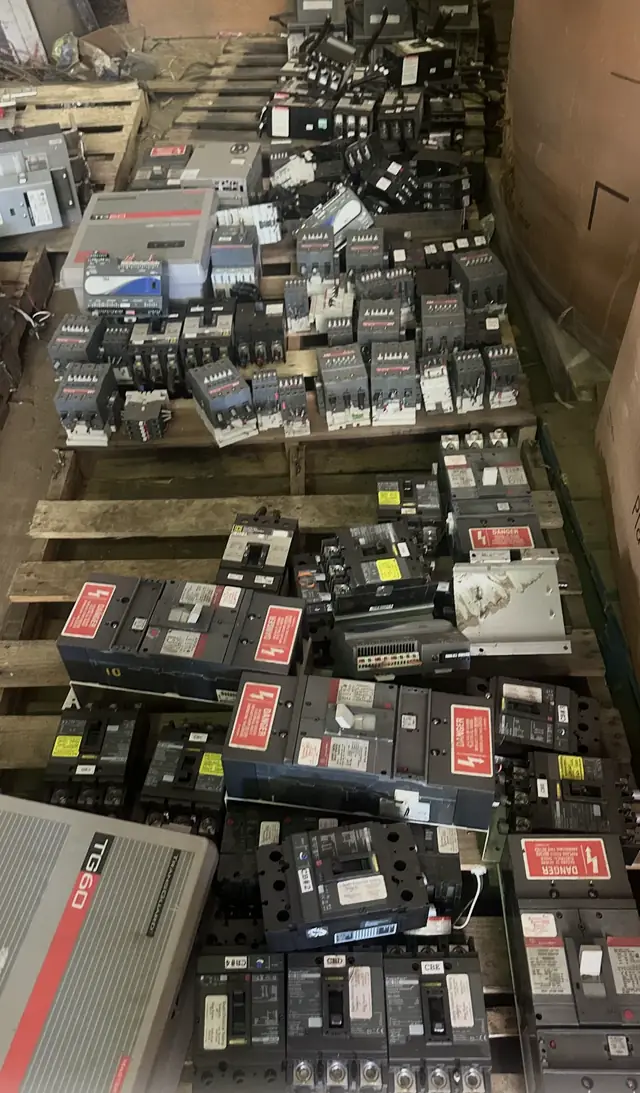
Organize items into logical lots before submission. Group identical models and identical condition categories together, and count quantities. Label lot sheets with part numbers, quantities, and a short condition note. This speeds review and avoids mischaracterization. Do not send equipment until you have a confirmed shipping or pickup arrangement from the buyer after review.
- Full-face label shot and close-up of catalog/model text.
- Handle position and terminal area photos.
- Damage, discoloration, or water exposure details.
- Lot photo showing quantity and representative unit.
When breakers are commercially interesting to buyers
Buyers typically find interest in sealed new-surplus stock, consistent lots of the same OEM model, and serviceable used inventory that has intact labels and no evidence of thermal or mechanical damage. Obsolete or hard-to-find models with clear identification can be valuable if they are in stable condition and properly documented. Honesty about condition and history increases the chance that an item will pass initial review.
Quantities, traceable labeling, and preserved packaging improve commercial fit. Single, heavily damaged, or uncertain-condition units are less likely to be purchased; however, documented lots of salvaged parts or rebuildable items may still be of interest for parts. Remember that submission for review does not guarantee purchase; buyers will evaluate risk, demand, and condition.
- Sealed boxes and consistent lot quantities are preferable.
- Clear, legible labels and no signs of burning or water damage.
- Obsolete but clearly identified OEM models may be of interest.
- Single damaged units are generally less attractive than consistent lots.
Safety limits, the one-reset rule, and the next step
Your safety limits are non-negotiable: stop for visible sparks, smoke, strong odors, heat, exposed conductors, repeated immediate trips, or water damage. Only one closed-cover reset is acceptable and only when none of those red flags is present; if the breaker trips again after that single reset, cease further resets and call a licensed electrician. Do not attempt energized diagnostic procedures yourself.
When you are ready to submit for purchase review, include the identification fields, clear photos, lot counts, and honest condition notes. Submissions are reviewed; they are not purchase orders or inspections. If you need on-site diagnosis or repair, contact a licensed electrician or the original equipment manufacturer for guidance and follow the authority having jurisdiction’s direction.
- Stop immediately for sparks, smoke, burning smell, heat, or water exposure.
- One closed-cover reset only when no red flags exist; otherwise call a professional.
- Submissions must include label photos, condition, quantity, and descriptive notes.
- Submission ≠ purchase; buyer review determines commercial interest.