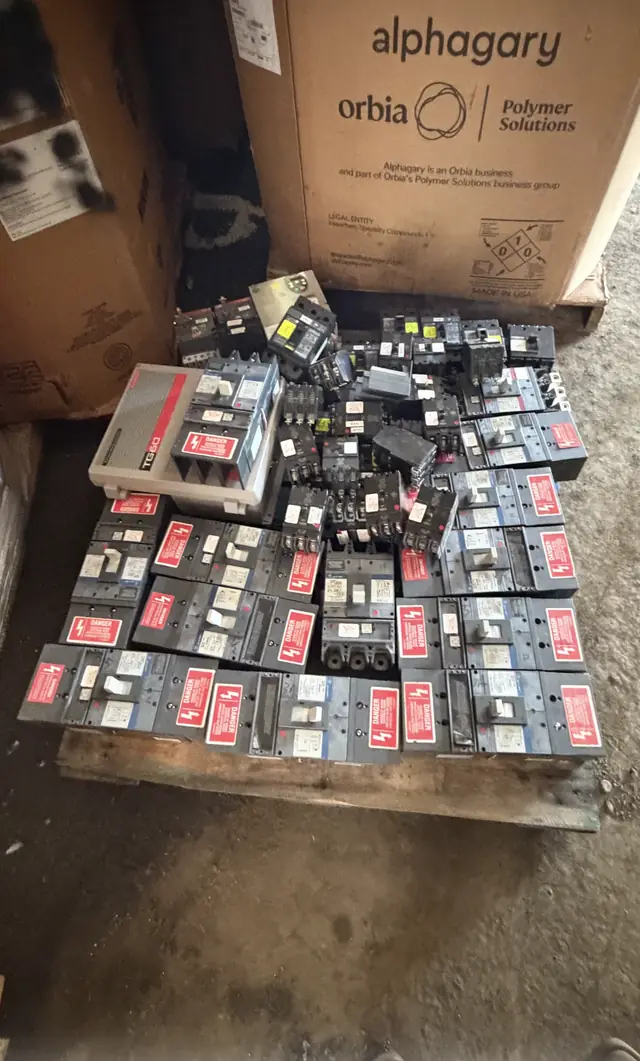
Stop and seek a qualified electrical professional if you see burn marks, exposed conductors, modified terminals, or missing safety labels. Follow current manufacturer instructions and the authority having jurisdiction. A website submission is not a safety inspection, offer, or authorization to ship or install equipment.
Our intent and what this guide covers
We review qualifying used, new-surplus, obsolete, and surplus circuit breakers and electrical panels for possible purchase; items may be submitted for a purchase review. This guide explains how to check live public recall records before you offer equipment for sale or submission, and how to collect the documentation that helps reviewers evaluate risk and commercial fit.
This page focuses on a live approach using publicly available recall search tools, what to capture as original evidence, how to identify the model/date fields that matter, and how to organize lots and condition descriptions for a purchase-review submission. Follow manufacturer instructions and seek qualified electrical professionals if you find signs of damage or tampering.
Why you should search recalls before selling surplus breakers or panels
Recalls can affect whether a unit is appropriate to resell or whether additional steps are needed before a buyer will consider it. From a commercial perspective, a clear and documented recall check reduces friction during a purchase review: it helps potential buyers evaluate liability, refurbishment needs, and the cost of any necessary mitigation.
From a safety perspective, suspected or confirmed recall status is a red flag. If you see physical damage, burn marks, missing labels, or prior repairs, stop and arrange an inspection by a qualified electrical professional. Do not attempt energized testing or installation to confirm functionality; that is outside the scope of this guide and should only be done by someone properly qualified and authorized.
- A live recall search reduces uncertainty for buyers and can speed up review.
- Documented searches are part of responsible surplus disposition.
- Unclear or unresolved matches typically move items out of immediate commerce until resolved.
Live public recall workflow — how to search and capture results
Start with the national consumer safety agency’s searchable recall database (for example, the consumer product safety commission site in the United States) or the relevant authority in your jurisdiction. Use the agency’s search form to enter brand, model number, date code, and any other identifying terms. Run searches for exact model strings and for truncated variants (for example, the model without suffixes) so you do not miss entries that use alternative names.
Capture original evidence at each step of the search. Take at least one full-page screenshot or save the result as a PDF showing the search terms, the date and time of the search, and the result listing. If the search returns a matching recall entry, screenshot the entry detail page or download the official recall notice. If no recall is found, capture the search page showing zero results and the search terms used; that “no results” record is useful proof for a purchase-review submission.
- Search fields to use: brand, model number, catalog number, date code/serial range, and keywords such as "breaker" or "panel".
- Run multiple searches with variant spellings and truncations.
- Save full-page screenshots or PDFs that include the browser address bar and timestamp where possible.
Identify exact model and date fields on breakers and panels
Look for the manufacturer’s nameplate or molded markings. Useful identification fields include the full model number, catalog or type number, lot or assembly code, date code, serial number, and any revision suffixes printed on the label. On panels, photograph the main label that lists the panel model and the manufacturer’s marking. Record any additional stamped or molded numbers found on the device body or packaging.
Use clear, well-lit photos and include a scale reference (a ruler or coin) for small stamped codes. Photograph both the label and the surrounding device so any partial label or adjacent markings are visible. If labels are missing, document the absence with wide and close-up photos and note any other identifiers such as accessory part numbers, mounting arrangement, or bus type; absence of a label may change a buyer’s interest or require a closer safety review.
- Must-have photo shots: full label, label close-up, device-wide view, date/serial close-up, accessory/terminal area.
- Note and photograph any stickers, overpaint, or label removal attempts.
- Record the environment where the unit was stored (dry, dusty, oily) if relevant.
Interpreting search results and handling unresolved matches
If your search returns a confirmed recall entry that matches the model/date/serial range, stop and follow the recall notice’s instructions. For commercial submissions, clearly state the recall match and attach the original recall notice screenshot or PDF. During a purchase review, documentation is assessed case by case to determine whether items should be withheld from sale, require actions described in the recall notice, or are otherwise unsuitable.
If your search produces a possible or unresolved match, route the item out of immediate sale channels until the status is clarified. Unresolved matches are common when labels are incomplete, when multiple part-number variants exist, or when the agency’s description differs from the marking on the device. Next steps can include contacting the manufacturer for clarification, obtaining an expert inspection, or providing additional photos and original lookup evidence to a prospective buyer for their safety review.
- Confirmed recall: attach the official notice and declare the match in your submission.
- No results: include the zero-results screenshot and the search terms used.
- Possible/unresolved: gather more evidence, obtain qualified evaluation, or disclose the uncertainty up front.
Organize lots and describe condition for a purchase-review submission
Group items into logical lots by brand, model, and condition. Provide a clear count for each lot and label each physical item or pallet with a lot number that matches your digital submission. For mixed lots, list every distinct model included, and attach condition photos representative of the lot as well as close-ups of any outliers. Buyers rely on consistent grouping to estimate handling and disposition costs.
Use honest condition language. Describe if items are new-surplus, unused in original packaging, reconditioned, cosmetically worn, visibly damaged, or of unknown history. Do not attempt energized testing to verify functionality as a substitute for qualified inspection; instead, note whether any functional testing was done and under what conditions. Remember that a submission is not an appraisal or offer—it is a request for purchase review that a buyer will evaluate.
- Label lot sheets with: lot number, brand, model numbers, quantity, condition summary, and link to original lookup evidence.
- Include at least one representative photo per lot plus detailed shots of any items with discrepancies.
- Document storage and handling history when available; this affects buyer risk assessment.
Evidence checklist and the next step
Before submission, assemble an evidence packet: identification photos, original lookup screenshots or PDFs, lot list with counts, and honest condition descriptions. Include the exact search terms and the date/time stamps for each lookup. If the search produced a recall entry or a “no results” confirmation, add those files directly to the packet so reviewers do not have to re-run the search.
Submissions that include possible or confirmed recalls, missing labels, or signs of damage may require evaluation by qualified professionals before sale. After assembling the packet, submit it for purchase review. Documentation is assessed case-by-case; a submission is not a purchase order, appraisal, safety inspection, or shipping authorization.
- Evidence packet: identification photos, search screenshots/PDFs, lot sheet, condition notes, storage history.
- Checks to include: matching model/date codes, consistency of markings, and any signs indicating removal or repair.
- If in doubt, retain the items and obtain a qualified inspection rather than attempting to sell them.