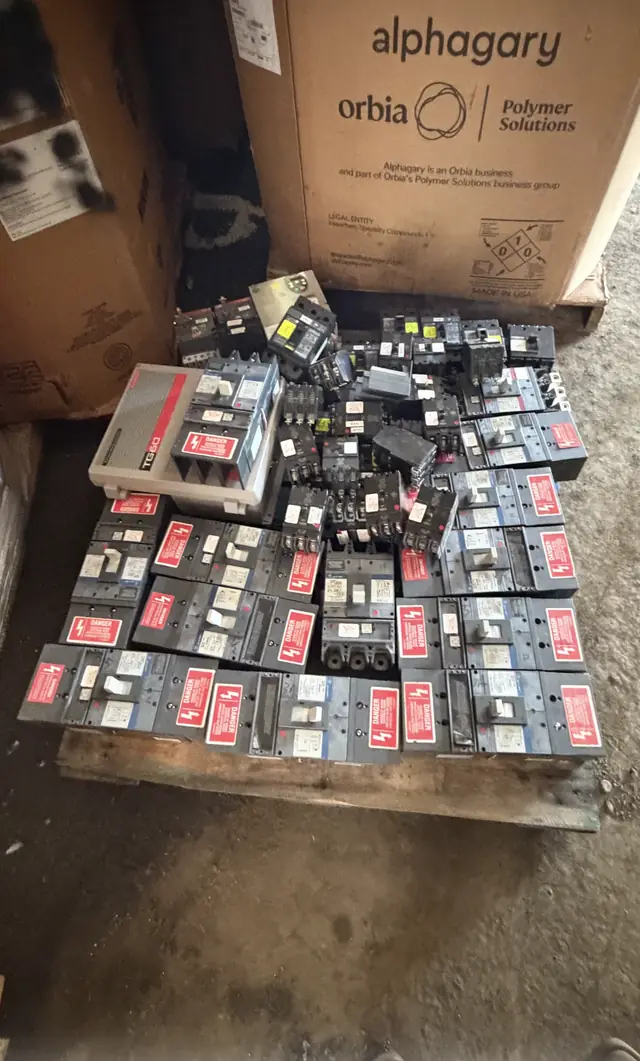
This page provides general information only. Stop if you find damage or evidence of arcing, follow current manufacturer instructions, and use appropriately qualified electrical professionals and the authority having jurisdiction for any electrical work. Submitting equipment is not a field test, appraisal, offer, or authorization to ship or install.
Why this matters to sellers
If you plan to submit breakers or switchgear for our purchase review, clear evidence of each unit's interrupting capability and any series‑rating limitations materially affects valuation and acceptability. We evaluate qualifying items, but a submission is not a purchase order, inspection, or certification; we require device‑specific markings and supporting documentation to determine whether a unit meets a buyer’s system needs.
This page focuses on how fault ratings are expressed, why two devices that look similar may not be equivalent for interrupting a fault, what markings and OEM/UL documentation are most persuasive, and the practical evidence to include with a submission. Follow these directions to reduce back‑and‑forth and to present a complete packet for review.
What an interrupting rating is and how it’s marked
The interrupting rating (sometimes called fault or symmetrical interrupting capacity) is the maximum available current a device is marked to safely interrupt under specified conditions. On a breaker nameplate this appears as a numeric value with current units (typically kA) and a stated maximum voltage; that pair of values defines the marked capacity for that device as tested or certified by the manufacturer and listed by safety evaluators.
A device’s marked interrupting rating is equipment‑specific. Two breakers with the same frame size or physical appearance can have different interrupting ratings because of internal components, trip units, or factory assembly. The marking on the device and any OEM or UL listing tied specifically to that catalog number are the primary evidence a buyer or reviewer will accept.
Series ratings and marked combinations: similar is not equivalent
Series ratings allow a downstream breaker to be paired with an upstream breaker so the combination can interrupt higher available fault current than either device’s standalone rating would permit. A series rating is not a general statement that any upstream breaker will do; it is a tested or engineered statement tied to a specific upstream‑downstream combination, manufacturer instructions, and a range of upstream device models or settings.
Look for an explicit series‑rating statement on the breaker label or in OEM documentation. A typical marked combination might read: Series rated for use with upstream breaker catalog numbers listed on manufacturer’s instruction sheet and tested to interrupt the available fault current when installed per manufacturer guidance. That wording, and the list of compatible upstream models, is the evidence our reviewers will examine.
- Marked combination example: a nameplate or supplemental label referencing specific upstream catalog numbers or a factory series‑rating bulletin
- Series rating statements often include maximum tested fault current, applicable frame sizes, and installation limits
Exact identification fields to capture and why they matter
When documenting equipment, capture the device fields that uniquely identify what was tested or certified. Key nameplate fields are catalog or type number, interrupting rating (value + voltage), maximum system voltage, frame or ampere rating, trip unit type and settings (if applicable), serial number or date code, and any series‑rating or combination statements. UL or similar listing file numbers and OEM bulletin numbers are highly useful if present.
Photographs that clearly show those fields reduce ambiguity. If a label has been partially rubbed or repainted, note that in the condition description and supply supplemental OEM documentation or a clear boxed photo of the same catalog number from another unit, if available. The reviewer’s task is to tie the physical unit to the exact tested or listed configuration, so precise nameplate evidence is essential.
- Essential nameplate fields: catalog number, interrupting rating (kA), rated voltage, frame/ampere rating, trip unit ID, serial/date code, series‑rating statement, UL/listing reference
- Photograph tips: straight‑on shots of the full nameplate, close‑ups of each line of text, and context photos showing the breaker in its rack or housing
What evidence sellers should gather before submission
Provide a consistent set of photos and documentation for each distinct item or lot. Useful photos include the full unit, all nameplate sides, close‑ups of series‑rating statements and serial numbers, and clear images of trip units and internal modules when access is safe and permitted. Include any OEM instruction sheets, factory test certificates, UL listings or catalog pages that explicitly match the catalog number on your unit.
Describe condition using precise, non‑speculative language. Examples of useful condition descriptors: new surplus (original packaging present), unused‑removed from service, used‑functional (no known faults, not load‑tested), used‑untested, service‑damaged (describe damage), or parts‑for‑repair. Avoid ambiguous phrases like in good shape; explain what you inspected and what you did not.
- Suggested photo set: full front, full back, each nameplate, trip unit close‑up, mounting/bus connections, any damage or corrosion
- Documentation that helps: OEM catalogs, series‑rating bulletins, factory test reports, UL listing references matching the catalog number
How to organize lots and label groups for review
Group items by exact catalog number and marked interrupting rating. If multiple serial ranges exist, separate those into distinct lots so a reviewer can see whether units were manufactured under the same production run. For series‑rated pairs, indicate which units are upstream and downstream and attach the OEM combination reference that links the two.
Use a simple spreadsheet or checklist with rows for unit ID, catalog number, interrupting rating, rated voltage, trip unit ID, serial/date code, condition, and attached documents. Number your photos to match the spreadsheet rows so reviewers can quickly verify that each claimed device has the necessary nameplate photos and supporting documents.
- Separate lots by catalog number, frame rating, and series‑rating statements
- Provide an index page that maps photo filenames to unit IDs and any attached OEM/UL documents
How we use evidence and the limits of review
We review the submitted evidence to determine whether a device’s marked interrupting rating or a documented series rating is sufficient for further consideration. Our reviewers look for an exact match between the physical nameplate (catalog and serial), any OEM or UL documentation provided, and the claimed configuration. Where a series rating is claimed, we verify that the specific upstream models and installation limits are documented by the manufacturer.
A submission and review are not a substitute for field verification, installation evaluation, or system fault studies. We will not represent a unit as suitable for any particular system based solely on submitted photos and paperwork. A professional electrical engineer or master electrician should be consulted to interpret whether a particular unit or series‑rated combination is acceptable for an intended installed service.
- We accept OEM and UL listing documentation that explicitly references the catalog number shown on the nameplate
- Expert review is required before indexing or final consideration
Safety limits and the next step if you want to submit items
Do not attempt energized testing, installation, or removal beyond what the manufacturer’s instructions permit. Stop and seek qualified help if you see burn marks, melted insulation, loose bus connections, evidence of prior arcing, or mechanical deformation. Follow current manufacturer instructions and engage appropriately licensed electrical professionals and the authority having jurisdiction for any work.
If you are ready to submit, prepare the organized photo set, the spreadsheet index, and any OEM or UL documentation that ties to each catalog number. Submitting your packet initiates a purchase review only; it is not an appraisal, offer, acceptance, safety inspection, or shipping authorization. Provide honest condition descriptions and the complete nameplate evidence to speed the review.
- Stop work and consult a qualified electrician if you observe signs of overheating, arcing, or physical damage
- A complete submission includes clear nameplate photos, the spreadsheet index, and any OEM series‑rating bulletins or UL references that match the device catalog numbers