If you see damaged insulation, signs of overheating, cracking, or a burning smell, stop and contact a licensed electrician. Do not perform energized testing yourself. Submitting items for review is not a safety inspection or installation approval.
Who this guide helps
This page explains how standard overcurrent breakers, Arc-Fault Circuit Interrupters (AFCIs), Ground-Fault Circuit Interrupters (GFCIs), and dual-function devices differ in what they detect and interrupt. We review qualifying items for purchase — submitting marked, described equipment begins a purchase review, not a sale, warranty, or installation approval. Sellers should read the identification and photo guidance below before submitting equipment for assessment.
The aim here is strictly informational and practical: help owners, demolition crews, contractors, and surplus managers distinguish devices, assemble lots, and supply exact nameplate data so qualified reviewers can evaluate each submission. This guide is informational and does not replace manufacturer documentation or professional advice.
- We accept qualifying breakers and related devices for purchase review — not every submission results in a purchase.
- Do not use this page as installation guidance; hire a licensed electrician for any electrical work.
- Submissions are evaluated for purchase; requirements vary by item and available documentation.
What each device is designed to detect and interrupt
Standard thermal-magnetic breakers (often labeled simply as circuit breakers or overcurrent protective devices) are designed to protect conductors and equipment from overcurrent and short-circuit conditions. They trip when current exceeds the device’s thermal or magnetic trip characteristics. These breakers do not detect arc-faults or ground-faults unless those conditions produce sufficient overcurrent to trip the breaker.
Arc-Fault Circuit Interrupters (AFCIs) are designed to detect electrical arcs that can lead to ignition in wiring and connected equipment. AFCIs monitor the signature of current and voltage and trip when they detect dangerous arcing patterns. Ground-Fault Circuit Interrupters (GFCIs) detect imbalance between ungrounded (hot) and grounded (neutral) conductors and trip to reduce the risk of electric shock. Dual-function or combination devices integrate arc-fault detection and ground-fault protection in one breaker body, but the product marking and exact product type determine which functions are present.
- Standard breaker = overcurrent protection only (thermal-magnetic trip).
- AFCI = arc detection to reduce fire risk from arcing in wiring or cords.
- GFCI = ground-fault detection to reduce shock risk from current leakage.
- Dual-function = integrates both AFCI and GFCI functions in one unit (check exact marking).
Original protection matrix: hazards vs. device response
The following protection matrix summarizes common hazards and which devices are intended to respond. This is a practical comparison to help sellers label items by claimed function; it is not a substitute for a manufacturer’s product documentation, product compliance testing, or an authority having jurisdiction’s determination.
Use the matrix to tag equipment for review. If a breaker’s nameplate claims both functions, capture that exact phrase on the label and in photos; do not assume combined wording implies identical behavior to separate AFCI and GFCI devices.
- Overcurrent — Standard breaker: Yes; AFCI breaker: Yes through its breaker element; GFCI breaker: Yes through its breaker element; GFCI receptacle-only: No; Dual-function breaker: Yes through its breaker element.
- Parallel or series arcing in conductors (sparking that can ignite insulation) — Standard breaker: No; AFCI: Yes; GFCI: No; Dual-function: Yes (AFCI portion).
- Leakage to ground / person shock (current imbalance) — Standard breaker: No; AFCI: No (unless leakage produces imbalance signature AFCI detects); GFCI: Yes; Dual-function: Yes (GFCI portion).
- Short-circuit fault — Standard breaker: Yes; AFCI breaker: Yes through its breaker or magnetic element; GFCI breaker: Yes through its breaker or magnetic element; Dual-function breaker: Yes through its breaker or magnetic element.
What to read on the nameplate: exact fields that matter
When preparing a breaker for submission, capture exact nameplate fields — these determine the product class and are essential for compliance review. Key fields include: manufacturer (as marked on the device), model or catalog number, product type wording (for example, Combination-type AFCI, Branch/Feeder AFCI, GFCI, Dual Function), ampere rating, frame rating, trip curve or type (if listed), short-circuit current rating (interrupting rating), and any listing or marking text exactly as printed (for example explicit words like Dual Function or Arc-Fault Circuit Interrupter).
Also note physical form factors that affect fit and compatibility: pole count (1-pole, 2-pole), mounting style (bolt-on, plug-on), and terminal types (screw, lug, stab). Record date codes and lot codes printed on the label. Do not infer compliance from a physical shape alone — the printed label fields are the necessary starting point for product-compliance review.
- Manufacturer name exactly as on nameplate.
- Model/catalog number and any suffixes or dash codes.
- Exact product-type wording (write it verbatim).
- Amp rating, frame rating, interrupting rating, pole count, mounting style.
- Date or lot codes and any marked test stickers or factory seals.
Condition language, useful photos, and what not to do
Describe condition using clear, honest categories: New (factory sealed), New-surplus (unused but removed from original packaging), Used-good (functional with normal wear), Used-fair (significant wear but intact), or Damaged/parts only (cracks, missing components, corrosion). Do not attempt energized testing to determine condition; energized work should only be performed by a qualified electrician. Condition statements should reflect visible physical state and label legibility.
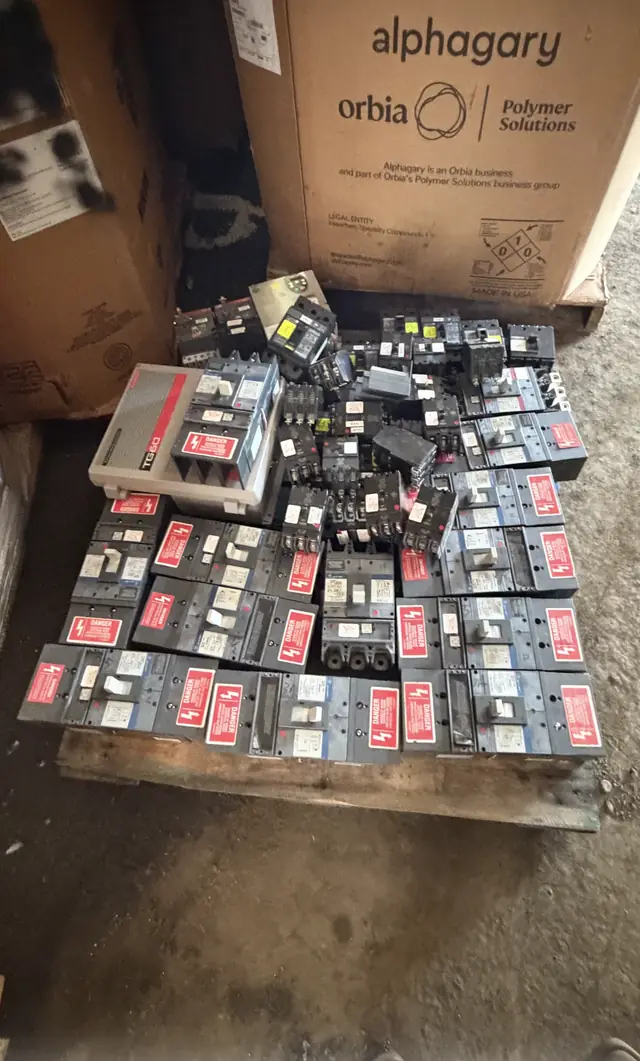
Provide a consistent set of photos with each submission. Good photos reduce follow-up and speed review. Include close-up shots of the nameplate, full-device front, side and rear showing mounting features, terminal areas and stabs, handle position (ON/OFF), and any packaging or accessory hardware. If devices are sold in lots, include an overview shot of the whole lot and representative close-ups of multiple units. Avoid photos taken under heavy glare that obscure printed text.
- Mandatory photos: nameplate close-up, full-face view, terminal area close-up.
- Helpful photos: side profile, rear/mounting face, lot overview with quantity visible.
- Condition examples: New-surplus (unused, original box present), Used-good (minor scuffs, label legible).
- Do not perform live circuit testing or submit photos from energized panels.
How to organize lots and which items typically proceed to review
Organize equipment by product type and condition before submitting. Keep AFCIs, GFCIs, dual-function units, and standard breakers in separate, clearly labeled bundles. For mixed lots, create a contents list with quantities and exact model numbers. Label each bundle with a unique lot ID to match submitted photos and the inventory list. Clear organization reduces review time and avoids misidentification.
Commercial fit depends on market demand, condition, and completeness of identifying information. Units with complete, legible nameplates and intact mounting hardware are easier to evaluate. Items lacking nameplate data, with missing components, or with corrosion may be acceptable for parts only; list them honestly. We review qualifying equipment for purchase — submitting well-documented lots improves the likelihood of a timely review.
- Separate lots by device function and condition.
- Provide a lot inventory with serial/model numbers tied to photos.
- Label each bundle with a lot ID visible in photos.
- Note missing accessories (shims, mounting hardware) and physical damage.
Safety limits, what we will not do, and how to submit for review
This guide does not provide installation, removal, engineering, or energized-testing instructions. Stop and seek a qualified electrician if you encounter damaged insulation, signs of overheating, smell of burning, bent bus stabs, cracked housings, or evidence of arcing. Follow the current manufacturer instructions and the authority having jurisdiction for any work. Submitting an item for purchase review is not an appraisal, offer, acceptance, safety inspection, compatibility determination, purchase order, pickup commitment, or shipping authorization.
To submit, assemble the lot with the required photo set, a typed inventory that includes exact nameplate wording, condition class for each item, and your contact information. Include any original packaging or labels when available. After submission, qualified reviewers will assess the items and respond; this page is a reference to help you prepare the submission efficiently.
- Do not remove live connections or perform energized testing — use a qualified electrician.
- Submission = documentation for purchase review only, not a guaranteed sale.
- Include full nameplate text, clear photos, and a lot inventory for fastest review.